



I wish there had been an Aquinnah Cultural Center when I was a child. Back then, to nurture the budding history nerd in me during a visit to the shops at the Gay Head (Aquinnah) Cliffs, I had to badger my parents into buying me a red and white wooden toy tomahawk.
The items curated at the center are far more enlightening than a toy tomahawk. One is a walnut gunstock club with a laced deer hide strap made by Aquinnah Wampanoag Ryan Derby. Carved into the walnut is a vivid wave design, a whale’s tale and a depiction of the Cliffs. Gunstock clubs were historically weapons of war, now used in traditional Wampanoag dances.
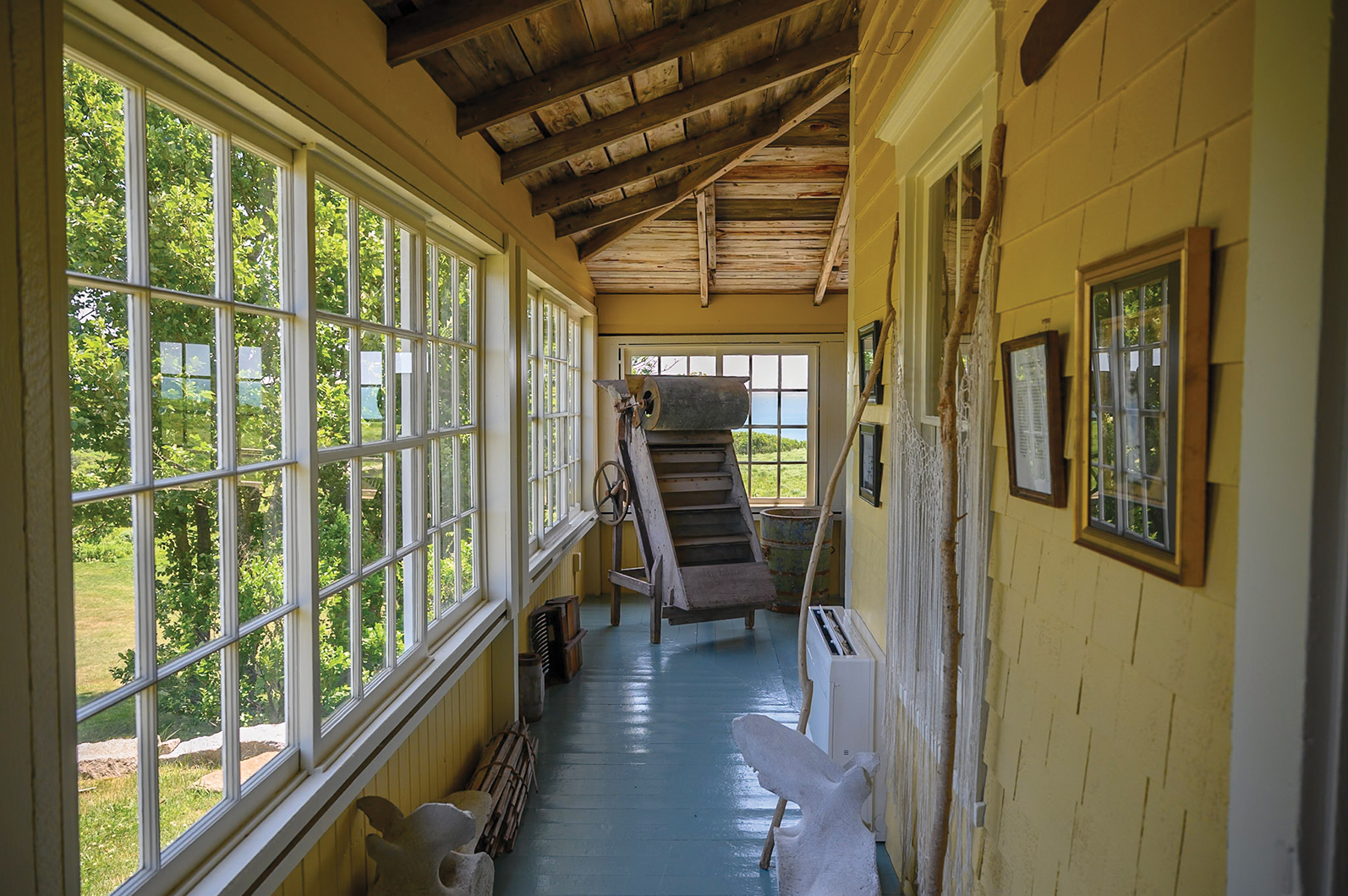
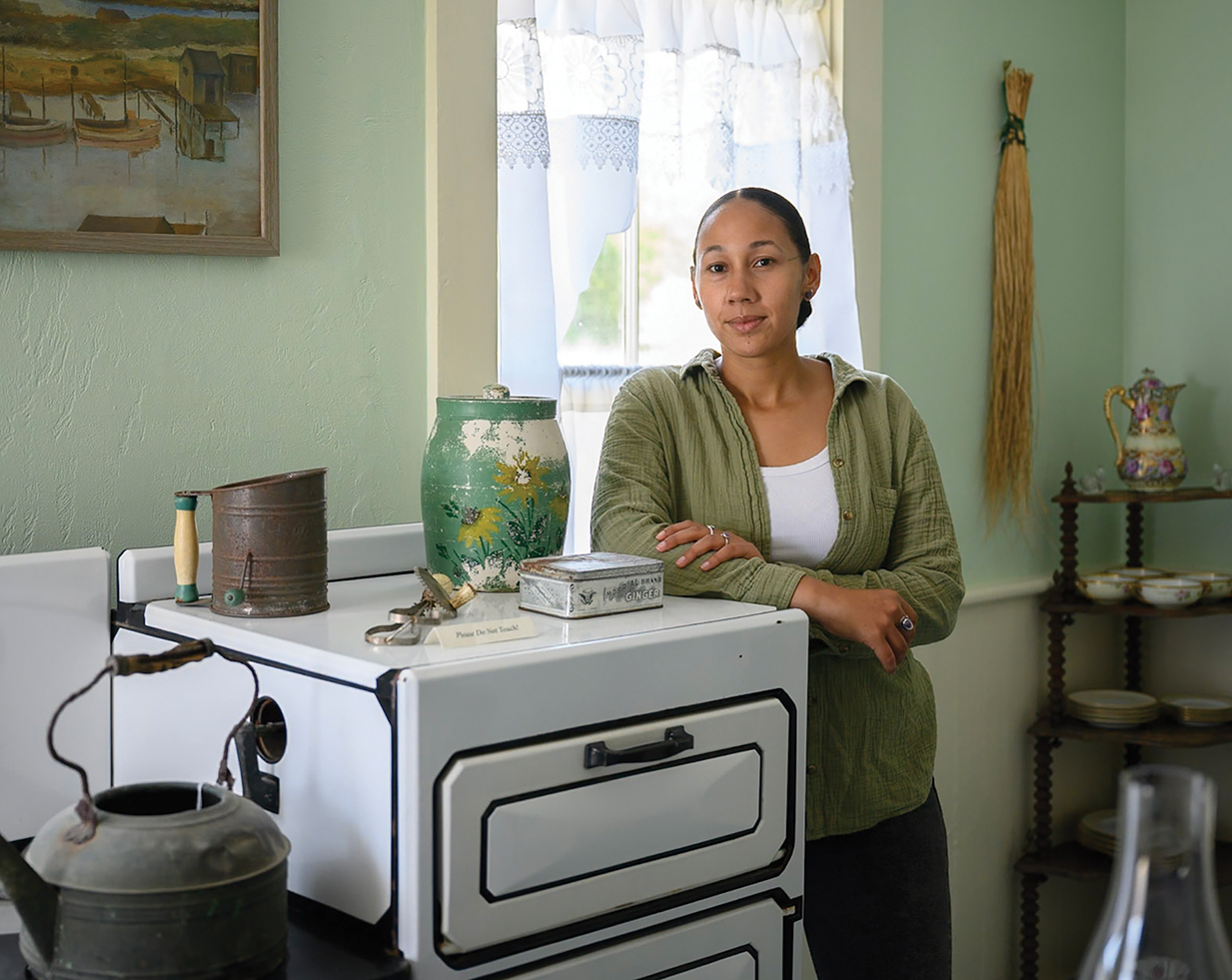
Located in the former Edwin DeVries Vanderhoop home at the Aquinnah Circle, the center is a non-profit Aquinnah Wampanoag cultural center and museum. On a recent visit I spoke with executive director and Aquinnah Wampanoag NaDaizja Bolling, who said they are trying to grow into the Aquinnah Cultural Center name. “I see the mission,” she said, “as ensuring that Aquinnah Wampanoag history is the basis for our living culture and continued presence here, to nourish the spirit of the Aquinnah Wampanoag community and our neighbors.”
Sovereignty is this year’s theme. A summer-long exhibit, Maintaining Our Sovereignty, pays tribute to those who have fought for what curator Mary Amanda McNeil, a Mashpee Wampanoag, calls “Wampanoag political, cultural and community survivance,” including those who were involved with the tribe’s thirteen-year land claim suit and federal acknowledgement process. Federal acknowledgement is the formal recognition by the United States of the Tribe’s sovereign, or independent, status. Next year is the 40th anniversary of the acknowledgement and the land claim settlement that conveyed over 480 acres of public and private land to the Tribe.

I remember how thrilling it was to see the Vineyard Gazette headline about the Tribe’s federal acknowledgement. I was working as a writer at the Institute for the Development of Indian Law in Washington, D.C. That toy tomahawk led me there.
It was a tumultuous time in Gay Head (Aquinnah) as the Wampanoag Tribe fought for the acknowledgement and land claims, and the exhibit offers a wide range of tribal viewpoints of it as well as the message of âs nutayuneân, meaning “ we still live here ” and still work to maintain sovereignty. The Aquinnah Wampanoags have lived on this Island for some 12,000 years.
A revitalization of the Aquinnah Cultural Center’s Oral History Project features seven new oral histories entitled Our Knowledge Keepers. The seven knowledge keepers are Sharon Diamond Araujo, Linda Coombs, Kisha James, Jeffrey Madison, David Vanderhoop, Berta Giles Welch and Donald Widdiss.
NaDaizja said some visitors know of the Wampanoags and are looking for a deeper level of knowledge. “More frequently, though, people stumble upon the center and I hope they recognize that there is a tribal community here and I hope we challenge the ideas of what a native community looks like,” NaDaizja said.

Artwork by Aquinnah Wampanoag Ella Mahoney frames an abstract map of Gay Head around a childhood photo of her mother, Juli Vanderhoop. Young Juli is holding a sling shot. In Ella’s words, the work “reflects on what it means to know who you are while living under systems that have long questioned Indigenous identity.”
The clay in a glass case is deep yellow, brick red and gray/green, molded into a stunning seven-piece necklace by Aquinnah Wampanoag artist Gladys Widdiss. Yet despite the draw of these intricate works of art, it is four nondescript glass jars that speak most to NaDaizja.

“The kitchen has four jars and we put real food in them — cranberry beans, cornmeal, hazelnuts and corn. They stand out to me because food is so central to the human experience and a key component to our cultural understanding. We gather around it, are nourished by it and have a spiritual connection to it,” she said.
A key launching point for this food sovereignty work, NaDaizja said, was the acquisition of native Aquinnah beans that made a circuitous trip home from a seed keeper in Kentucky. The center grows food at Stillpoint in West Tisbury and has established cornfields at space provided by Island Grown Initiative at their farm in Tisbury.
The center practices seed saving and oversees the food forest behind the Aquinnah Town Hall. This year they added a traditional Wampanoag arbor to the forest along with blueberry bushes, strawberries and apple trees. “The goal is to restore the relationship the Wampanoag and others had with the land,” NaDaizja said.
Indigenous peoples are often impacted by societal problems more than others. Beginning with major land loss during and after colonization, dispossession has long been a roadblock, including for the Wampanoag Tribe of Gay Head (Aquinnah) today in the midst of the Island housing crisis.

Climate change hits Indigenous peoples hard, because they have an established deep, cultural connection to the natural world. Yet that strong relationship with Mother Earth led Brad Lopes, the center’s education and public programs manager, to say at an education workshop last year, “In many ways, the future will be Indigenous-led.”
The center staff provides education in the schools, to educators, to Island organizations and to the public. NaDaizja said, “We’ve felt the evolution of other organizations and their relationship with the Tribal community. It is really impactful and intentional.” The center also hosts a Native Artisan Market and Festival in July.
I was fifteen years old in 1976 during the United States’ Bicentennial celebration. I wrote a letter to my local newspaper noting that the United States was built on a foundation of colonization. It galled me that such a monumental injustice was not common knowledge. It is more common today on the Vineyard, through the work of the Aquinnah Cultural Center.

The center was established in the late 1990s and found its physical home in 2007 when the Town of Aquinnah purchased the Vanderhoop house and offered the center a long-term lease. This winter the building was insulated and equipped with heat pumps, mini-splits, and a new electrical system.
The Vanderhoop homestead was built on a high point in Aquinnah with a spectacular view of the sea. And to this day, even during times when the view is obscured by fog, NaDaizja said, “You can still hear the water.”
The Aquinnah Cultural Center is open in season Tuesdays through Sundays from 11 a.m. to 4 p.m. Guided tours are available.
Liz Dolan Durkee is a writer living in Oak Bluffs. She was the long-time conservation agent for Oak Bluffs and then climate change planner at the Martha’s Vineyard Commission.




Comments