
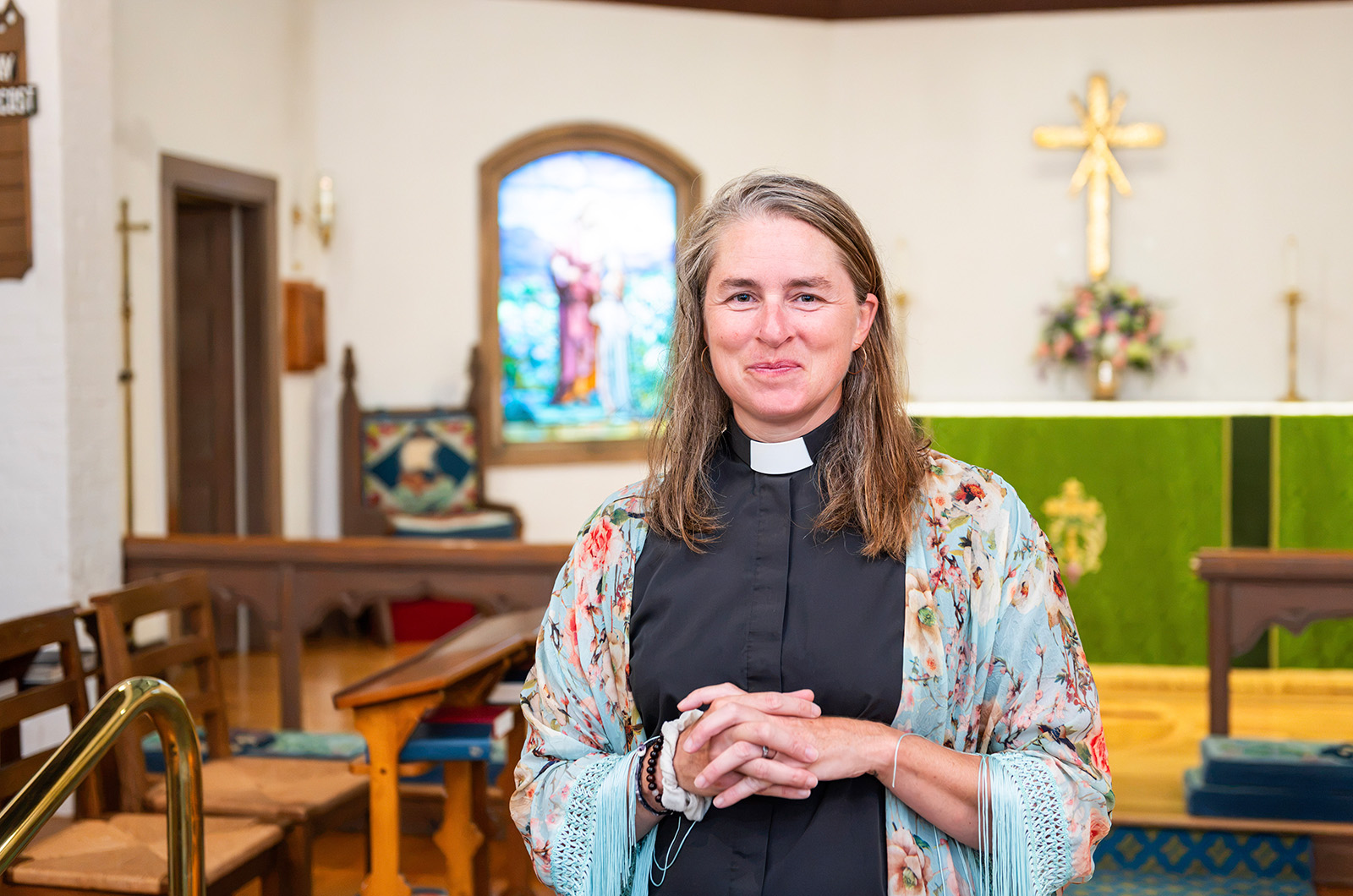
Rev. Rita Teschner Powell, the new rector of St. Andrew’s Episcopal Church in Edgartown, has become the first female settled priest in the church’s 131-year history.
She arrived in the pulpit last month, more than a year after the retirement of Rev. Vincent (Chip) Seadale. Rev. Cynthia Hubbard acted as interim pastor following Reverend Seadale’s departure last spring.
Reverend Powell, 48, came to the Vineyard from a chaplaincy at Harvard University. She is also a poet, a singer and a former varsity softball captain at Barnard College, where she first became interested in Christianity after a decidedly secular upbringing.
“I was an athlete, and to be honest, that was absolutely my religion,” Reverend Powell told the Gazette last month, during an interview at the small brick church on the corner of Winter and North Summer streets.
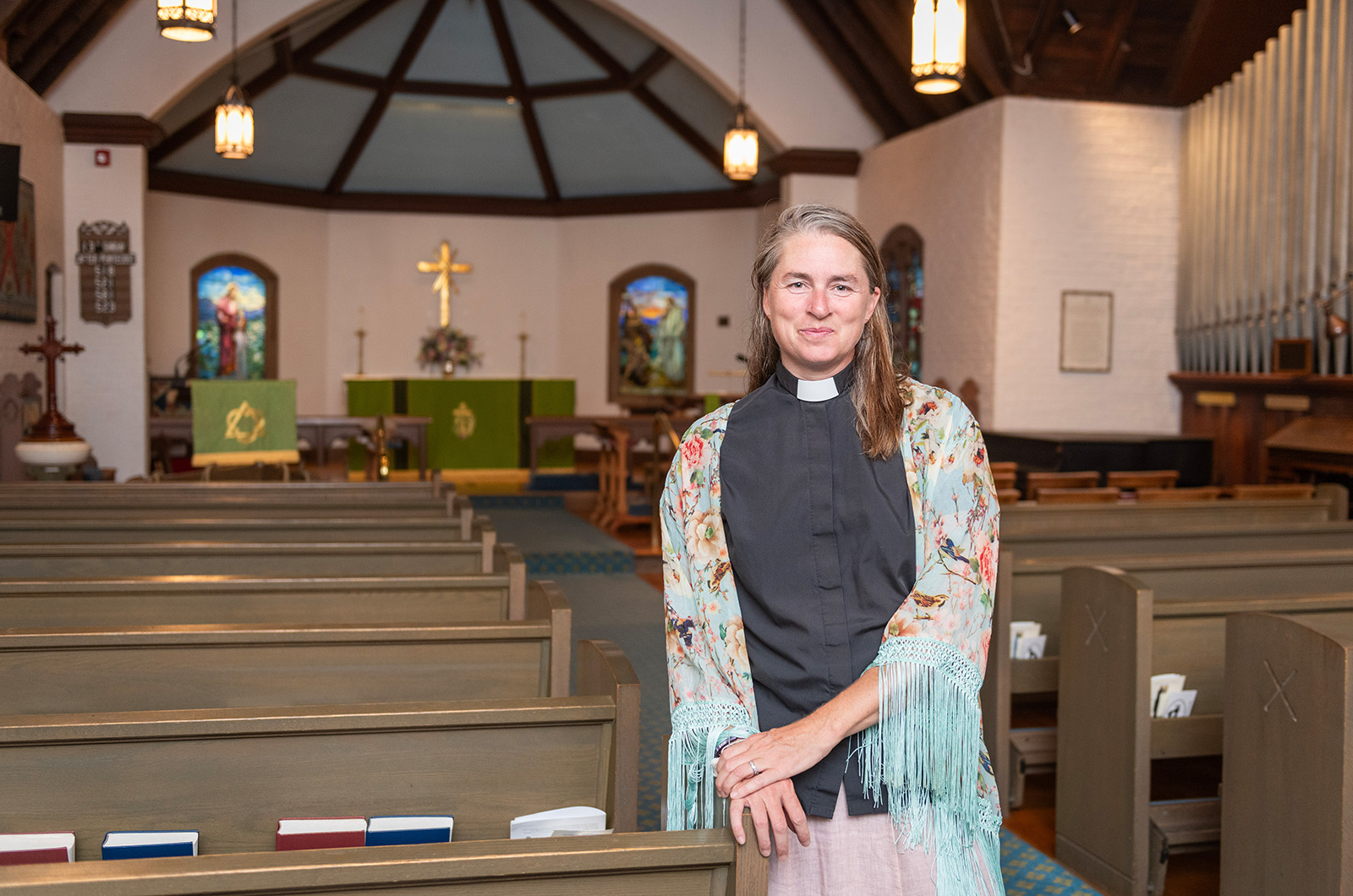
The outdoorsy daughter of a left-leaning Western Massachusetts couple, Reverend Powell absorbed her earliest sense of reverence while spending time on her grandfather’s dairy farm in Brookfield.
“I grew up outside of religion, but very much with a strong kind of New England sense of gratitude for the land and the blessings of the created world,” she said.
Music provided another stepping stone toward her religious vocation, she said.
“My uncle was a choir boy at All Saints Worcester, so my family had a deep love for Anglican church music,” she said.
A third, decisive influence was a certain contrarian streak in Reverend Powell’s own personality. At Barnard, observing what she saw as an intellectual disdain for Christianity, she decided to study the faith for the first time.
“I began to be curious about what it would mean to take seriously inheriting something that you didn’t necessarily create, or even belong to, [yet] formed so much of what we think of now as secular America,” she said. “I wanted to sort of take account of what I [had] lived and breathed without even knowing it.”
As she studied, Reverend Powell said, she began to discover surprising parallels with sports.
“I started realizing how much of my athletic experience had elements of religion,” she said. “Arguably, a game has strong components of ritual practice. You wear uniforms like vestments. There are very strict rules about who can go where [and] if you’re not playing, you can’t go in this area... all these kind of things.”
She developed the idea in more depth for her undergraduate thesis.
Reverend Powell also found herself drawn to the formative history of Christianity, particularly the first few centuries after the crucifixion of Jesus Christ.
“That sort of absurd idea of claiming that Jesus is fully human while simultaneously being fully divine... when it was first originated, it was felt to be an absurd idea, and lots of fighting ensued, like, punching in the street,” she said. “It tracked with what I felt I was finding in the religion-of-sports conversation: that the divinity in the world is very much present in embodied experience.”
As absorbing and enriching as her studies were, however, neither Reverend Powell nor her parents expected them to lead to a vocation. Instead, like many other liberal-arts graduates, she went to work in a field completely unrelated to her degree.
At Central Park Conservancy in New York City, she managed construction projects that ranged from repainting iron bridges in historically accurate colors to installing new irrigation at the park’s Sheep Meadow.
“I spent all my working hours in the park, which was a really amazing way to live in Manhattan,” she said. “I loved a job where I wasn’t in an office. I loved being out and about.”
“The park felt like a sacred place to me,” she added, likening its hushed seclusion to that of a church sanctuary. “Two blocks away, there’s screaming and honking and this and that, and you cross over into the park and a different experience becomes available.”
She also enjoyed the cross-section of New Yorkers she got to know on the job, from immigrant laborers to Fifth Avenue socialites, she said. But becoming a landscape architect didn’t feel like her path, so she chose the Yale Divinity School instead.
“I wanted to study religion more, and I wanted to study Christianity more, [and] in the process of that, I sort of realized that actually there was a call there to the priesthood, which was very surprising to everyone that knew me,” she said.
More surprises were in store. After visiting an ecumenical monastery in Taizé, France, with a group of teenagers she met as a youth pastor in Connecticut, Reverend Powell would return to the monastic community with young people from the Lakota congregations she ministered to during her posting in South Dakota.
Both places spoke to her soul, she said, and so it was in South Dakota that she meditated on her decision to become a monk at Taizé.
“I thought I needed to do some spiritual listening, so I went out there that summer, planning to go to the monastery in September,” Reverend Powell said.
After working at a diocesan summer camp in the Black Hills, she was ready to leave for Taizé when a chance meeting upended her long-term plans.
“On my way out of South Dakota — to be a monk, you understand — I met a very handsome, blue-eyed baseball player,” she said.
She and Justin Beebe hit it off instantly, Reverend Powell said, and although she was determined to return to the monastery as planned, it was no longer an open-ended commitment.
“I spent the semester with the community at Taizé, but then I knew I needed to come back to South Dakota,” she said.
The couple married and remained in South Dakota for several years before moving East with their two children. Son Jackson Beebe, 16, is a senior at Belmont High School, and their 14-year-old daughter Juliet Beebe is a rising sophomore.
The children and their father have been spending weekends with Reverend Powell at the St. Andrew’s rectory on Bold Meadow Road, and will move in for good once Jackson is finished with high school.
Juliet is looking forward to attending Martha’s Vineyard Regional High School, said Reverend Powell, who told the Gazette the recent Islandwide vote to fund the high school’s $335.5 million renovation and addition was a major factor in her decision to accept the job at St. Andrew’s.
“The fact that the Island decided to make this huge investment in the high school — that’s a powerful statement,” she said.
Her husband also is looking forward to Island life.
“Both of us were really craving a smaller community,” she said.
The couple’s enthusiasm was appealing, St. Andrew’s church warden Barbara Rush told the Gazette.
“She and her husband were very vocal about wanting to be back in a smaller community. They’re active, outdoor people that love the ocean,” Ms. Rush said.
She also applauded Reverend Powell’s sermons, which often mingle early church texts with contemporary inspirational poetry.
“Her sermons are fantastic. She preaches with joy [and] it comes through,” Ms. Rush said.
In addition to her master’s in divinity from Yale, Reverend Powell holds an MFA in creative writing from Seattle Pacific University, for which she studied with poet Scott Cairns.
Her first book of poems, A Light from the Burial Ground, is scheduled for release later this fall by St. Julian Press.
Sunday worship at St. Andrew’s begins at 9 a.m., with organist Robert Lehman providing music before and after the service.
An earlier version of this story misstated the surname of Rev. Powell's husband and children, which is Beebe.




Comments
Comment policy »