
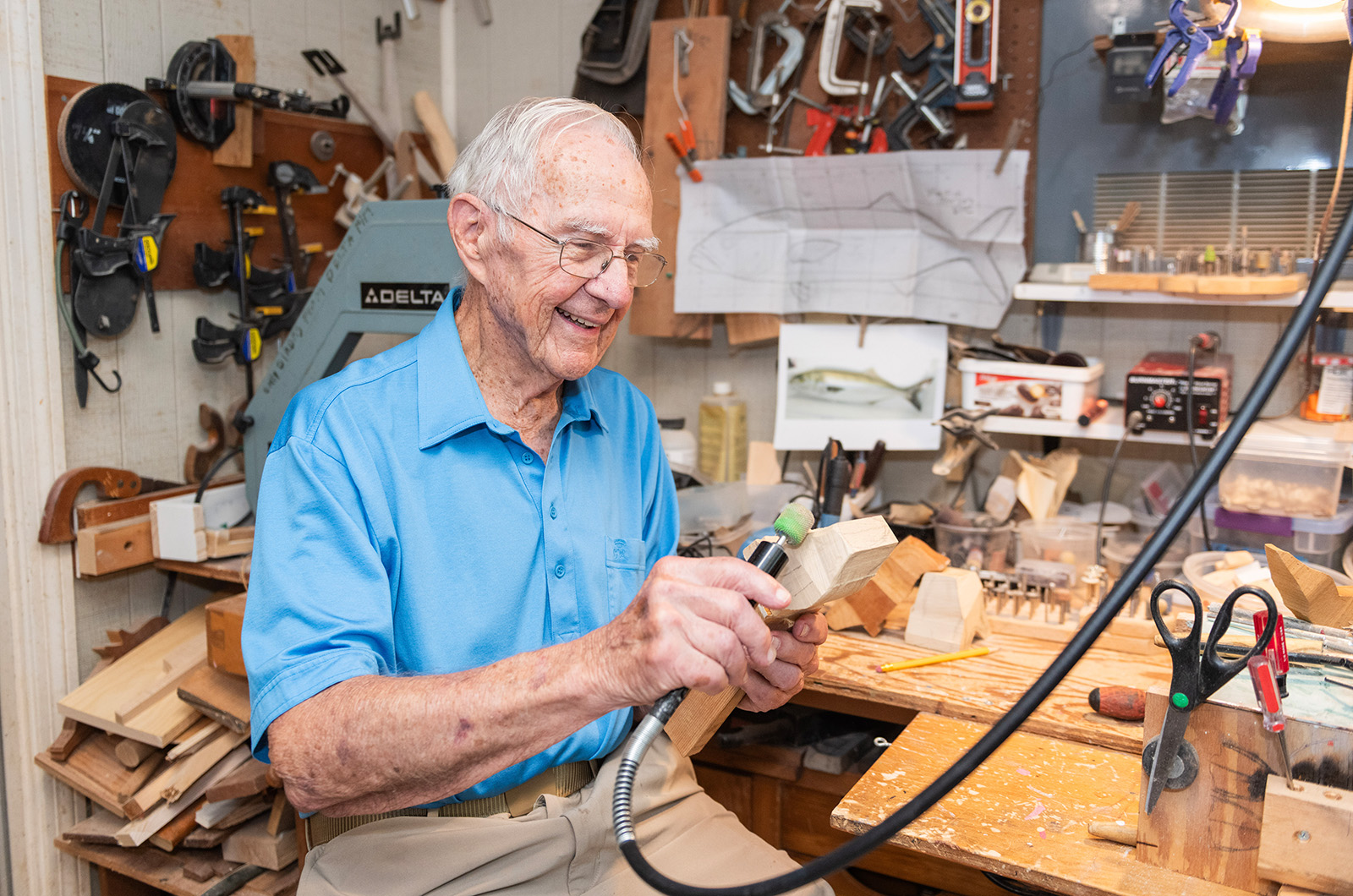
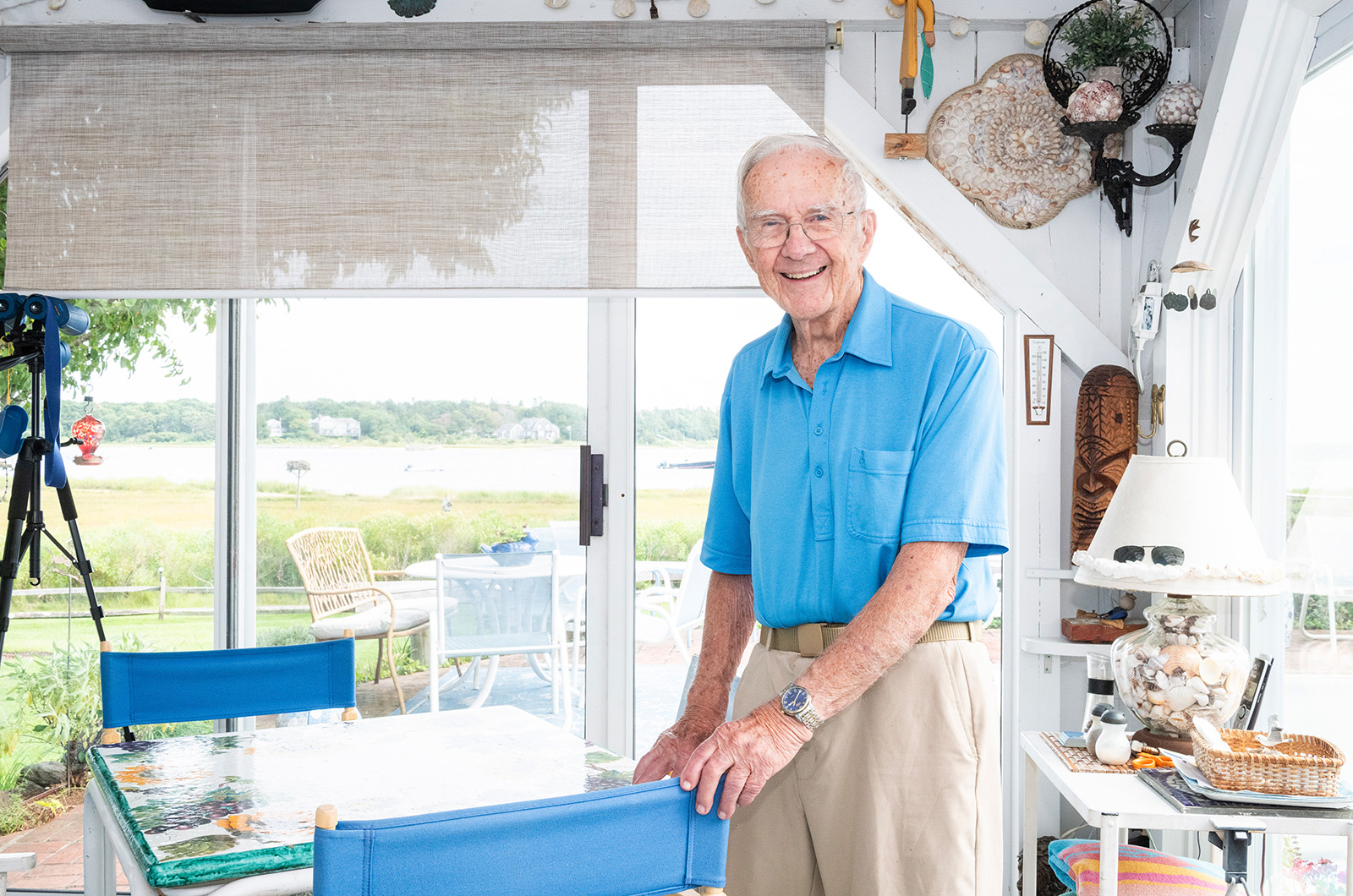
A visitor to Leo P. Convery’s house in Edgartown leaves feeling much younger than when they arrived. Such is the effect of the 93-year-old’s enthusiasm for all things.
Upon opening the door to his home and being asked how he’s feeling that day, he answers: “I’m standing up, so I’m feeling great.”
He is also moving fast.
A tour quickly begins of his extensive collection of scrimshaw, duck decoys, music boxes and ships in a bottle (hundreds of them) that decorate each room.
On the back porch, he points to the resident osprey family perched in their nest atop a pole placed there by Gus Ben David. It’s a beautiful spot, on the edge of Edgartown’s Down Harbor, a development Mr. Convery helped create in the 1970s.
“The osprey arrive like clockwork each spring, and soon they will be leaving,” he says with a note of sadness.
He perks up when asked about the new exhibition of his wood carvings at the Carnegie Heritage Center. Mr. Convery has been working at this craft since he was a young boy and his father gave him a set of tools, but this is the first public show of his carvings.
“Sometimes, just sitting there, if you’ve got problems in the world, they’re gone,” he says of his craft and getting lost in the flow of sawing and filing and imagining a detailed shape being created out of a simple block of wood.
The show has been up since August but on Sept. 24 Mr. Convery will join all the other artists representing the annual Bass in the Grass fundraiser to discuss his work and the pieces he created for the auction. He will also give a more extensive talk on Sept. 23 at the Rotary Club meeting at the PA Club, complete with a PowerPoint display of his artistic process.
The Bass in the Grass fundraiser commissions Island artists to create a signature work out of a wood cutout of a striped bass. The art is then auctioned off to raise money for the Vineyard Preservation Trust.
“Sissy Biggers at the trust came to me and said, ‘Hey, we want to put an exhibit on, and we also need something for the auction,’” he says. “And when Sissy says, go, you go. So I put together a set of a bluefish and a striped bass.”
Mr. Convery created his Bass in the Grass pieces last winter, but his entire solo show includes nearly 40 pieces done over several decades.
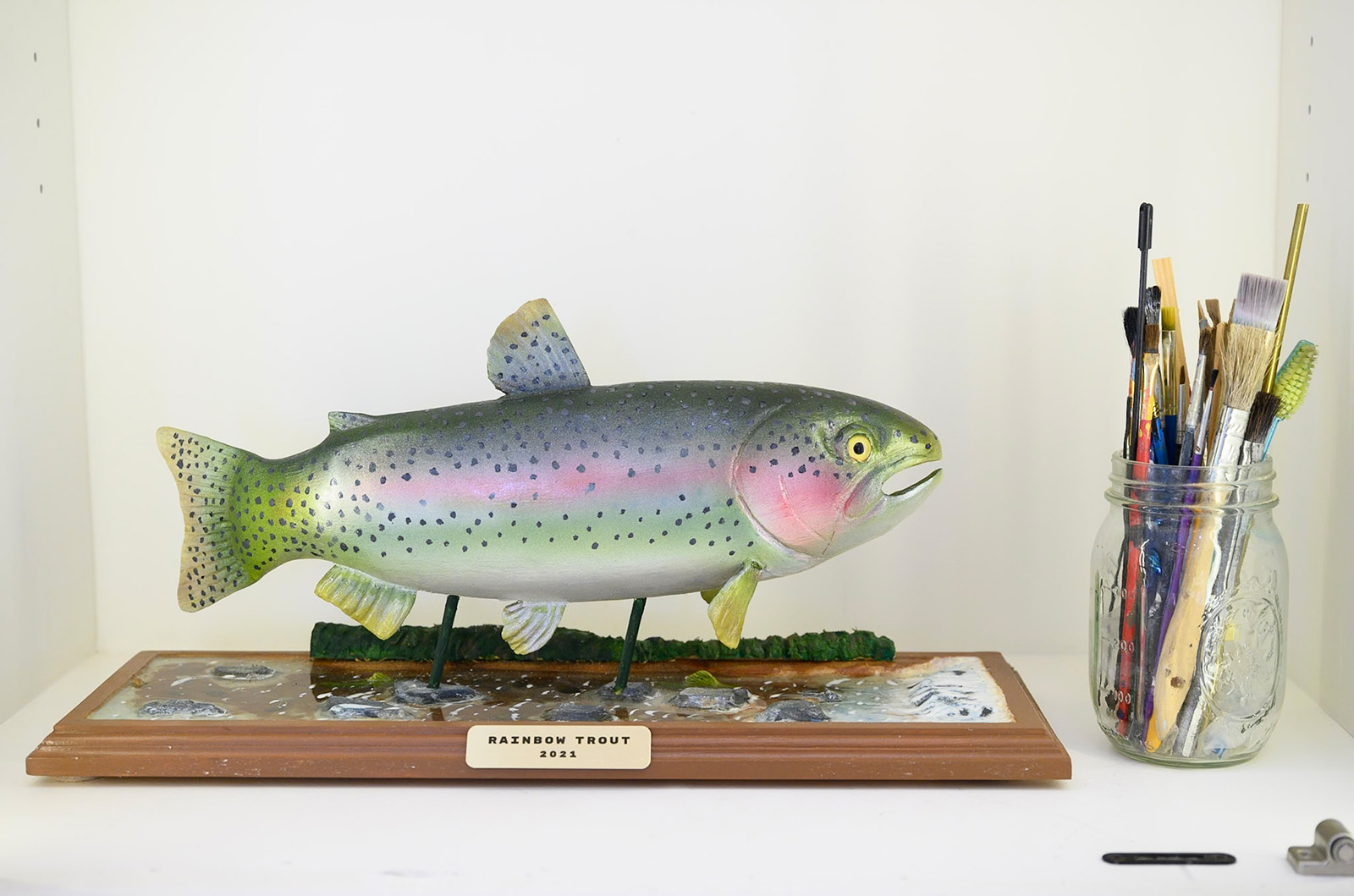
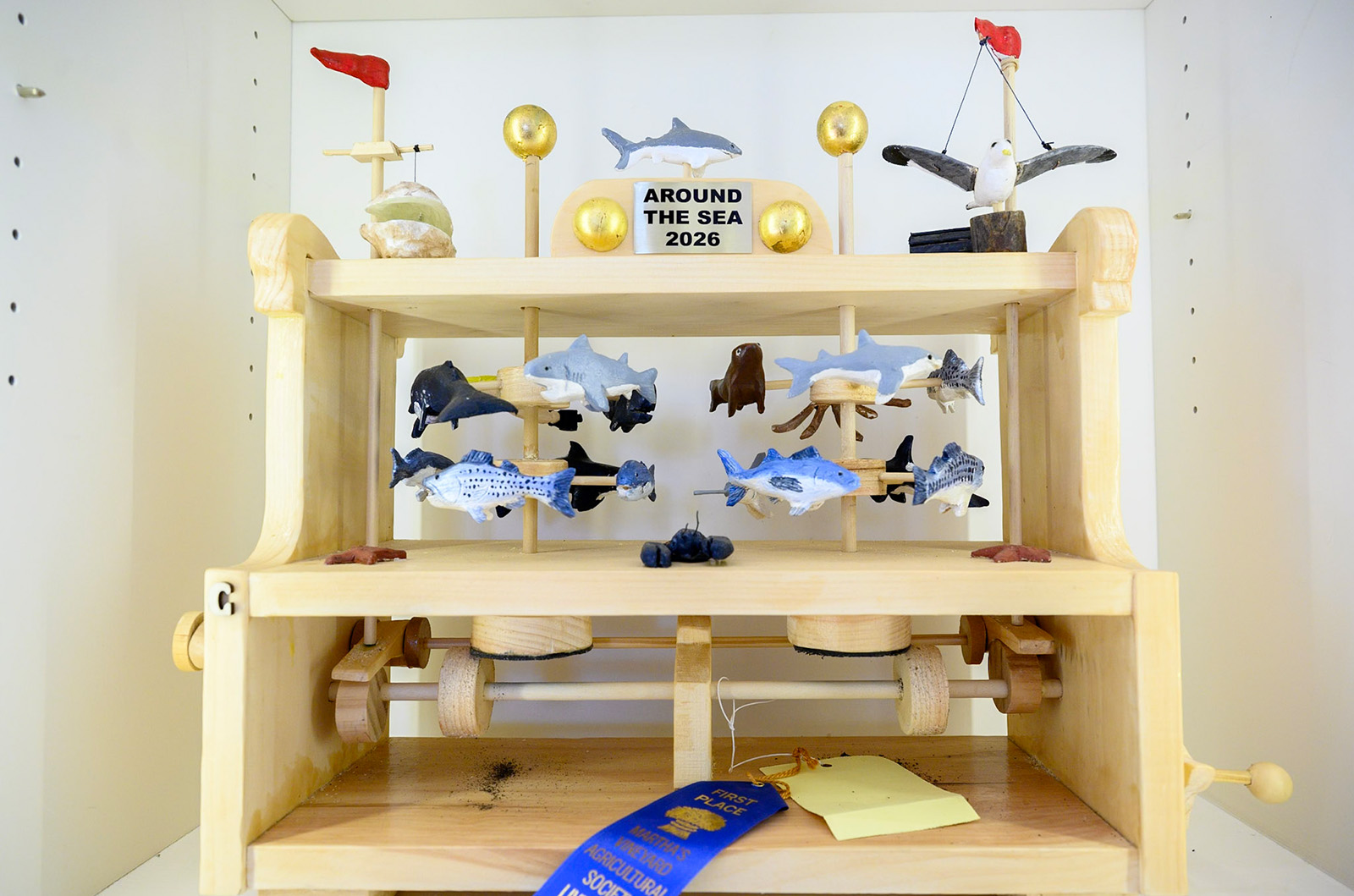
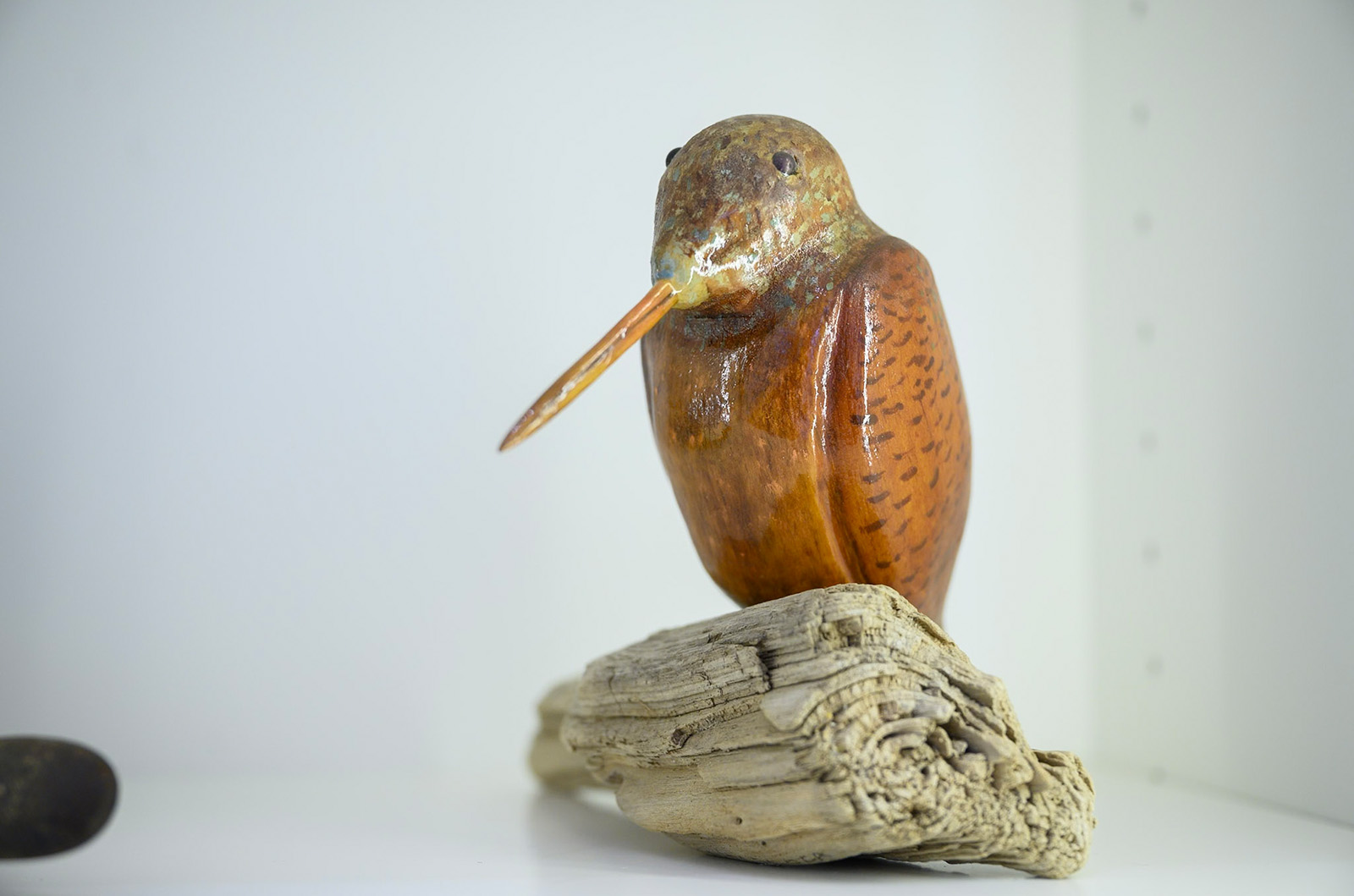
Upon entering the Carnegie and turning left at the tall case clock built in 1822 (more commonly known as a grandfather clock) one encounters a veritable wooden zoo featuring dolphins, puffins, striped bass, sharks, swordfish, osprey birdhouses and a series of complicated automata — wood sculptures that can rotate like a carousel or display the opening and closing of an oyster. Mr. Convery took on the challenge of creating automatas recently, after he crossed the bar into his 90s and was looking for a new challenge.
Mr. Convery is the first to admit he is not a professional artist, although judging by his work he has the talent to be one. His actual career began at the Harborside Inn, started by his grandfather Antone Prada in 1914. He started working there as a boy, and when he was a young man he met his wife Alison there, when she arrived one summer for a job. They have been together ever since.
After the family converted the Harborside Inn into timeshares in the 1980s, Mr. Convery turned to real estate and development. He built the Navigator Restaurant and ran it for nearly a decade, in addition to creating Edgartown’s Down Harbor development.
Mr. Convery has lived nearly his whole life in Edgartown, leaving only for college at Cornell’s Hotel School and then to serve his country in the armed forces.
Along with the Vineyard and family life, wood carving has been the other constant in his life, and his fingers are proof of this. These are not the soft hands of a real estate developer. They are thick and weathered, each finger the size of large sausage, each knuckle a work of art in its own right.
“I can’t fully close my hands anymore because of arthritis,” he says. “But I can still hold my tools.”
Mr. Convery is in his workroom now, on the far side of the house. It is a man cave of hammers and saws, files and vices, safety masks and wood scraps. In the center of the rooms sits a vintage Sears and Roebuck Craftsman saw from the 1960s. Nearby is a set of mechanical rotary files, operated by a foot pedal, and all manner of sanders.
“With all the noise sometimes I need to wear a headset, and with my mask on when I come out of here I look like I’ve arrived from outer space,” he says.
He uses various types of wood, and some of the local builders know to save him some choice pieces when they have scraps left over.
“I had a fellow who built a house way up the road here. He used a lot of white pine and when he got through, he says, ‘I got a pile of white pine, you want it?’ That’s as good as you can get,” Mr. Convery said.
Nowadays he can only work for about an hour and half at one sitting before he has to take a break.
“Because the mental and physical exhaustion,” he says. “My back gets sore. My hands get sore.”
He gets up from behind the saw, ready to call it a day.
“I’m kind of disappointed when I finish a piece because now I have to start a new one,” he says. “But it gives you something to look forward to. Answering the question of how am I going to solve this problem and get it together. And no one else is going to do it. It’s just you. It gives you a reason to get up in the morning.”



Comments
Comment policy »