
When Alessandro Bocconcelli first traveled to the Los Lagos region in southern Chile in 2014, he was captivated by its immense beauty. Located adjacent to the Pacific Ocean in the Chilean Patagonia, the region includes a large internal sea surrounded by enormous swaths of untouched wilderness. It is home to an abundance of marine life, including the blue whale.
But it has also been the subject of controversy due to the influx of salmon farming in the area.
Mr. Bocconcelli is an oceanographer emeritus at the Wood’s Hole Oceanographic Institution. Recently, he was on the Vineyard to give a talk at Stillpoint in West Tisbury to discuss his research in Chile, and the adverse effects salmon farming is having in the area.
Initially, Mr. Bocconcelli traveled to Chile to better understand how whales use and respond to low-frequency sounds.
“I ended up working more and more with marine mammals and acoustics,” he said.
His research, which was conducted in partnership with Centinela, a conglomerate of marine biologists, engineers, artists, fishermen and locals, soon became enveloped in how the influx of unregulated salmon farming affected the internal sea at Chiloé.
“Bluefish and sea bass basically disappear because of fish farming,” Mr. Bocconcelli said.
Salmon farming is a worldwide industry, and over 70 per cent of all salmon consumed in the United States is imported, Mr. Bocconcelli said.
“There are 3,000 farm leases in Chile,” Mr. Bocconcelli said. “Apparently, 1,343 are active, but if something happens, they just move the fish to another farm. The United States is taking more than 60 per cent of all the salmon produced in Chile.”
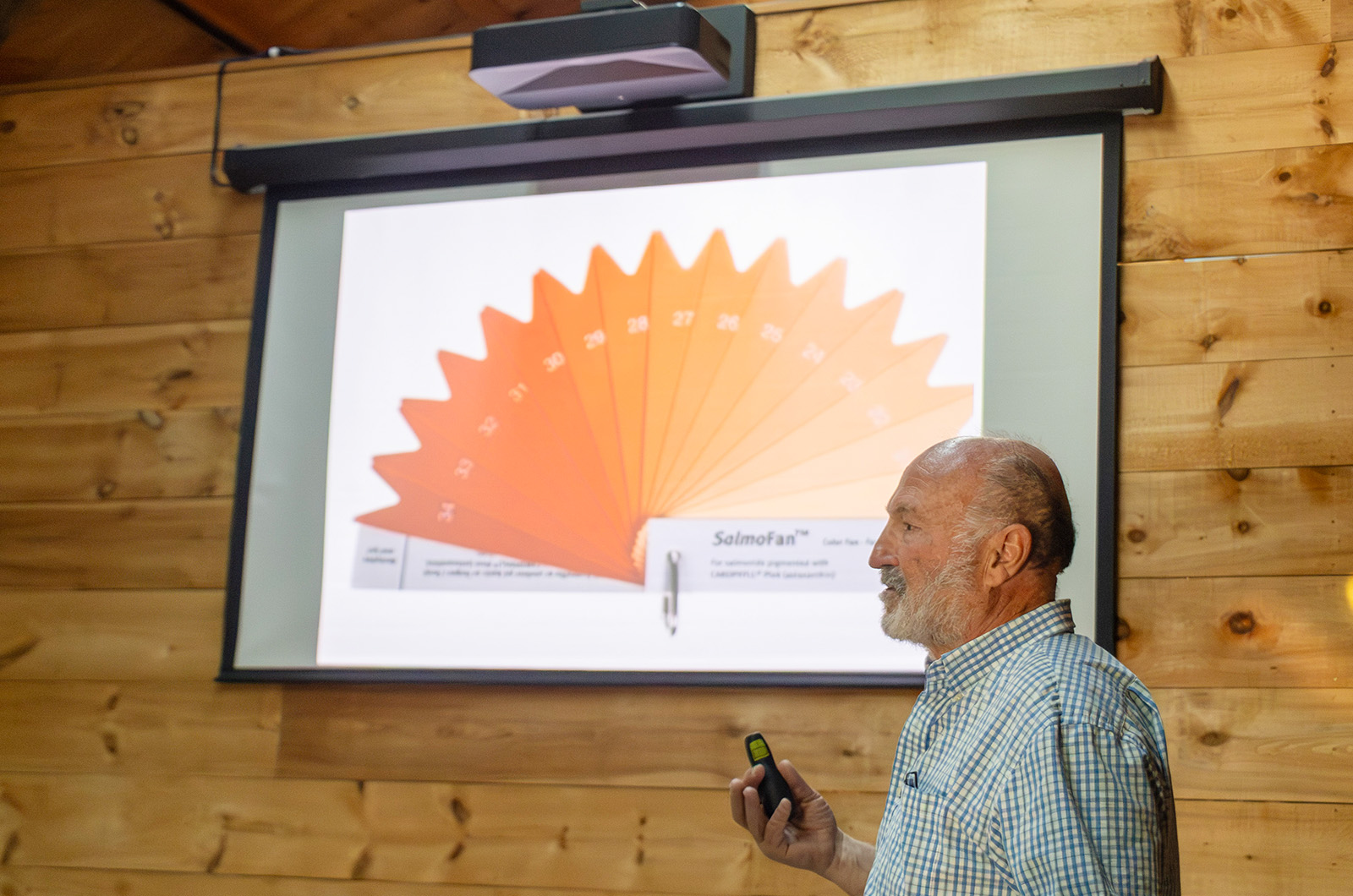
Salmon, which are not native to Chile, are genetically engineered on the salmon farms to be single sexed and able to grow faster and bigger. They are also fed continuously, said Mr. Bocconcelli, with a mixture that includes chicken guts and legs, fish, rapeseed flour, blood from pigs and cows, sunflower seeds, gluten from corn, soy, shrimp and milk.
“That’s why, in the end, they don’t really taste like real salmon anymore,” said Mr. Bocconcelli. “You have to consider that these fish are fed continuously because they want them to grow fast.”
When salmon manage to escape from the farms they become voracious as they are used to eating continuously. They turn to eating the eggs of the native fish, which Mr. Bocconcelli said can have an enormous impact on species native to the area.
Salmon farms also become overcrowded. In some instances farms can be packed with over three million fish, which leads to disease, Mr. Bocconcelli said. In 2024, it was reported by the Monterey Bay Aquarium that salmon farms in Chile used approximately 350 metric tons of antibiotics in an effort to curb the spread of diseases.
“Turns out Chile is the biggest consumer of antibiotics in the world,” said Mr. Bocconcelli. “Apparently, [Chile] uses 400 tons of antibiotics every year, just dumped in the water, which is 200 times more than what is used in Norway.”
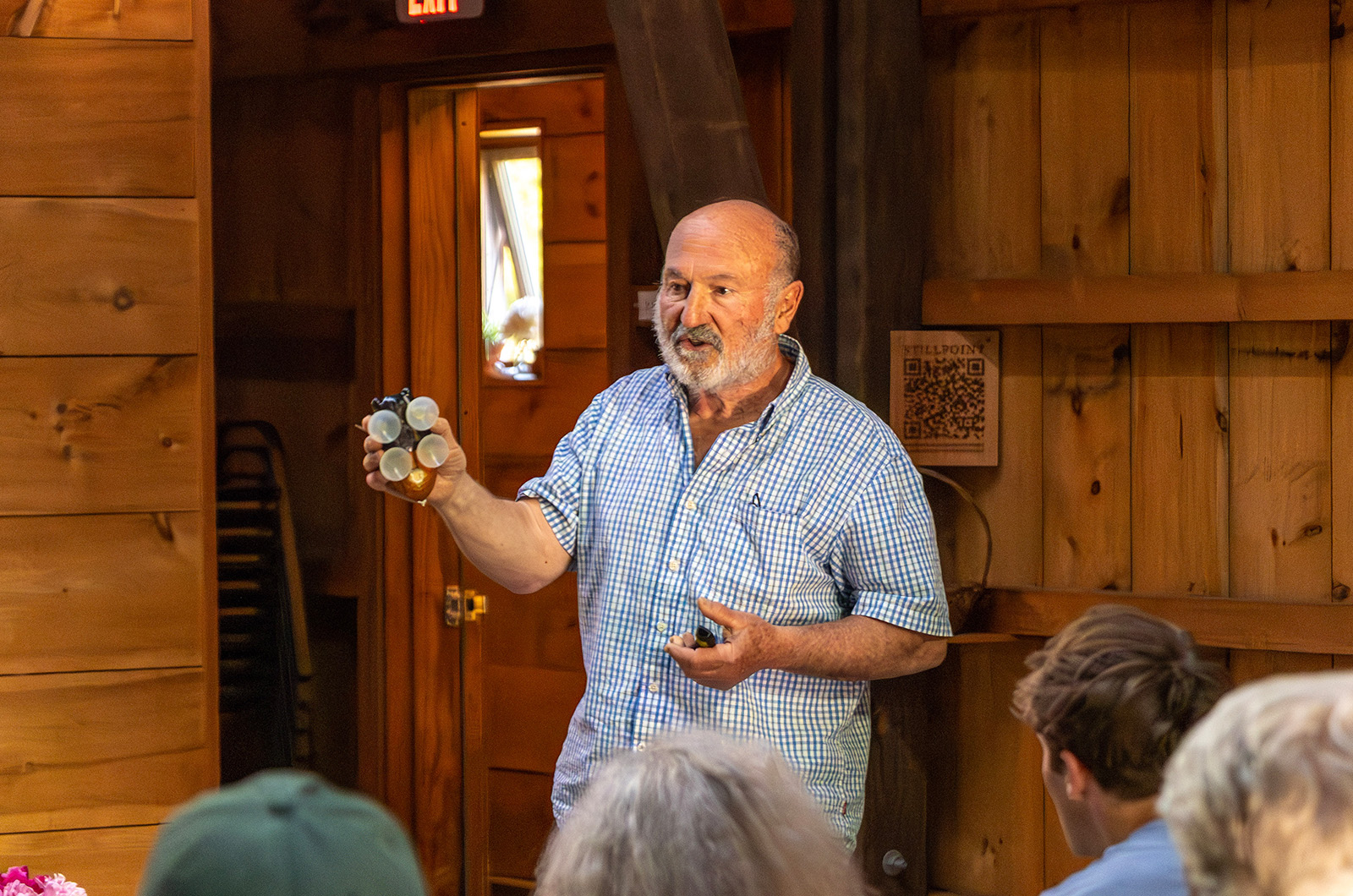
Mr. Bocconcelli and his partners at Centinela also discovered that the blue whale population was being adversely affected by sound waves emitted by the salmon farms. At the talk, Mr. Bocconcelli passed around a small transmitter they place on the backs of blue whales to monitor them. The device is about the size of an average adult human hand and is made of two antennas and a series of sensors encapsulated in a 3D printed waterproof housing.
“[The device] has a bunch of sensors inside,” said Mr. Bocconcelli. “It measures the whale’s movements, the acceleration, the water temperature, the dive profiles, how many times they eat, because we can figure out how many times they gulp the food, and then we get a radio that tells us where it is, and we can look at it.”
During one expedition through Chiloé, Mr. Bocconcelli and his team discovered that sounds from the salmon farms were at a similar frequency to the whales.
“[The] machinery and pumps are on all the time,” Mr. Bocconcelli said. “They make it quite erratic in the water, which is bad for marine mammals, and it’s bad for fish, and it’s bad for the birds, but nobody’s ever measured it.”
In addition to studying marine ecosystems, Mr. Bocconcelli and his partners at Centinela have developed an educational program for children living in the area. The kids are angry about the plastic washing up on the beach, he said, so they organized to clean the beaches with them.
Mr. Bocconcelli feels that there are instances where aquaculture can be done right, but without appropriate regulation salmon farming can have potential catastrophic effects on the surrounding marine ecosystems.
“I am not against aquaculture, but what they are doing in Chile is a crime against humanity as far as I’m concerned,” he said.



Comments
Comment policy »