

When Nia Rhodes Jackson was a teenager growing up in the 1990s in Queens, New York, she recently recalled, she didn’t have a curfew. Concerned about safety and racial tensions, Ms. Rhodes Jackson’s father typically drove and picked her and her sister up from various social outings.
Life was different when the family got to the Vineyard each summer. There were less racial worries in Oak Bluffs and Ms. Rhodes Jackson was trusted to stay out and come home at a particular set time. Plus, there was the added comfort of knowing her grandmother and mother’s friends, all within a two or three block radius, were keeping an eye out from their front porches for any trouble she might be up to.
Those women looking out from their porches were some of the original Cottagers, members of the prestigious, philanthropic group of Black Island homeowners celebrating its 70th anniversary this summer. Founded in 1956 by Thelma Garland Smith, in the spirit of service and friendship, Ms. Smith spearheaded the founding of the Cottagers in response to a criticism overheard by a white Islander that Blacks did not clean up the beach and did not contribute to community needs. Rather than just take this as an insult, she and her friends viewed it as a call to action.
Today, the organization now boasts numerous multigenerational families in its 125 member ranks, among them Ms. Rhodes Jackson, her mother, Joanne Edey Rhodes and her sister, Asha Rhodes Meade.
“I really think of us through the lens of a multigenerational sisterhood,” Ms. Rhodes Jackson said. “The organization I grew up being loved on by was one of mothers and grandmothers stretching out their arms towards the community, meeting its needs.”
Twelve women, the original Cottagers founders, first began meeting on one another’s porches, planning not only beach cleanups, but fundraising efforts to help local organizations, such as Martha’s Vineyard Hospital.
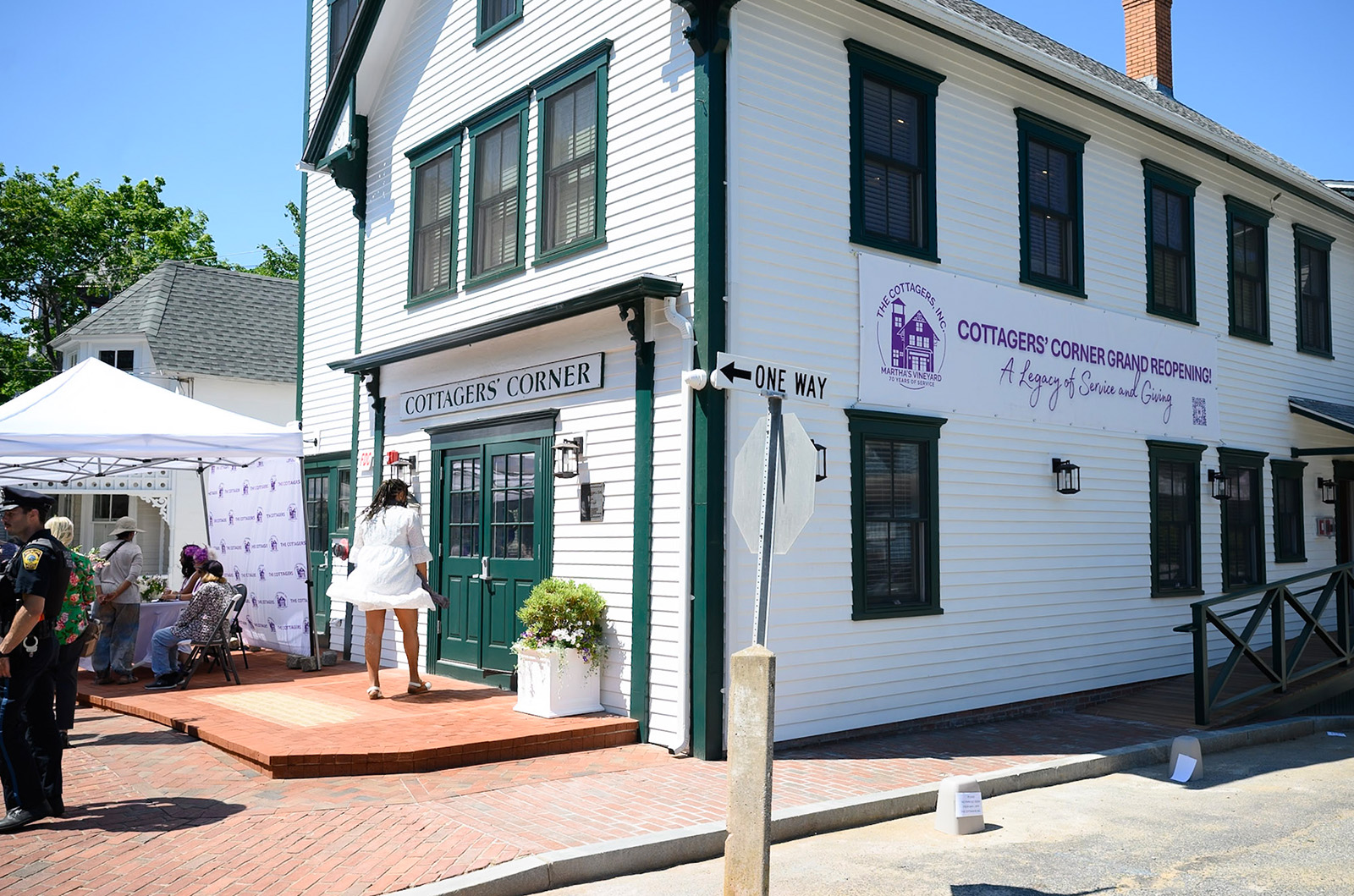
As Cottagers’ ranks expanded, porch meetups were quickly outgrown. In 1968, the group voted to buy the old town hall at 57 Pequot avenue in 1968. The Queen Anne style building, which became known as Cottagers' Corner, reopened last week after an extensive renovation.
Originally, a majority of Cottagers were either educators who had the summers off from work, or housewives who took their children to the Vineyard for the entirety of the summer, their husbands traveling back and forth from New York, Washington and Philadelphia on weekends.
Among them was Constance Batty, who chaired the teacher education department of State University of New York at Old Westbury.
“The people I was friendly with were, for the most part, teachers, around my age, and very involved in the Cottagers,” she said. “It was fun to go to the meetings, and sometimes we’d stay after, and then we’d all play bridge.”
Ms. Batty’s daughters, Judith and Alicia, are both Washington attorneys who knew it was a matter of when, not if, they’d join the Cottagers.
“My mother called me one day and said she submitted my application,” Judith Batty laughed.
Patricia Bush, current Cottagers president, called “melding together these generations” one of the organization’s greatest blessings and challenges.
“We can boast three generations of active Cottagers right now,” Ms. Bush said. “It keeps us very proud and rooted in our history. At the same time, we want to keep the best of the traditions and also be relevant to younger women today.”
One bit of modernization that Ms. Bush has overseen has been changing the dates of Cottagers meeting.
“Originally, Cottagers met on Wednesday morning — a tradition that just continued on because of the expectation that attendees could be on Island all summer. But recently, a member relayed to me that she had to leave the Island to go to work mid-week. We did a survey, and the group voted to move the meetings to Monday. Not everyone has the ability to work remotely.”
In the organization’s early days, the Cottagers raised money through a rummage sale, a clam bake, a fashion show and the annual house tour. This summer, the Cottagers will host their annual house tour on July 16, an ongoing Lucky 70 raffle fundraiser for a trip to Nevis, and a benefit concert with Jeffrey Osborne on July 30.
The group aims to raise roughly $70,000 this year, money to be used for scholarships, charitable donations and organizational needs. With the reopening of Cottagers' Corner, Ms. Bush hopes the group can hold art classes again for children, along with other programming in the building, which can also be rented out for various events.
To be a Cottager, one must be at least 18 years old, and a Black woman on the deed of a Vineyard home. Once accepted, members are required to attend two meetings in person each year, as well as two events, and participate on two of the Cottagers’ committees — among them, the financial, fundraising, friendship, house tour and bylaw committees.
Ursula Day, who is now 100 years old, joined the Cottagers in 2001, more than 50 years after she first began coming to the Vineyard in 1948. A longtime principal at P.S. 30 in Queens, N.Y., Ms. Day said she didn’t feel she had time to do the work required of being a Cottager before she retired.
“I had heard of them, but I knew, initially, I didn’t have time to meet the requirements. My work was so busy,” Ms. Day said.
Joining at the behest of fellow member Kathryn Allen, Ms. Day said “I find the women really very easy to get along with, and we all seem to be on the same footing.”
Distinct from feminism, which Rhodes Jackson and others noted often comes with a political bent, the Cottagers define themselves through a concept of Sisterhood — working together in service of the Island community.
“It’s not a ‘in spite of’ or adversarial component, it’s more of ‘in connection to,’” Ms. Rhodes Jackson said, noting husbands, fathers and brothers of the Cottagers “have always supported the things we’re doing, such as coming out to help with setup and cleanup.”
“You have to remember that in each age group, the women do have their own political positions but that is not necessarily brought into the mission of the Cottagers,” Ms. Edey Rhodes said. “Truly, it’s always been about service to the Island community. There’s a strong sense that the Vineyard is a place you rest, and when you come here, your friends, tell you ‘welcome home.’”






Comments
Comment policy »