

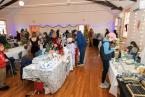
On Saturday, the Aquinnah Cultural Center hosted the 19th annual Native Artisans Market and Festival at the circle above the cliffs of Aquinnah.
Each year, the Aquinnah Cultural Center organizes the festival to bring Native artisans together to showcase their art. In doing so, it teaches visitors about Martha’s Vineyard, the town of Aquinnah and its rich history of Native American art and culture, which can be traced back over a thousand years.
This year, over 20 vendors representing the Wampanoag Tribe of Gay Head (Aquinnah) as well as the Mashpee Wampanoag Tribe, the Narragansett Indian Tribe and the Nipmuc Nation traveled to Aquinnah from all over New England to participate.

“It’s a little different from a lot of powwows, where a lot of the merchandise is a little bit more mass-produced,” said NaDaizja Bolling, the executive director of the Aquinnah Cultural Center and a member of the Wampanoag Tribe of Gay Head (Aquinnah). “I think that’s what’s really unique about this event; the artists are hand making everything.”
Many Native artisans created items using wampum, which is carved and shaped from quahaug shells. Wampum has a long history among tribal members and has been used to decorate clothing, necklaces, earrings, rings and belts among other things.
Other types of art on display were made using various materials such as silver, clay and various forms of fabric.
According to Martha Vanderhoop, an artist and member of the Wampanoag Tribe of Gay Head (Aquinnah), silver has only recently been used by Native artisans as a medium to create art.

“It’s called metal clay,” she said. “I believe that Indigenous art should not just stagnate. I think it should continue to move forward. So, I’m doing something a little bit different.”
Ms. Vanderhoop has owned and operated a shop at the cliffs of Aquinnah for nearly 60 years. There, she sells an assortment of traditional, contemporary and evolving pieces of jewelry.
And whether it is a painting, article of clothing or piece of jewelry, the beauty of Martha’s Vineyard is represented in each work of art.
“I think a lot of [Native artisans] are making art that’s inspired from the land that they know and the world as we see it,” Ms. Bolling said.
Additionally, tribal members performed a series of songs and dances throughout the day. Like the physical art displayed on tables, the performances were passed down over generations and tell the story of the land and its people.
“I think it’s just a really important way to keep our culture active and to keep Native people supported,” Ms. Bolling said.





Comments
Comment policy »