
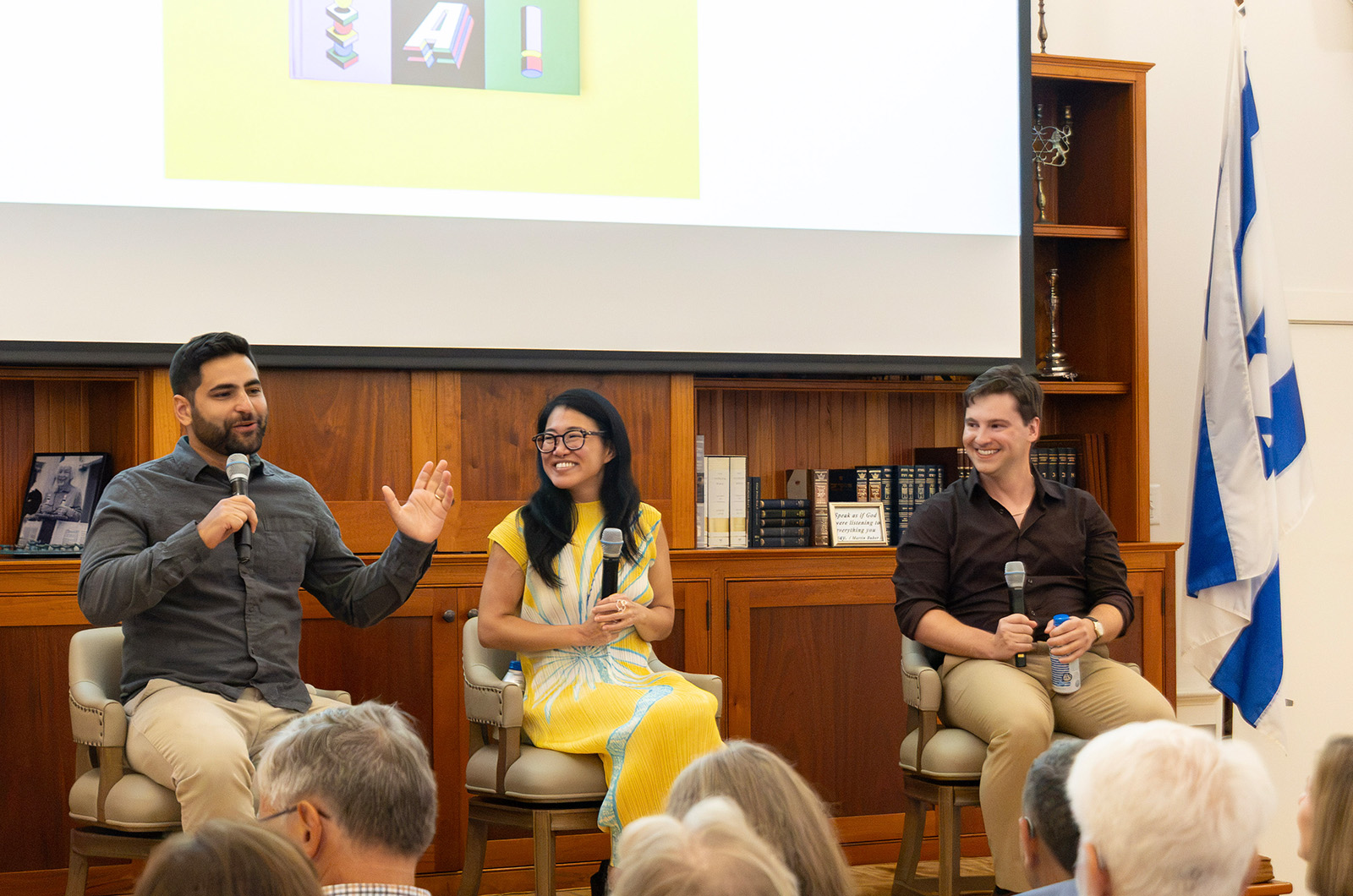
Millions of people spend a bit of each day with Wyna Liu, Joel Fagliano and Sam Ezersky. For some, these meetings take place upon waking, or arriving at work. Others seek them out at the stroke of midnight.
If this were a puzzle, its solution would be that Ms. Liu, Mr. Fagliano and Mr. Ezersky are daily puzzle editors at the New York Times. The trio visited the Island Thursday to lead the final night of the Martha’s Vineyard Summer Institute, the speaker series at the Martha’s Vineyard Hebrew Center.
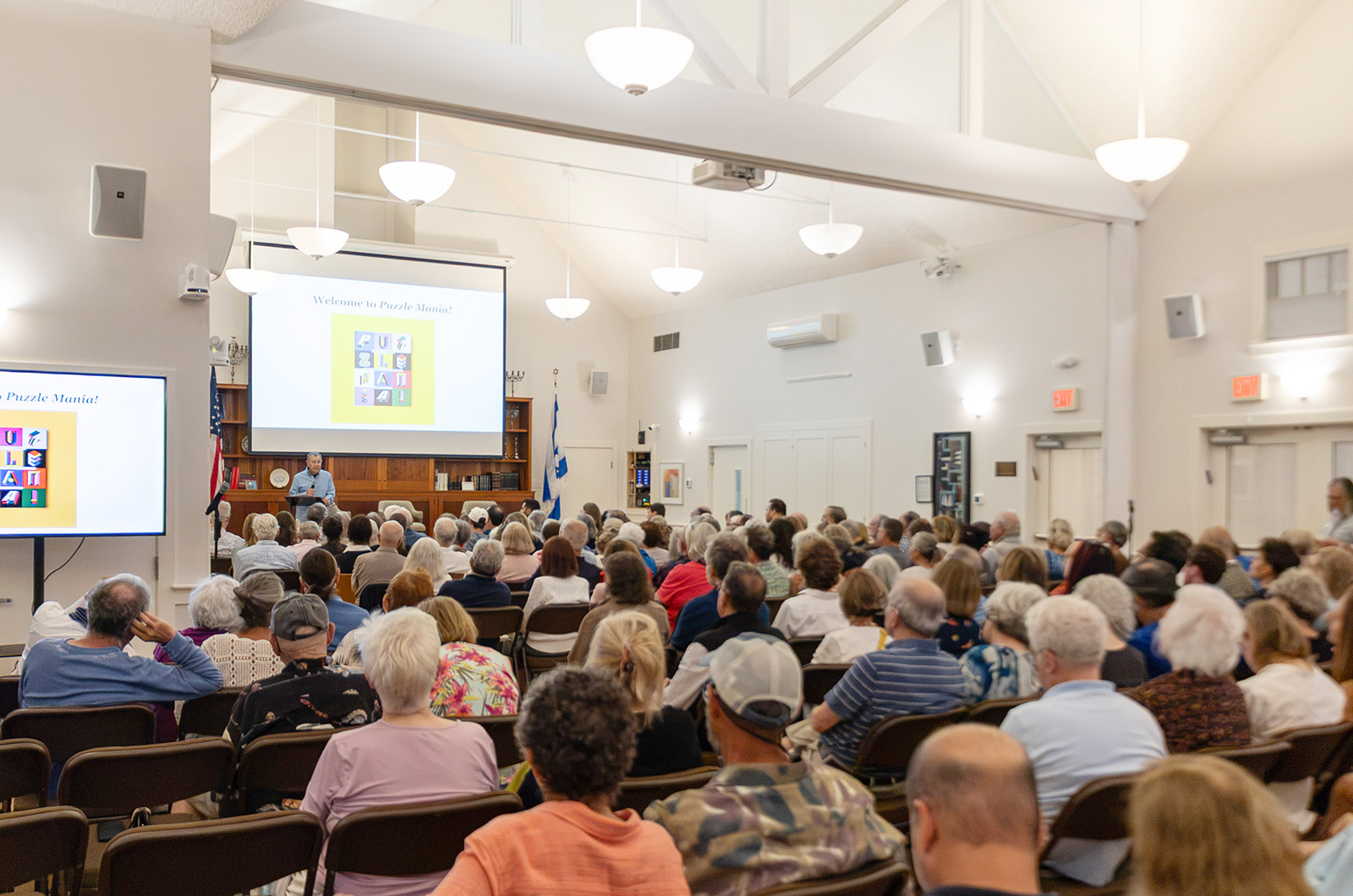
At the Times, Ms. Liu edits Connections, which asks players to sort16 scrambled terms into their four correct categories. Mr. Fagliano edits the Mini crossword, and Mr. Ezersky edits Spelling Bee, where players must use a grouping of letters to make as many words as possible (and ideally, a pangram using all of them). Print versions of these games appear in Puzzle Mania!, a Times puzzle book edited by Mr. Fagliano.
Games have grown in importance at the Times since the publication acquired the viral five-letter word-guessing game Wordle in 2022. Today, the games desk is manned by a staff of almost 100, and the puzzles, which players devour daily with ritualistic intensity, drive a significant portion of the website’s traffic.
“It was like a tidal wave,” Mr. Fagliano said.
But all three editors have been riding the Times puzzle wave for quite some time. Mr. Fagliano and Mr. Ezersky both had puzzles accepted by the Times as teens, and Ms. Liu had a puzzle accepted on her first try in 2019.
For them, balance makes a puzzle click. A puzzle should be solvable, but sufficiently challenging, with a mix of references and themes accessible and appealing to more than one age group.
“The best puzzlemakers have the solver in mind the whole time,” Mr. Fagliano said. “They’re thinking, what’s the path to the solution? How can I create little roadblocks along the way that will stop them, but not ultimately cause them to fail?”
“Believe it or not, we want the puzzles to be solved,” Ms. Liu added.
Being a puzzle editor doesn’t mean sitting around and solving crosswords all day. Keeping the Times packed with quality games day to day is an intensive and collaborative effort, shared by puzzlemakers, software engineers, graphic designers and market experts. They dream the puzzles up and optimize them, using feedback from the public and each other.
“For a long time, I actually acted as Wyna’s test solver,” Mr. Fagliano said. “If you think the Connections you see are hard, you should see the ones that get filtered out.”
The trio prepared some never-before-seen puzzles for the crowd to play. Ms. Liu made a custom round of Connections, the first four words of which were MARTHA’S, VINEYARD, SUMMER and INSTITUTE. All four words ultimately belonged to different categories.
“I spend a lot of time organizing the words in a certain way to trick you,” Ms. Liu said.
Still, none of the games took long for at least one of the 200-odd puzzle acolytes in the crowd to solve.
When the puzzle pros opened the floor to audience questions, they pondered the impetus for the puzzle revolution. For them, it comes down to connections — the human kind.
“I hear about groups of college friends staying in touch by sharing the games and chatting each day,” Mr. Fagliano said. “That didn’t used to happen.”
One attendee asked if the editors foresee artificial intelligence taking over the art of puzzlemaking.
“I wouldn’t let it,” Mr. Ezersky said.
Some guests aired out their complaints, bemoaning their recent Connections and Wordle failures and questioning the games’ mechanics. One wanted to know why the word anal is in the Spelling Bee dictionary while other vulgar words are not. Anal, Mr. Ezersky patiently explained, has a benign meaning as well — “ultra-fastidious” or “persnickety.”
The team reminded the crowd that it’s all in good fun.
“We’re not trolling you guys. We’re not trying to make you all mad,” Mr. Ezersky said. “We’re just humans at the end of the day, and we’re engaging in this fun battle of wits together.”






Comments
Comment policy »