
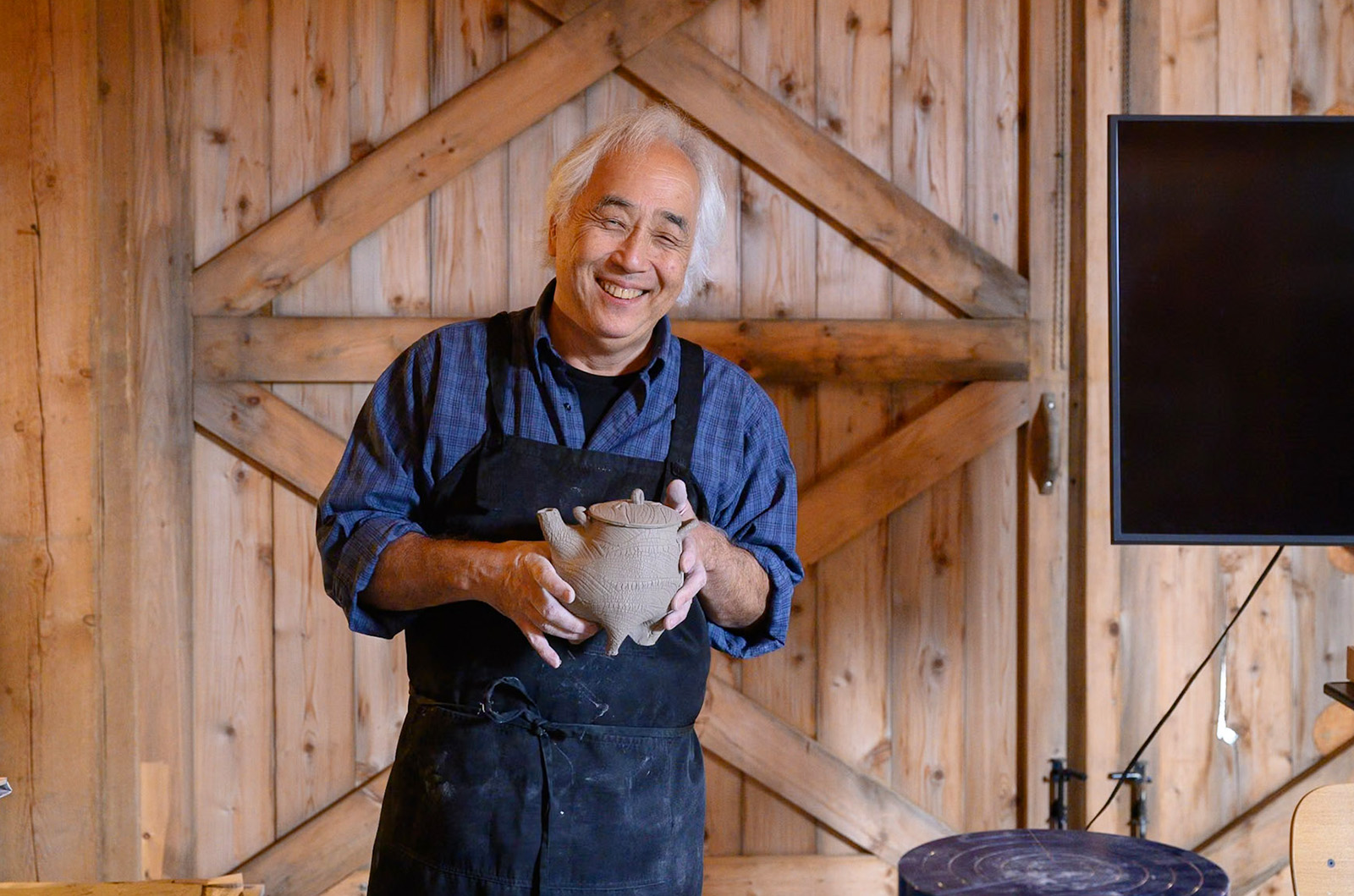
Whether through ceramics or music, nature is the predominant character in Akira Satake’s work.
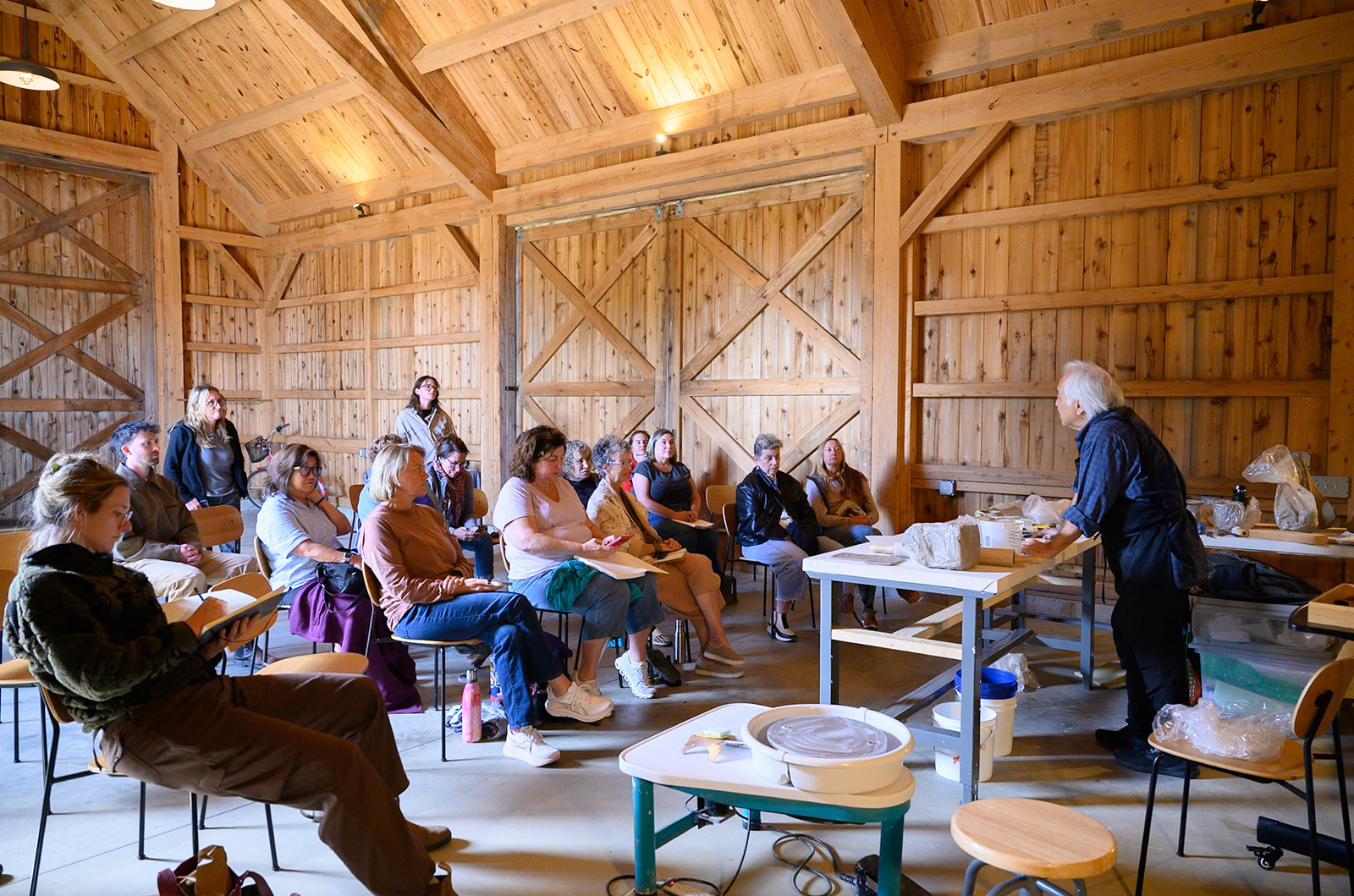
During a ceramic’s demonstration held at Slough Farm on Saturday, Mr. Satake stood before a small group of Vineyarders and worked to loosen a large lump of clay by smacking it against a table. Then he twisted a short dowel through the middle of the block to give him more leverage for the following step in his process.
“A sculpture piece is a mixture of very organic surfaces and shapes,” he told the group gathered in the room.
Much like a dancer, a sculpture or piece of pottery with a good core can look beautiful while also looking as though it were formed naturally, he said.
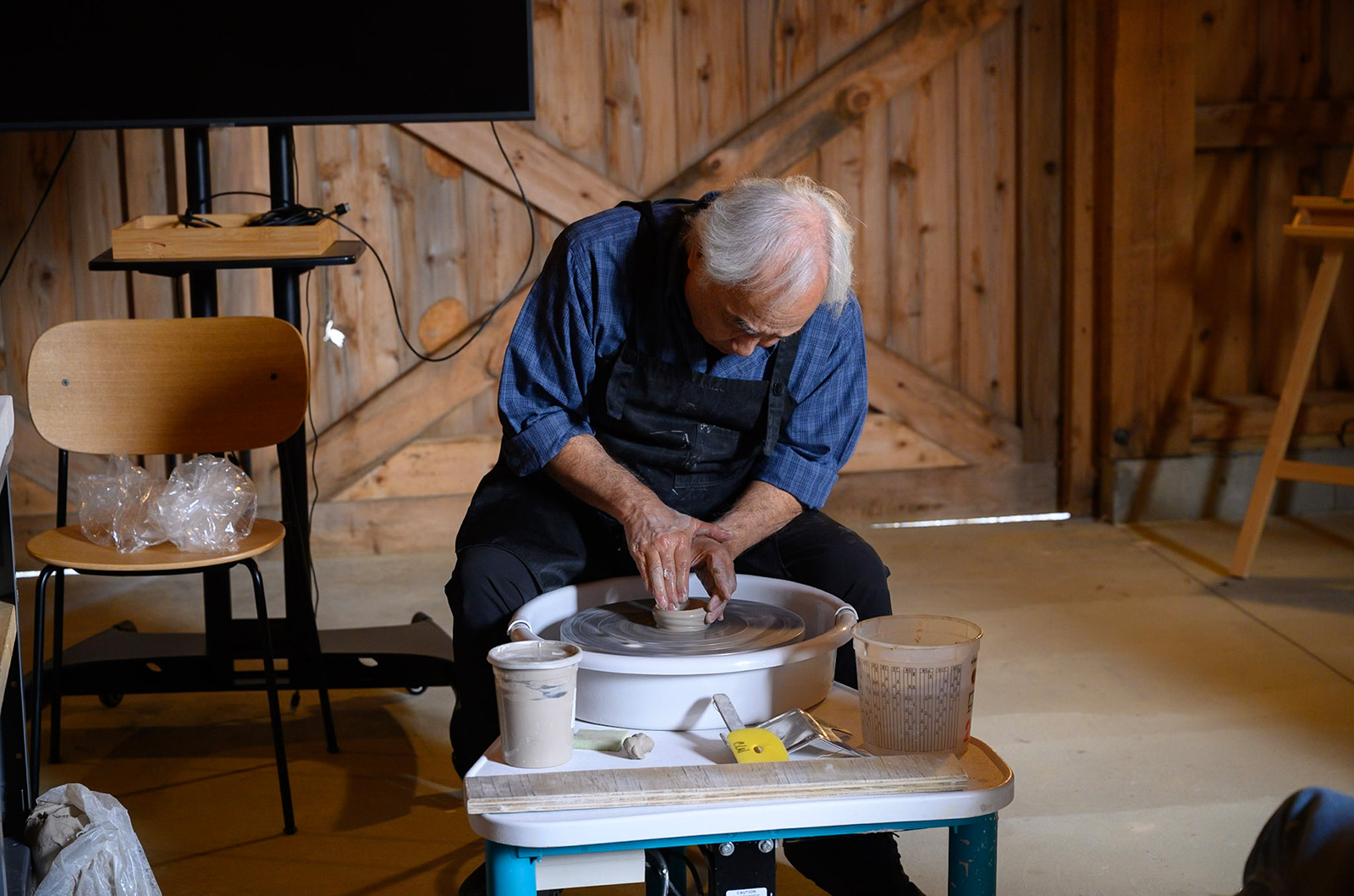
“I keep that in my mind when I’m making something like this,” said Mr. Satake.
The workshop was a day-long event to demonstrate techniques he has used to create his world famous pottery and sculptures. But ceramics is not be the only performance he will be giving on the Island. Mr. Satake is also a professional musician, and before he travels back to his home and studio in Asheville, N.C., he will play the banjo at the Martha’s Vineyard Film Center on Wednesday, Sept. 23, before a showing of Akira Kurosawa’s 1963 film, High and Low.
Mr. Satake was born and raised in Osaka, Japan, where he was surrounded by art. His father, a banker by trade, spent his free time oil painting. Often, he would travel to a nearby village to purchase various wood-fired pieces of pottery. He also built his own gas kiln in Mr. Satake’s childhood home, where Buster Keaton films and bluegrass music by Lester Flatt and banjo player Earl Scruggs, were often a source of entertainment and inspiration for Mr. Satake and his older brother.
Mr. Satake learned to play the guitar by listening to Doc Watson records, and with the help of his brother, who is eight years his senior, the pair studied the image on the Flatt and Scruggs record to build Mr. Satake’s first banjo.
He worked as professional musician throughout high school, but realizing that the opportunities for making a living in Osaka as a banjo player were limited, he moved to the United States and eventually settled in New York City, where he ran music production company.
But after 10 years, he felt that he needed to make a change, and in his 40s returned to ceramics, the art of his youth.
When creating both music and pottery, Mr. Satake often starts with a vision, but his main priority is to create something that has energy and often he lets the art build naturally. Technique is not the most important part, he said during his demonstration on Saturday.
“I want you to have your own voice,” he said. “If your work looks like my work then nobody will take you seriously.”
“Doing it quickly is good,” he added. “You don’t think too much and, therefore, you don’t doubt yourself.”
Mr. Satake said he often travels the world searching for inspiration. Recent trips to Patagonia and Hawaii provided opportunities for him to study various natural rock formations, dry river beds and beaches covered with volcanic rock, elements that are evoked in both his creative process and his finished works.
“Observe what you are looking at to see the beauty in it,” he said. “That is my workshop theme.... And don’t be afraid to make mistakes.”
Mr. Satake’s banjo performance at the film center on Wednesday begins at 7 p.m. The showing of Akira Kurosawa’s High and Low begins at 7:30 p.m. For tickets, visit mvfilmsociety.com.





Comments
Comment policy »