
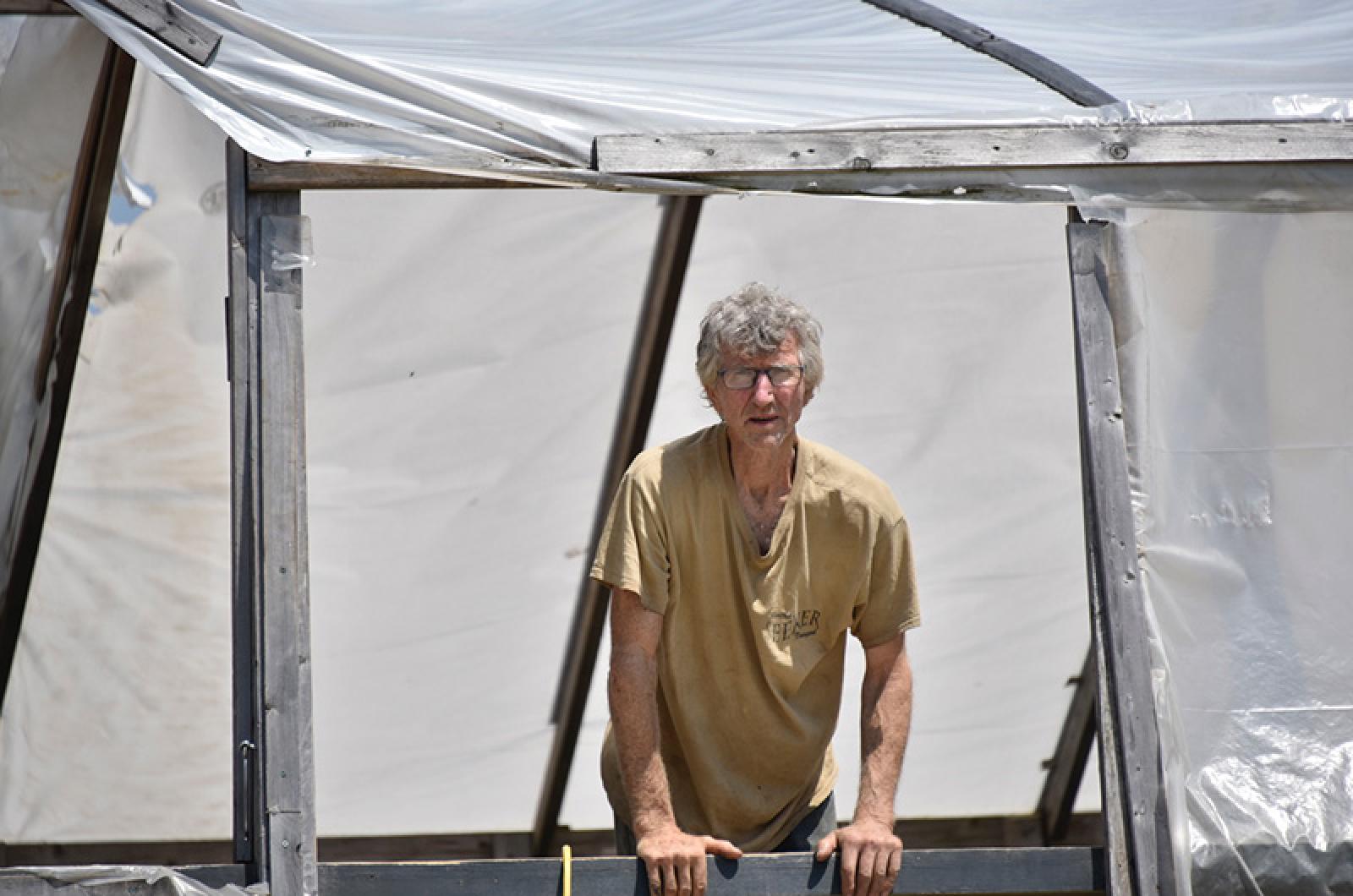
Ted Box got his first boat at age three — a red rowboat birthday gift. But his arms were still too short to row from the middle of it, so he took one oar, went to the front of the boat, and paddled into the water.
“It was freedom and independence,” his sister Tiara said. “That changed his whole life.”
Mr Box, a master shipbuilder, furniture-maker, dancer, musician and writer who captivated the Vineyard with his quixotic, decade-long project to build a wooden, 70-foot scow vessel in Vineyard Haven called Seeker, would spend the rest of his life on the water, inspiring generations of artists, tinkerers, carpenters and dreamers like himself to find purpose and community in the sea.
He died of natural causes on Jan. 18 at age 80, his sister said.
Mr. Box grew up in Seaford, Long Island, the third of eight children in a family that had a strong maritime tradition. His maternal grandfather, H. Thomas Morrell, had built a boat by hand, and his father, a product of the Great Depression, fished to feed his family.
Mr. Box built his first boat at age 14, with plans from Popular Mechanics. But the boat had a square front, like a punt, and Ted wanted it to have a pointed bow. He changed plans halfway through the project. Eventually, Ted’s father gave him a deadline, saying that if it wasn’t completed in a month he would take an axe to the boat. Mr. Box reworked the front in one week.

“My father got two of his friends to help launch it,” Mr. Box said in an interview with Martha’s Vineyard Magazine in 2022. “That was his way of showing I’d done a good job.”
Mr. Box wouldn’t meet many more deadlines throughout his life, but his love of boat-building never wavered. He went off to college at the University of Miami, and then the University of Hawai’i, first studying music — he had a natural ear for instruments, and played the piano, trombone, ukulele, classical guitar and violin — before switching his major to marine science. After two years, he moved to Provincetown, where he worked as a fisherman with his brothers, Tod and Tom, and studied boat-building under the tutelage of Francis “Flyer” Santos, a master seaman and boat-builder who became Mr. Box’s mentor for the next 60 years.
“Most guys couldn’t last a day,” Mr. Box told the magazine. “They’d quit at lunchtime and not come back for a paycheck.” The work was rough, involving shoveling sand or painting the bottoms of fishing draggers. “It’s a miserable job. Was then and is now. But it wasn’t that way to me. It was a doorway into a life I wanted.”
After years honing his craft under Mr. Santos, performing sea rescues, building custom boats and taking the occasional lobster or dragging job, Mr. Box planned to move his family, which then included three children, to Florida. But he stopped for a weekend on the Vineyard and decided to stay. He worked for Capt. Bob Douglas for two years, building and restoring a 48-foot English Channel Pilot Cutter, and then plied his trade in carpentry and contracting. Hurricane Bob, the 1991 storm that caused more than $1 billion in damage along the east coast, provided Mr. Box with an opportunity.
“Walking the beaches littered with driftwood, it came to me what to do,” he told the magazine.

Mr. Box soon became a nationally-renowned driftwood furniture-maker, with pieces selling for large sums in Los Angeles and appearing in galleries across the country. His work, whimsical and unique, captured the magic of the Vineyard and its seascape: butterfly dressers with winged doors, driftwood recliners that mimicked the wave-patterns of the ocean, conch-shaped roll-top desks that seemed plucked straight out of Wonderland. His innate creativity imbued every aspect of his life. He taught ballroom dance and tai chi and wrote poetry. He was known to perform intense, full-body workouts that included hundreds of push-ups and sit-ups. He body-surfed in hurricanes. He could jump, flat-footed, into a standing trashcan, his sister said.
The financial freedom that furniture-making provided allowed Mr. Box to pursue a different dream — building a 70-foot scow vessel from blueprints that he had found in the Smithsonian 40 years earlier, when he met Howard I. Chapelle, an expert in maritime boat-building. The boat, if completed, would be one of the biggest wooden vessels of its kind constructed on the Vineyard — a place with its own storied maritime history.
That, of course, was a big “if.” Mr. Box, equipped with little more than a wing, prayer and dozens of hundred-pound cypress planks from South Carolina, began the project in 2011 on Ernie Boch’s then-vacant lot in Vineyard Haven. He initially intended to have the boat in the water in 18 months. But a never-ceasing string of health issues, budgetary constraints, a lack of land and accidents — like when a snowplow crushed his masts — turned 18 months into two years, then three years and then five years.

Through it all, Mr. Box, in his 70s, his voice growing raspy after a bout with throat cancer, his hands sinewy and sea-weathered, never quit on his magnum opus, even as it began to look less like a boat and more like a 40-foot tall Conestoga wagon.
And when Mr. Box struggled to “rivet his dream to his will,” an eclectic community of machinists, carpenters and wayward souls who found purpose and a father-figure in the Sisyphean endeavor, stepped in to help. They tarred, sanded, planked, drilled, painted and polished where Mr. Box could not. Donations came in the form of materials, such as ropes and angle-irons, and knowledge, like when an amateur engineer built Mr. Box a model to attach the boat’s 1,400-pound rudder. He found volunteer workers in his ballroom and improvisational dance students. His furniture clients provided financial support. The boat slowly took shape, a reflection of the distinct Vineyard life and community he had built around it.
Finally, seven years after he began, Mr. Box had to act: Ralph Packer was leasing his land to Vineyard Wind and Seeker was now far too heavy to move on land. So on a sunny Saturday in June of 2018, he set up two steel beams that stretched from Seeker’s hull to the water, greased them with soap, and contracted a pair of excavators to push from land.
“It’s alive!” Mr. Box proclaimed cathartically from the stern, as the boat entered the harbor. Others in the crowd wept.
“This thing we’re standing on only existed in my imagination,” Mr. Box said aboard the boat in 2018. “Every day for seven years I had to ask myself, am I big enough to build this boat? And now, I think I’ve answered that question.”
Over the next few years, Seeker moored idly in Lake Tashmoo, Mr. Box’s goal of it being a floating art gallery and community theatre space never truly taking hold as his health issues worsened. He lived on the boat during warmer weather months, working on a project that was never intended to end.
In the winter of 2024, however, Seeker sank after a heavy rain-storm. It still sits half-submerged in Lake Tashmoo. But the dream was never about the boat.
“When I decided to build this boat,” Mr. Box said in a 2018 interview, “I thought to myself, it takes many hands to make a masterpiece, and I wondered how many people would find an expression of their dream in this project, and I’ve lost count. The whole community danced with us.”





Comments (11)
Comments
Comment policy »