
Junior Ethan Knight went in-depth on his weightlifting hobby for this year’s high school science fair. For research, he and his friends tested the ways music impacted their performance at the gym.
“I felt like I would want to know the answer and if it was negative, then maybe I wouldn’t listen to music when I worked out,” Mr. Knight said.
Thankfully, the weightlifting group will not have to turn the music off during their workouts as they discovered the rock and hardstyle tunes they enjoy increased the amount of repetitions they were able to do by five per cent.
The correlation between weightlifting and music was just one of many subjects tackled over the last several weeks and displayed on Saturday at the regional high school annual science fair presentations and awards ceremony. The school cafeteria was filled with 16 posterboards showcasing projects in biology, chemistry and physics.

Many students said the fair allowed them to explore beyond their textbooks and follow their personal interests.
Juniors Tiffany Balbino and Kimberly Peres explored the science behind their passion for art in their project Glowing Flower. The two painted a pink hibiscus and used the skills they learned in honors chemistry to make its center come to life. The two built a circuit behind the painting, lining the bottom with copper tape, connecting a battery and poking LED lights through the paper. The result — clusters of shimmering sparkles in the flower’s pollinated core.
“Before I was like, art and science don’t really go together that much, it’s so separate...” Ms. Peres said. “But after this, I found they can actually work really well together, and I can actually enjoy building circuits.”
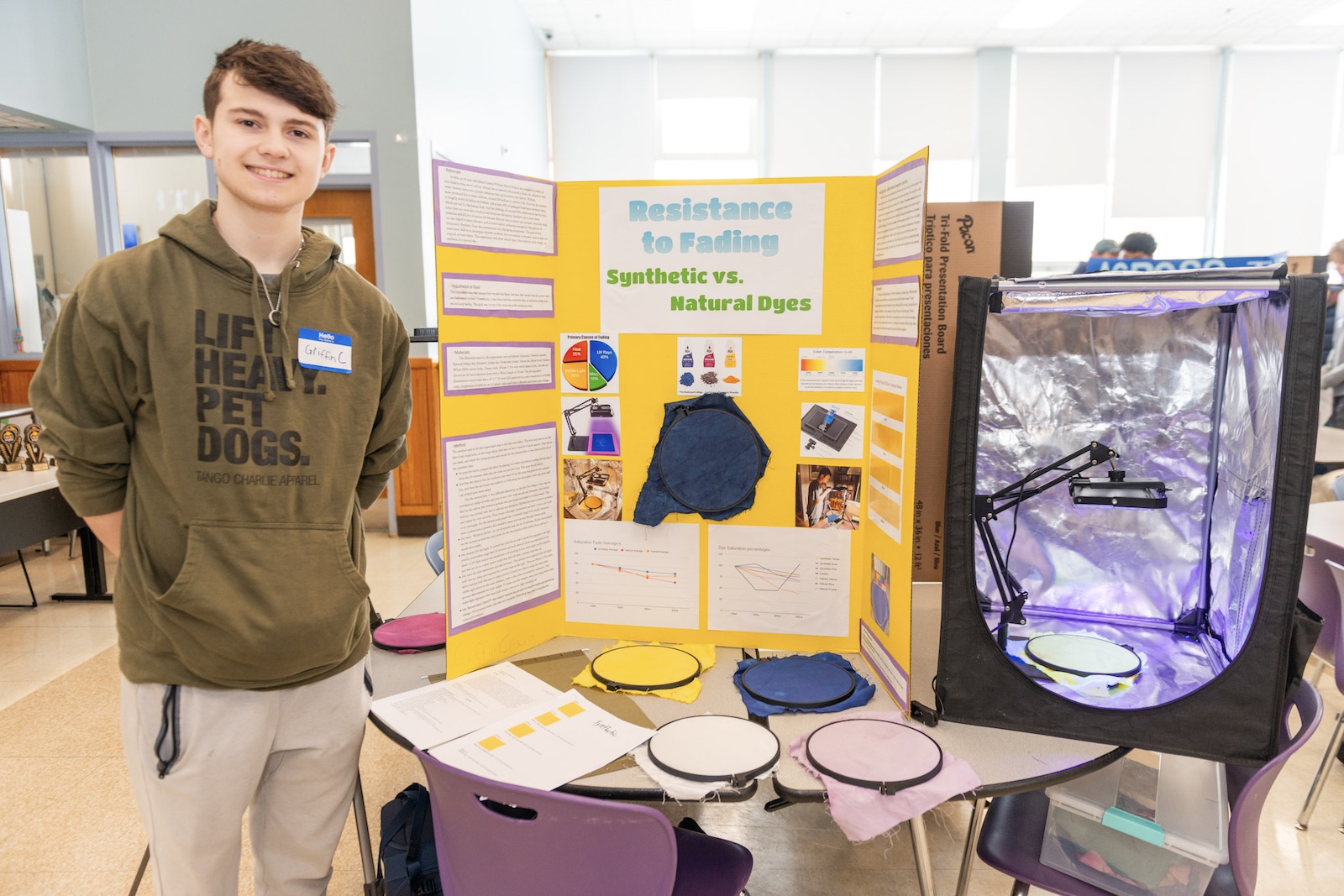
The overall grand prize went to sophomore Griffin Craig whose project Synthetic vs Natural Dyes drew crowds. He tested the effects of UV light on fabrics colored with man-made and natural dyes.
When deciding what project to do, Mr. Craig said he wanted something visual due to his dyslexia. When he looked at his grandmother’s painted rock collection, the idea struck him.

“It just kind of clicked,” he said.
He used turmeric, powdered indigo and cochineal bugs he ordered from South America to replicate the same yellow, blue and purple colors of the synthetic dye. He then tested each piece under UV lights for multiple hours, taking pictures periodically, and compared how they faded over time.
He found the synthetic dye held longer, though the natural dyes were more versatile.
“With synthetics, it’s the concentration that changes the color,” he said. “With natural, it’s the mordant, what metal or alloy you add. You can make so many more colors and the colors fade in a specific way just by swapping around what you have inside.”
Students also studied environmental topics.

Sophomore Rosalia Apaza chose to explore the impact of rock salt, often used to clear ice off the sidewalk, on plant germination.
“I thought it was relevant to focus on since it is used in the road, it is used in agriculture, farming, pretty much everywhere,” she said.
She compared greenscapes salt, which is marketed as eco-friendly, to industrial rock salt, dissolving both crystals in water and pouring the mixture over corn seeds.
“I found that the greenscape salt, if you use low concentration, it actually increases the sugar intake which is used for the health of the plant,” Ms. Apaza said.
Nearby, freshman Griffin Tiernan presented his project Exploring the Absorbency of Stone. Cubes of sandstone, soapstone, granite, bluemist and quartz lined his table behind printed graphs.

“When a stone has water inside of it, if it’s cooled down [or heated] too much then that water could freeze and crack the stone, or it could turn into steam and explode the stone,” Mr. Tiernane said.
He said the information is useful because it can inform consumers. To his surprise, sandstone had the lowest absorbency, which he hypothesized could be because of its high porosity, allowing water to drain faster.
Science teacher Anna Cotton, who helped coordinate the fair with science teacher Nicole Munn, told the students their work was exceptional. She thanked the judges, who volunteered from many of the Island’s environmental organizations, and said the fair is a great example of the community at work.
“The [judges] ask you all these questions and you do an amazing job, and they sit in the library all morning raving about how incredible you are,” Ms. Cotton said.
Overall Winner:
Griffin Craig: Synthetic vs Natural Dyes.
Investigative Category:
Zoe Higgins: Digging into Soil Science: The Effect of Soil Type on Plant Growth.
Nevah Fitzgerald: The Connections Between Screetime & Sleep.
Rosalia Apaza: The Effects that Rock Salts have on Germinations.
Engineering Category:
Lacey Munn and Mackenna Metell: Eco-Friendly Wax vs. Non-Eco-Friendly Wax.
William Hoff: Compost’s Effect on Drainage.
Greyson Hartzband: Treasure Hunting Game.
Special Awards:
Sheriff’s Meadow Foundation Award: Rosalia Apaza: The Effects that Rock Salts have on Germinations.
Island Grown Initiative Award: Zoe Higgins: Digging into Soil Science: The Effect of Soil Type on Plant Growth.
Martha’s Vineyard Surfcasters Association Award: Madison Curelli and Alicia Silva: Biodegradable Plastic.
Sustainability Award: Griffin Craig: Synthetic vs Natural Dyes.
Lagoon Pond Association Award: Griffin Tiernan: Exploring the Absorbency of Stone.
Martha’s Vineyard Shellfish Group Award: Divya Randolph: Wampum Coloration.
Wind Turbine Awards:
Liana Dubin, Leela Khelalfa, Leah Thomson, Humberto McGroarty Sampaio, Joao Nunes, Emmett Taylor, Lejaun Webb.
Category Awards:
Highest Honor Earth, Space and Environmental Science Research Award: Savannah Anderson: Rock Tumbling.
Highest Honor Biology and Behavioral Science Research Award: Colton Filiault” How Long Do Apples Stay Fresh in Different Types of Liquids?
Highest Honor Chemistry Research Award: Gabriel Bengtson: Nuts on Fire.
Highest Honor Physics and Computer Science Research Award: Emery Fullin: The Bridge Design Project.




Comments (2)
Comments
Comment policy »