
King Juba II had an ironic sense of humor.
This ancient Age of Augustus (30 BC – AD 14) ruler of Numidia and Mauritania had an interest in science, botany and the natural world and surrounded himself with other learned naturalists and thinkers. One of his advisors was physician Euphorbus.
Euphorbus was also an explorer who travelled widely (thanks to the patronage of Juba II) to find plants that have medicinal benefits. During one trip to the High Atlas Mountains in what is now northern Africa, Euphorbus wrote to his benefactor about a succulent plant, a type of spurge, that seems to have excellent value as a laxative.
Juba was flushed with excitement about this report and decided to honor his subject (and settle a score between brothers) by naming this plant Euphorbia after his dedicated doctor. Euphorbia’s brother was physician to the emperor of Rome and had been recently honored by his boss with a bronze statue for his service to the kingdom. While there was no statue for Euphorbus, Juba bestowed this plant-naming honor. Ultimately, the brother, Anthony Musa, also had plants named for him, so the rivalry remained winnerless.
Perhaps there was a victor when you learn the meaning of the name Euphorbus. The translation has been reported as “well fed.” Descriptions of the newfound plant as sturdy, thick, as wide as it is tall, plump, and fleshy could be seen as an insult rather than an honor, after reports that Juba may have matched that plant and his subject, “because of the corpulence of both.”
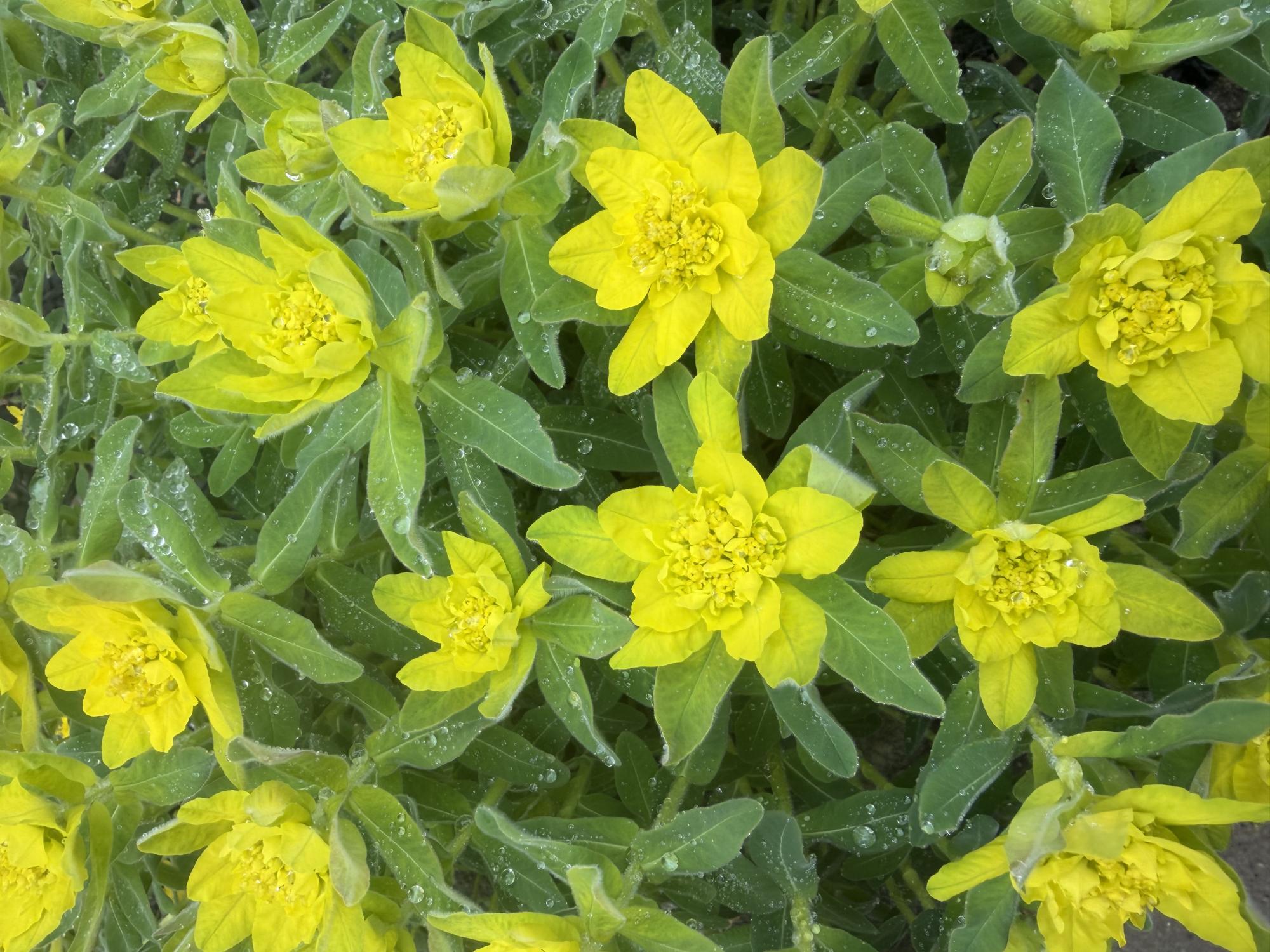
While the plant found by Euphorbus was not the same species I noticed last week on Main street in Vineyard Haven, these two plants are connected by a shared genus and natal region. Cushion spurge, Euphorbia polychrome, caught my eye with its beautiful, succulent green and yellow flower-like blossoms.
This nonnative species originated in the lands of what is now Turkey, Europe, and Libya but has spread worldwide as a useful, resilient, attractive horticultural plant. This spurge is resistant to nibblers including deer and rabbits, can survive drought and disease, and is an early and persistent bloomer of golden flowers. It can thrive in most soils and light levels, is perennial, and can serve as an effective groundcover due to its spreading capabilities. With all of these qualities, it is not surprising that, like its namesake, it received accolades. Britain’s Royal Horticultural Society awarded Cushion Spurge an Award of Garden Merit.
Though it took home the trophy, this spurge does have a dark side. While its discovery story paid homage to this genus’s laxative properties, this species is not one that you should use medicinally. Cushion spurge has toxic characteristics, including its milky sap, sometimes referred to as latex, which can cause skin irritation, and eye damage and even blindness.
Things get worse when Euphorbia varieties are ingested, as illness and even death in vulnerable people and animals can result. It was a Euphorbia that was poisoned and killed the Ethiopian mythological serpent king Arwe. He died after drinking this plant’s juice, which was given to him by a woman before her daughter was to be sacrificed to him.
A tyrannical leader, Arwe might have gotten his just rewards from a deadly drink of justice-bringing juice. This Euphorbia may have brought euphoria to the victim and her mother, and the story makes the naughty naming by Juba seem quite harmless by comparison.
Suzan Bellincampi is director of the Felix Neck Wildlife Sanctuary in Edgartown, and author of Martha’s Vineyard: A Field Guide to Island Nature and The Nature of Martha’s Vineyard.




Comments
Comment policy »