
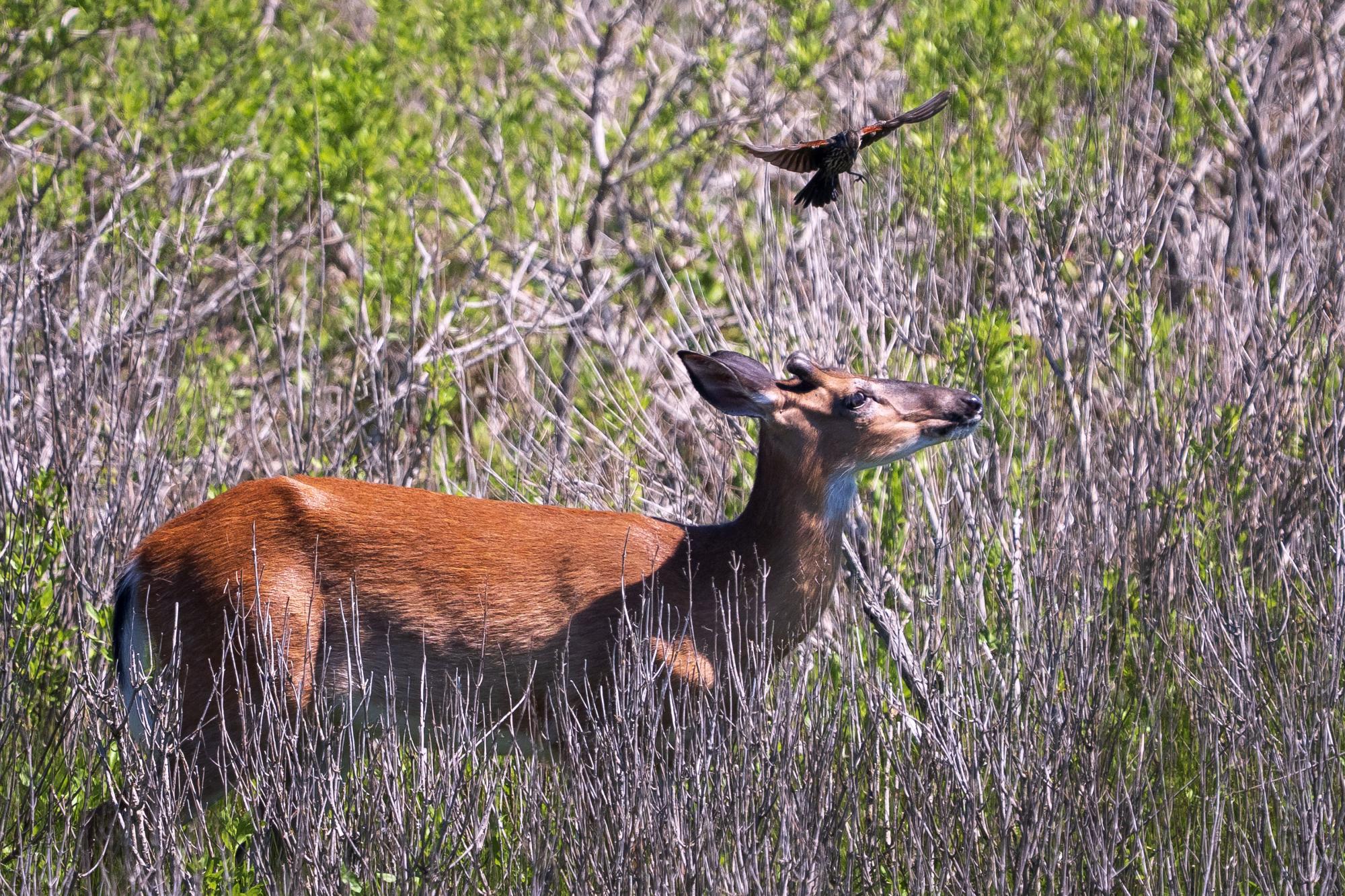
In an effort to combat tick-borne illnesses and allergies on the Vineyard, Tick Free MV is looking to reduce the Island’s deer population by 70 per cent, in part by using tools from the state to open up a year-round deer harvest.
The Vineyard nonprofit launched in December, and a key component of the organization’s strategy has always been tied to managing the Island’s population of deer, which are the arachnid’s main reproductive hosts.
But this is the first time the group has set a concrete goal for reducing the herd’s size.
“The whole reason we’re doing this work is because of the public health crisis that’s unfolding here on Martha’s Vineyard,” executive director Virginia Barbatti told the Gazette. “What’s very clear to us is the first thing we need to focus on is deer management. Period.”
This winter, Tick Free MV contracted wildlife management company White Buffalo for an aerial deer population survey, which counted 4,681 deer across the Island. The survey took place right after hunting season and before spring’s influx of new fawns, meaning the number is likely higher now. Still, the survey’s count translates to an Islandwide deer density of roughly 49 deer per square mile — a number that far exceeds the state’s 12 to 18 deer per square mile range for optimal ecological health.
Ms. Barbatti would like to see the Vineyard’s deer herd whittled down to 1,500 deer. This would bring the Island deer population density down to roughly 15.6 deer per square mile, a number that falls squarely within the state’s recommended range.
“The deer need to go from over 5,000 to 1,500 or less,” Ms. Barbatti said.
But that kind of reduction would be hard to accomplish within the confines of hunting season, even with the extended dates that the state put in place last year. Tick Free MV therefore plans to rely on state-backed deer damage permits to boost the year-round harvest.
Issued by The Massachusetts Division of Fisheries and Wildlife (MassWildlife), deer damage permits allow land owners whose property produces something agriculturally — such as farms, conservation land and botanical gardens — to harvest deer as pests on their property. Property owners with the permit can name several subpermitees who are allowed onto their property to harvest deer in their stead.
Martin Feehan, who runs MassWildlife’s deer damage permit program, gave a presentation on the permits at the Agricultural Society in February. He told the Gazette that he’s issued over a dozen so far on the Vineyard, which previously had zero permit holders.
“The deer damage permit, coupled with hunting, is able to draw the population much closer to what is needed from a management standpoint,” he said.
He said deer damage permits have been used for individual property management elsewhere, but not for population control on the scale being attempted on the Vineyard.
“There really isn’t a similar situation to Martha’s Vineyard on that right now on the mainland,” he said. “Densities aren’t quite high enough.”
Permitees or subpermitees are allowed to keep a portion of their deer harvest but must donate the rest to the Hunters Share the Harvest program, which gives the venison to state residents facing food insecurity. On the Vineyard, Island Grown Initiative helps carry out the program with its food pantry, which serves one in five Islanders.
MassWildlife won’t issue a deer damage permit to a property unless there is a year-round deer processing facility nearby to store and butcher the deer — something the Vineyard previously did not have.
To satisfy the requirements of the permit system, and to meet the demand for deer processing that will come with an increased deer harvest, Tick Free MV is giving a grant to MV Hunt Club, which keeps its cooler and processing facility open during hunting season, to keep it open year-round.
“They’re open right now in order to allow for those deer damage permits to exist, because deer damage permits enable removal of deer year round,” Ms. Barbatti said.
Brian Athearn, founder of the MV Hunt Club, sees the Island’s hunters as integral to managing the Vineyard’s deer population, both to protect the environment and protect people from ticks.
“As hunters, we want to be a part of the solution,” he said.
He said the Tick Free MV grant will help cover electricity and other operational costs. He added that year-round operations are also made possible by the Wampanoag Tribe of Gay Head (Aquinnah), which helped MV Hunt Club equip its facility with heating and cooling for year-round butchering.
Of the hunt club’s 60-odd members, about six of them regularly butcher for the Hunters Share the Harvest Program, Mr. Athearn said. His son, Hunter Athearn, has taken over the butchering side of the operation and is teaching his friends how to process venison.
“The state gets the meat, the tribe gets the meat, and we go about our business,” he said.

Tick Free MV is also working with the Martha’s Vineyard Agricultural Society to set up another year-round cold storage and processing facility for venison. The West Chop Community Fund is putting $50,000 behind the effort.
“That investment is going to be critical in our ability to increase the deer harvest in coming years,” Ms. Barbatti said. “It’s a real investment in our hunting community, and it’s also an investment in our food systems infrastructure.”
While deer damage permits can create more opportunities for year-round deer harvesting, the harvest that the permits allow is distinct from hunting, Mr. Athearn explained. Hunting, he said, can only happen during hunting season, and is subject to restrictions that don’t apply to harvesting deer with a deer damage permit.
“We’re allowed to harvest these deer with everything except for snares and explosives,” Mr. Athearn said with a laugh. “That’s not hunting.”
With over 40 per cent of the Island’s land in conservation, opening up as much land as possible for year-round deer harvesting means trying to get the permits to Vineyard conservation agencies, Ms. Barbatti said.
“A lot of that [conservation] land overlaps with the high deer density zones that we identified in our aerial deer survey,” Ms. Barbatti said. “We are calling on the major conservation groups to pursue deer damage permits.”
Adam Moore, president of the Sheriff’s Meadow Foundation, told the Gazette last week that his organization is in talks with Tick Free MV about participating.
“I am speaking with Tick Free MV about [deer damage permits] tomorrow, and then our hunting committee, property management committee and board of directors will discuss and consider this,” Mr. Moore wrote. “We will also speak with the Commonwealth to learn more.”
James Lengyel, executive director of the Martha’s Vineyard Land Bank, confirmed his organization is also in talks with Tick Free MV about the permits and other ways it can support the nonprofit’s work.
“The land bank is involved in Tick Free’s work and wants to do whatever it can,” Mr. Lengyel wrote. “That may take the form of a deer-damage permit, and/or other forms. We’re going to look at what Tick Free proposes and then take it from there.”
In addition to trying to increase the Island’s year-round deer harvest, Ms. Barbatti said her team will continue to support pending state legislation that would allow universal use of crossbows by hunters, allow hunting on Sundays and decrease the 500-foot buffer hunters must maintain between their harvest and occupied dwellings.
Gov. Maura Healey has been outspoken in her support for these legislative provisions, and said in March that she planned to roll them into this year’s budget bill.
Mr. Athearn is optimistic about deer damage permits as a tool to increase the Island’s deer harvest and what that could mean for food security, especially with new processing centers operating.
“I think once the system gets in place, it’s going to be a perpetual, constant food supply,” Mr. Athearn said. “I’d call it a renewable resource that can feed hundreds of thousands of people.”
But beating back the Island’s ballooning deer population will require an all-hands-on-deck approach from Island hunters.
“We have to bust our numbers,” he said.




Comments (6)
Comments
Comment policy »