
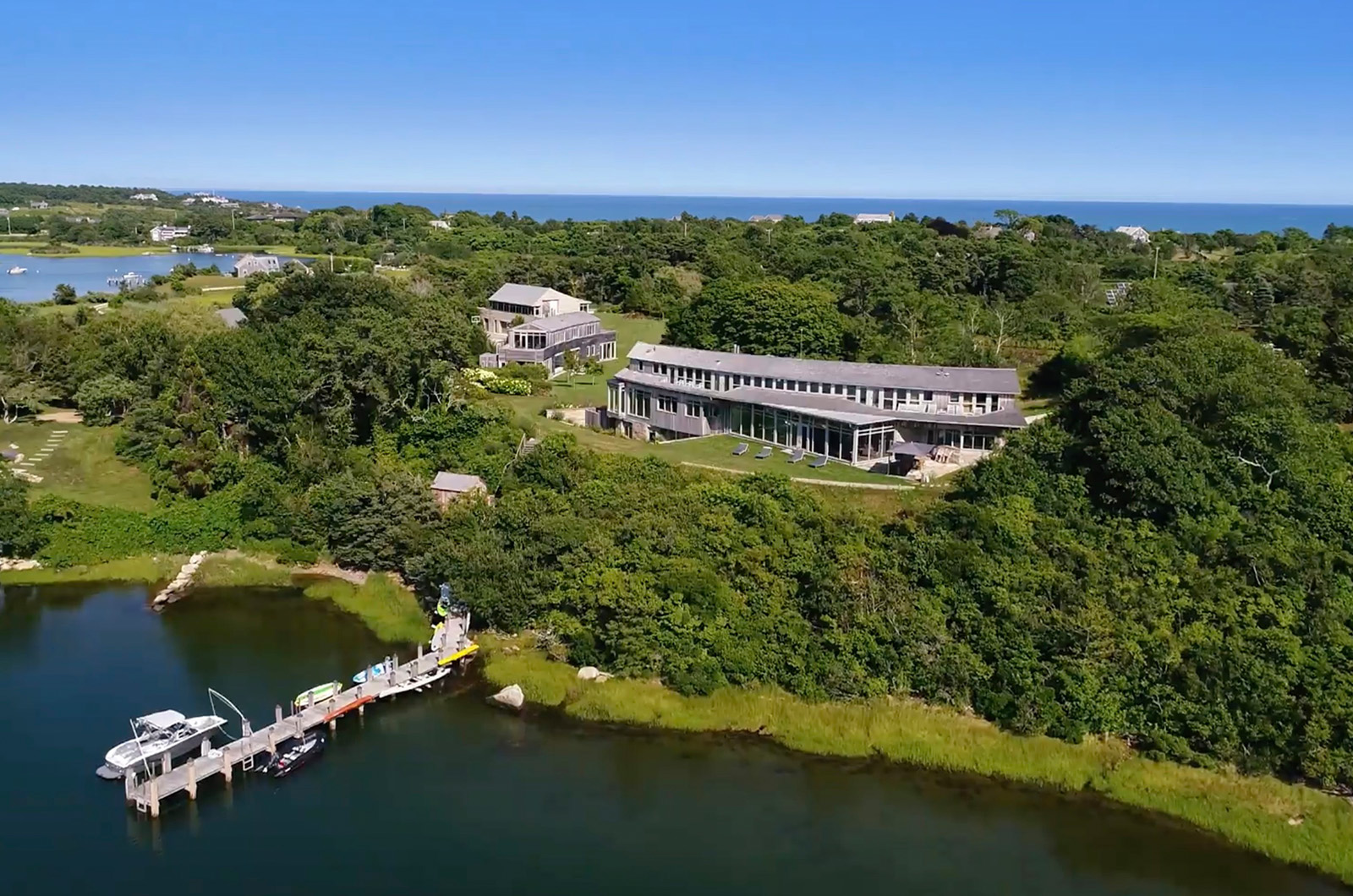
The house so big it sparked a political movement in Chilmark is on the market.
The 14,780-square-foot property, located at 18 Point Inner Way in Chilmark and owned by Adam and Elizabeth Zoia, is currently for sale for $45 million. If sold at the asking price, it would be the highest single residential sale ever to take place on the Vineyard, eclipsing the current $37.5 million record a Katama Bay mansion fetched last year.
The property is set apart not only by its size and price tag, though. Islanders may also remember it as something of a political lightning rod that led Chilmarkers to adopt a bylaw limiting new residential builds on three-acre lots to 3,500 square feet of livable space — a first for the Vineyard.
Chilmark planning board member Janet Weidner, who helped create the bylaw, described the Point Inner Way compound as “the catalyst” for the regulation change. She also said it was not the only large compound that stirred debate.
“I think making people more conscious of their impact on other people was a good thing,” she said.
Tom Wallace, listing agent for the Chilmark compound and principal broker at Wallace & Co. Sotheby’s International Realty, said the owners are leaving the Vineyard to be closer to aging family members.
He said there has been significant interest in the property since it went on the market.
“Having pretty views, and then also being able to step out onto your vessel and head to sea, is awfully appealing,” he said. “And let’s face it, there’s a wonderful appeal to Chilmark.”

The seven-bedroom, 13-bathroom compound overlooks Menemsha Pond and includes a main house and several secondary structures. Outdoor amenities include a patio, a tennis court, boathouse and 115-foot deep-water dock. One of the vessels docked there is a $2 million Italian cruiser yacht, one of only five of its kind in the world. Wrapping the vessel into the sale of the house, Mr. Wallace said, is not out of the question.
According to Mr. Wallace, properties of this type are popular among Vineyard buyers who want a multi-generational meeting space for their families.
“We’ve seen a trend towards family compounds, multiple houses on a single two-, three-lot parcel together, and we’ve also seen a trend towards larger structures for larger families,” he said.
In 2024, the compound briefly hit the rental market for $1 million per month. Mr. Wallace told the Gazette that while the owners ultimately decided to use the house themselves, the demand was there.
“We absolutely had a player ready to sign the check,” he said.
The building of the home and subsequent push for the big house bylaw was chronicled at the time by Thomas Bena, who at the time was juggling work as carpenter and as founder of the nascent Martha's Vineyard Film festival. The film, One Big Home, took Mr. Bena 12 years to make, coming out in 2016.
The Gazette sat down recently with Mr. Bena at Stillpoint, the nonprofit he founded in West Tisbury, to discuss how the film resonates on the Island a decade after its release. He recalled seeing the compound being built for the first time while clamming with his family in Menemsha Pond and feeling he had to do something.
“I don’t want to vilify the people who built that house, but that was the house that just seemed so egregious that it felt like a tipping point,” he said.
The film opens on the Point Inner Way compound, then unfinished. For the carpenters building it, the house is both a representation of their livelihood and of a lifestyle far out of their reach. One shot shows the words “Chilmark Hotel” scratched into a support beam. Scrawled on another beam in red marker is the word “egoista” — both Spanish and Brazilian Portuguese for “selfish.”
Mr. Bena remembered this tension acutely.

“I think it was really powerful to be a carpenter working on homes and hearing it day after day on the coffee breaks, on the lunch break: the disgust, the fear of being pushed off the Island,” Mr. Bena said.
One of the film’s central questions is about consumption, and who gets to determine its limits. Viewers watch Mr. Bena grapple openly with this question, in all its slipperiness and subjectivity, as he and his wife build their own Chilmark home in which to raise a family. He wonders if what he’s building could be one of the so-called “trophy homes” he spent so long railing against.
For Mr. Bena, such decisions need to be hashed out through democratic participation.
“The people need to do the work to determine their own destiny,” he said.
One of those people was Chris Murphy, a Chilmark zoning board member and former planning board member who is featured in the film for his work on the bylaw. He said the idea of limiting house size had long been discussed before the Zoia compound went up, but recalled many years of hesitation to address the issue.
“The planning board said, we don’t want to touch this with a 10-foot pole,” he said.
But he, along with Mr. Bena and several other Chilmarkers, including lawyers Jessica Roddy and Joan Malkin, formed a working group to figure out how a bylaw limiting house size could look. Soon enough, it went to Chilmark town meeting, where it passed.
Mr. Bena was there that night with his camera crew, filming what became one of the documentary’s final scenes. It was unclear how things would turn out, and as far as he was concerned, that was a good thing — both for the film and for the democratic process.
“Imagine that last scene, how boring that would have been if you didn’t have people disagreeing,” he said, recalling how many people attended the meeting and spoke up. “That was part of the drama.”
Some people were concerned that regulating house size could tank the real estate market. Others wondered if it would drive away development and put contractors out of work, or that the bylaw would overly burden town regulatory authorities, or invite a firestorm of litigation from disgruntled developers.
Since the bylaw went into effect, the town has conducted a biennial review of its performance and releases its findings to the public. As it turns out, Ms. Weidner said, such fears were unfounded.
“Really, none of that happened,” she said.
The end result was a product of compromise. Mr. Murphy wanted to set the limit at 2,500 square feet for a three-acre lot, while others thought it should be 5,000 square feet.
But Mr. Murphy, who said he’s been involved in Chilmark politics since before he was old enough to vote, said the bylaw’s creation and passage remains one of the most stunning examples he’s seen of complete political participation by a community.
“It was a thing that needed to be done, and I think the most important thing we did was to bring the whole community on board,” he said. “I can’t tell you how many meetings there were.”
According to the town’s first biennial report on the bylaw from 2015, the average size of new residencies in Chilmark decreased by over 40 per cent the year after the bylaw passed. Square footage of construction activity decreased by 46 per cent.
The latest available biennial report, from 2024, found that the average size of new family residences built in Chilmark in 2023 was 3,094 square feet.
“There’s a couple of things we can tweak, but I think it’s done great,” Ms. Weidner said. “It made people conscious of what they were building.”
Ms. Weidner said the planning board’s work to shore up the bylaw is ongoing. The 2024 report identified regulating non-habitable buildout, such as tennis courts and pools, as a challenge. It also raised the issue of space built below grade that doesn’t technically increase square footage, but makes structures bigger.
“It’s a little bit of a concern,” Ms. Weidner said.
After Mr. Bena’s film came out in 2016, he traveled the country for three years, encountering several other communities looking to address development issues of their own. Several Massachusetts towns have adopted bylaws similar to Chilmark’s, including West Tisbury, which passed its own version in 2022.
“It was almost like a zeitgeist moment,” Mr. Bena said.
In the decade since the film debuted, Mr. Bena said his views have become stronger, but also more compassionate. He no longer feels the anger he once did. He said Islanders must invest in working together to approach the pressures facing the Vineyard today, citing pond health and tick-borne illness, as well as the perennial question of affordable housing and how much development is too much.
“We all have to gently work at how we get ourselves to the next chapter together,” he said. “It’s messy. We don’t have to agree.”
As for big, pricey homes on the Vineyard, Mr. Wallace doesn’t see the market’s appetite for them going anywhere. Great Point, a 32-acre, 12-bedroom waterfront compound in Katama, is currently listed at $49 million — $4 million more than Point Inner Way.
If anything, Mr. Wallace said, market demand for big Island homes is only getting stronger.
“It would be lovely if we all had little cottages and kind of the picturesque imagery that I remember of most homes when I arrived in the ‘70s,” he said. “The bottom line is, that’s not the direction the market is going.”






Comments (6)
Comments
Comment policy »