
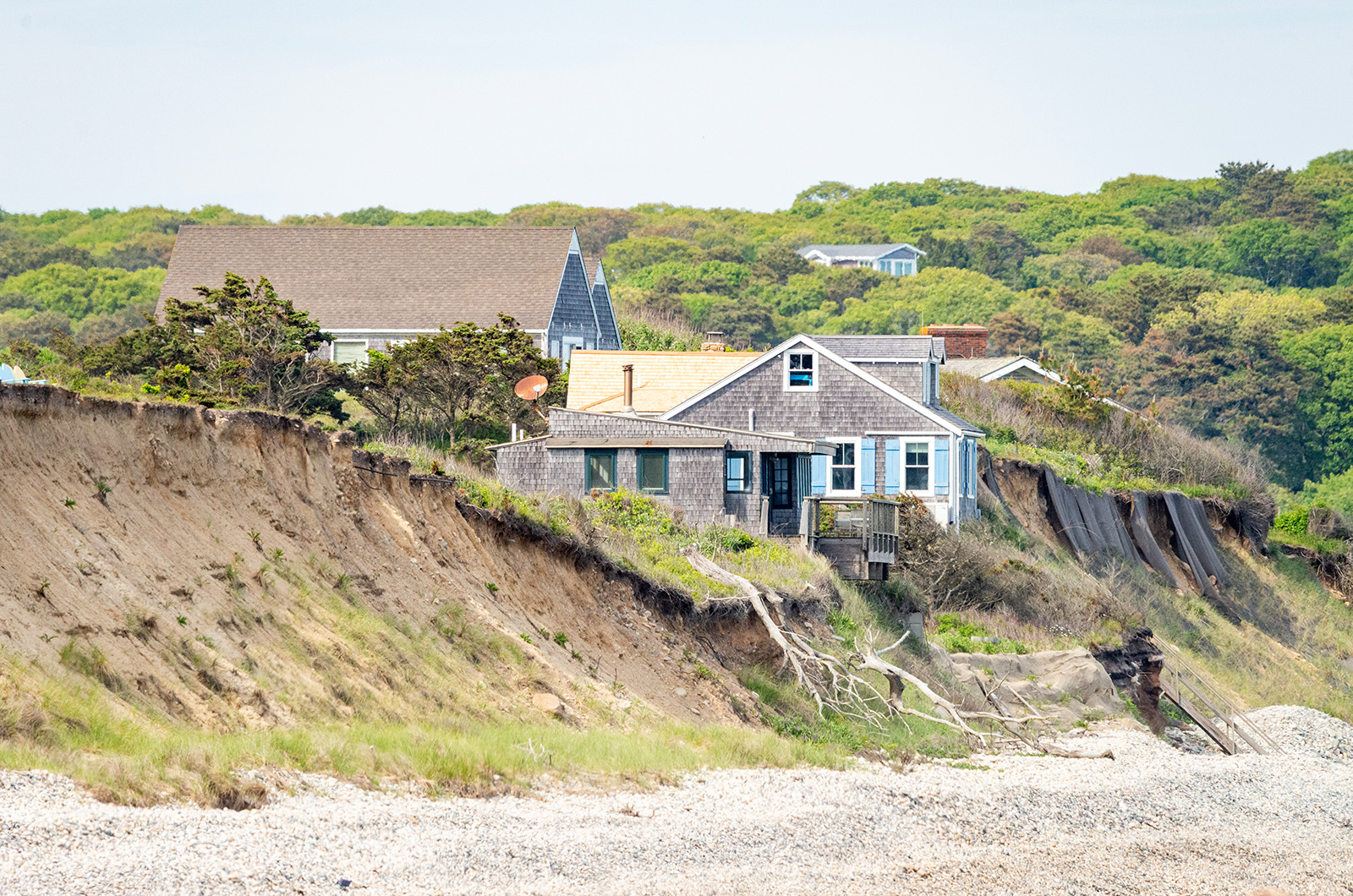
In an effort to keep their home from tumbling off its perch on an eroding bluff and onto Stonewall Beach, a pair of Chilmark homeowners are turning to a new tool: giant screws.
Paul and Jody Darrow have been working for years to protect their home from the encroaching coastline and their latest plan, pitched to the town conservation commission this spring, seeks to drive helical piles through the house floor and into the ground to temporarily stabilize the property as the dune is restored.
The hope is to safely secure the home long enough so the Darrows can develop a plan that is amendable to them and the numerous boards that would have to review a house relocation. The piles, which are shaped like large screws, would aid in that effort, according to the applicants.
“We want to take every reasonable measure to ensure absolute safety for our crew,” Bryan Collins, with the Sourati Engineering Group, wrote to the Chilmark conservation commission. “We analogize the helical piles to a police traffic detail for road construction as it is a measure taken above and beyond to ensure absolute safety for all involved.”
The proposal is the latest from homeowners on Greenhouse Lane to save their properties from Mother Nature. The Darrows’ situation, sitting less than two feet from the edge, is the most dire, but the idea of potentially putting piles into the bluff has some town officials worried.
Conservation commission chair Stephen Kass said last week that the town had spoken with the Massachusetts Department of Environmental Protection and expressed concerns about the purpose of the helical piles, how they relate to the shore protection and relocation plans, and how they would be installed and removed.
“DEP agreed with us,” he said at the commission’s June 18 meeting. “The staffer we spoke with [said] that the concerns we had raised about potential acceleration of bank destabilization were important and legitimate questions that we want to be able to answer before we act.”
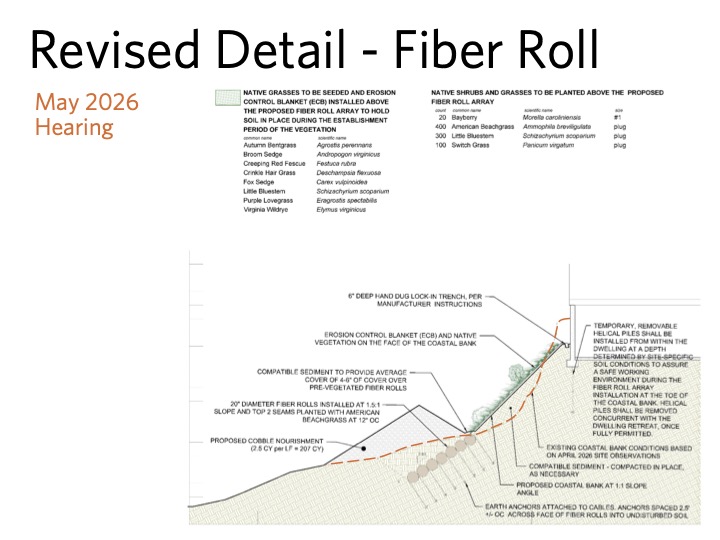
The plan would entail doing test borings to fully understand what is in the ground underneath the Darrows’ 1,400-square-foot home. The configuration, depth and other design details of the piles would be determined by what the tests unearth.
Preliminary plans estimated about 20 piles may be needed, with each one measured at three and a half feet in diameter.
The Darrows are also proposing to install seven, 85-foot-long fiber rolls along the beach area to beef up the dune, which currently drops off precipitously next to the home. A large blanket would be draped over top of the rolls to keep them in place, and native vegetation would be planted to establish an even firmer footing, according to the proposal.
The proposed dune work is similar to a previous plan that was approved by the conservation commission in April 2025. In that iteration, the Darrows and their two neighbors planned to do the dune restoration together, and each put forth a plan to move their homes.
The plan was controversial in town, and though it was approved, the homeowners appealed the decision to the DEP, arguing that the conservation commission overstepped its authority by imposing too strict limitations. The owner of 8 Greenhouse Lane, one of the three homes involved in the previous plan, also filed a lawsuit against the town in Dukes County Superior Court.
But since then, the two other neighbors have withdrawn their plans for the dune work, leaving just the Darrows and the stretch of sand and rocks in front of their home to be bolstered. Eight Greenhouse Lane owner Joel Greenberg received approval from the conservation commission earlier this month to ditch the dune restoration, and said that he would be withdrawing from the litigation.
“That’s always been the goal,” he said at the June 4 meeting.
The DEP also confirmed earlier this month that the appeals filed with the agency were on hold at the request of the property owners.
The conservation commission at its meeting last week wondered if the piles proposed for 18 Greenhouse Lane would destabilize the bluff even more, and hired a professor from the University of Oklahoma, who has extensively studied helical piles in the past, to advise the town.
The commission also wanted more assurances from the Darrows’ consultants that this work wouldn’t be a detriment to the area.
“I just think it needs to be a complete picture of the process with its potential implications,” said commissioner Joan Malkin. “I feel like it would be a hardship for our consultant to try and express a definitive opinion without looking at the sort of soup to nuts approach to it.”
The commission’s permitting process drew frustrations from Mr. Darrow at the June 18 meeting, and he questioned if commissioners were acting in good faith after one member asked about work he said had previously been approved.
“I’ve been holding my tongue down for over two years trying to get this done, and it’s so unfair, so unhuman, to treat a taxpayer and a member of this community like this,” Mr. Darrow said. “It’s unbelievable. No one can believe that this board is acting in good faith and that you’d prefer for this house to fall on the beach than help me protect it.”
Mr. Darrow said he had spent hundreds of thousands of dollars on experts to find a way forward for the home, and it would be $1 million worth of work for the beach restoration and the helical piles.
“I know you don’t care, because your singular thought is... to protect the environment, but you know what, if you don’t allow this, the environment is not going to be protected,” he said.
Mr. Kass said that while he understood the frustration, the commission was only doing its due diligence and needed to ensure that any project didn’t hurt the Chilmark environment. He also noted that the commission had previously approved a plan to relocate the house, but Mr. Darrow never went through with it and decided to appeal the decision.
Mr. Kass went on to ask Mr. Darrow if he believed he would be able to relocate the house within a year if the commission approved the piles.
Mr. Darrow’s attorney pointed out that the homeowner would need to come back for the relocation portion of the project because the latest order would replace the existing one.
The commission will resume the hearing on the Stonewall home on July 16.






Comments
Comment policy »