

The Trump administration is considering options to open up lucrative fishing grounds off the Vineyard coast that have been closed to scallopers for more than 30 years.
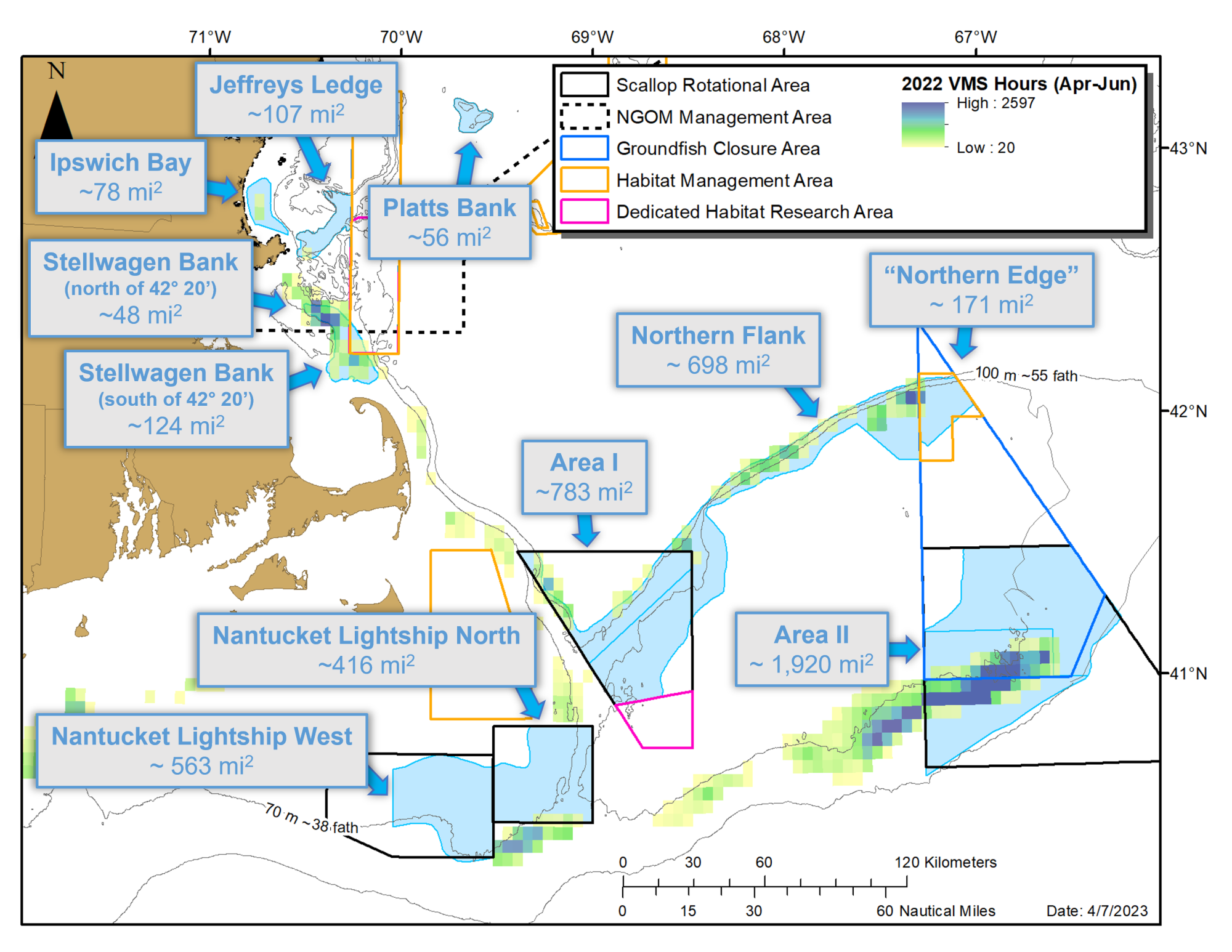
Earlier this month, President Donald Trump declared July 2 National Scallops Day to celebrate actions by the National Oceanic and Atmospheric Administration to open up the area of Georges Bank known as the Northern Edge to scalloping.
“That will mean millions more pounds of beautiful Wild Scallops a year on the kitchen table of Americans, and more jobs in Norfolk, Virginia, Cape May, New Jersey, New Bedford, Massachusetts, and essentially all parts of the East Coast,” the President wrote on social media.
The fishing grounds are about 120 miles away from Martha’s Vineyard and have been closed to commercial fishing since 1994. Regulators closed the area to preserve the spawning cod and other groundfish.
Despite the measures, the species have not rebounded, prompting scallopers in the region to argue that fishing wasn’t a direct cause. Fishermen have petitioned regulators to open the area to scalloping, one of the major catches in New England.
Islanders welcomed the proposal from the federal government.
“I’m deeply in support of these measures,” Menemsha fisherman Wes Brighton told the Gazette.
The captain of the 77-foot Martha Rose scalloping boat, Mr. Brighton has fished in other areas of Georges Bank in the past, and felt this could be helpful for fishermen in the region.
“The Northern Edge has been held hostage for far too long, on the principal rationale that its original closure was for groundfish preservation,” he said. “But if we take the agencies’ own stock assessments of groundfish at face value, groundfish stocks are still in collapse after 20 years of dramatically reduced fishing effort and closures like the Northern Edge. Both can’t be true.”
NOAA has asked the New England Fishery Management Council to consider establishing a controlled, rotational limited-access scallop fishery in the Northern Edge.
The council, a regional body that works to conserve and manage fisheries in the northeast, received a letter from NOAA assistant administrator Eugenio Pineiro-Soler in July with the request to allow fishing in the Northern Edge. Officials said it was an extension from an April 2025 executive order from the President, which called on freeing fisheries from overregulation.
Council spokesperson Alex Dunn said the council will consider the request through the council’s annual priority-setting process. For now, the area remains closed to fishing.
The council considered reopening the Northern Edge in 2024, but the idea never got off the ground for fear that fishing could harm other species.
“Identifying an appropriate time for an access program is challenging because scallop meat yields peak in June and July during an important season for juvenile cod settlement and egg-bearing lobsters on the bank,” the council said at the time.
There are about 170 square miles of productive fishing ground in the Northern Edge. For Mr. Brighton, the long-term closure means either the stock assessments have been inaccurate, or closed areas like the Northern Edge are not effective at rebuilding fish populations.
“The lifespan of a scallop is eight to nine years with the closure in place for over 20 years,” he said. “There have been up to 10 cohorts that have died from natural mortality in that closed area that could have economically supported our local fishing ports while harvesting sustainably.”
NOAA is also looking to rescind trip monitoring requirements, deprioritizing ropeless lobster trap requirements, and changing some of the scallop permit rules.
The Trump administration has made rescinding regulations made under prior presidential administrations a hallmark of President Trump’s second term.
In April, the President removed commercial fishing as one of the prohibited activities for the Northeast Canyons and Seamounts Marine National Monument. The nearly 5,000 square mile area to the southeast of the Vineyard was made the first marine national monument under President Barack Obama.





Comments
Comment policy »