
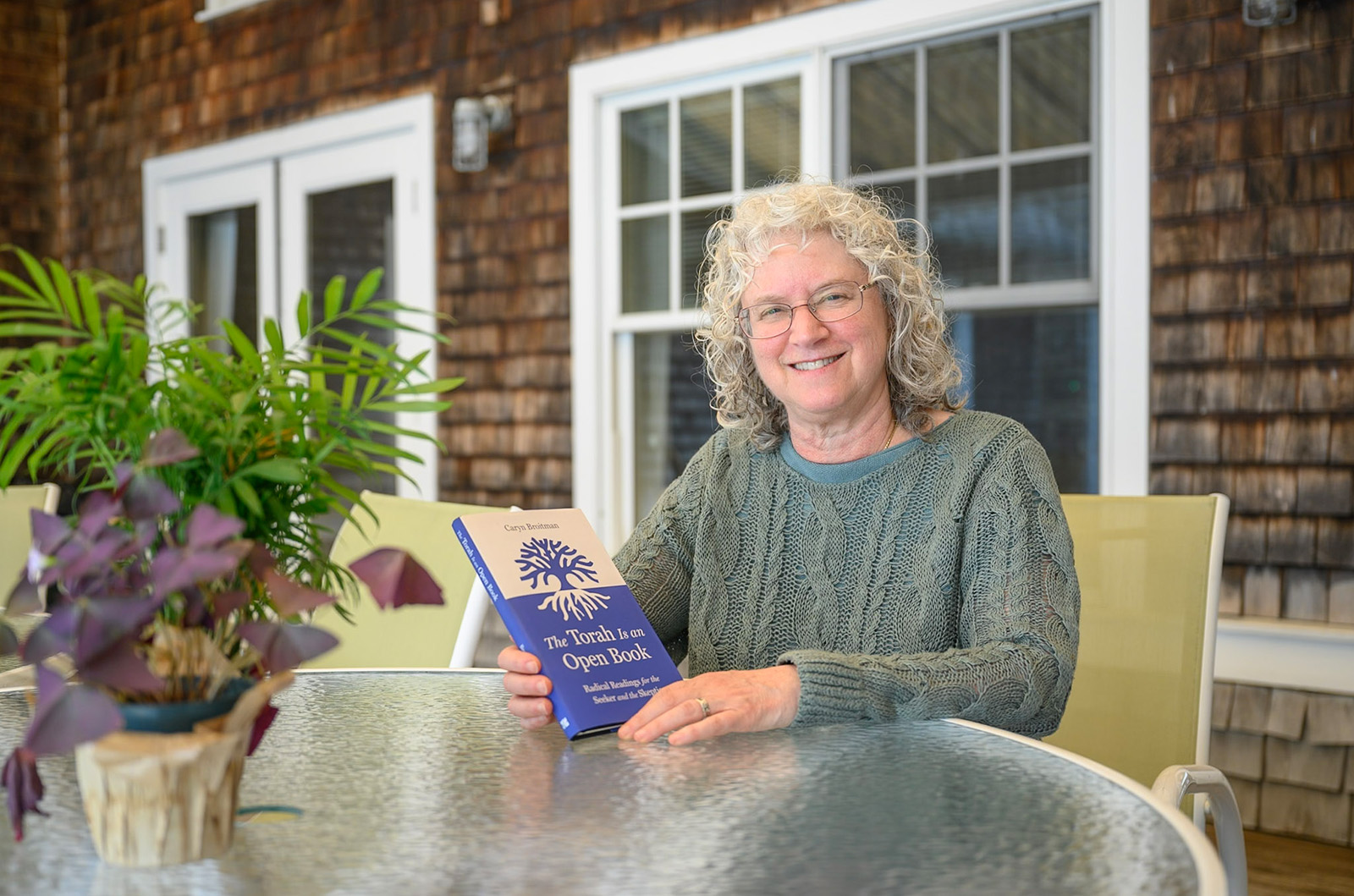
In 2022, Rabbi Caryn Broitman met an angel at the Tabernacle.
The Camp Meeting Association had asked Rabbi Broitman, the head rabbi at the Hebrew Center, to preach at one of its summer services at the Tabernacle. After the service, a woman wanted to have a deeper conversation about the sermon. She asked Rabbi Broitman, “Have you ever thought about writing a book?”
That woman was Adrian Ingram, now Rabbi Broitman’s editor and agent for her upcoming book, The Torah is an Open Book, which will be published in August.
“I just felt like she was an angel,” Rabbi Broitman said in a recent conversation with the Gazette.
Rabbi Broitman’s book encourages readers to read the Torah — the scroll that contains the first five books of the Hebrew Bible — in a radically interpretive way, a practice deeply ingrained in the Jewish tradition.
“It really means living with it, playing with it, reading it in very unconventional and radical ways, giving interpretations one after another that completely opposite could not coexist other than in conversations with each other,” said Rabbi Broitman. “That is the art of reading, interpreting Torah.”
Radically interpreting the Bible is an ancient practice in Jewish tradition. In certain compilations of the Hebrew bible, the text is printed in the middle and surrounded by concentric commentaries from different periods — the two are meant to be read together.
Much of Rabbi Broitman’s book relies on interpretations from the Talmud and Midrash, both collections of ancient rabbinic interpretations of Torah.
“The commentaries argue with each other,” said Rabbi Broitman. “I want to bring this kind of interpretive practice to people today.”
Rabbi Broitman has a lifelong interest in modernist literature: James Joyce, Virginia Woolf, Marcel Proust. There are layers of meaning to these authors’ novels, and every time she opens a page she finds some new insight.
“I know a lot of people who are really comfortable doing those layers of meaning with poetry or literature of any period, but when it comes to the Bible, they read it very literally,” Rabbi Broitman said.
Read literally, the Bible can be wielded to hurt, exclude and shame people, said Rabbi Broitman.
“People blame it on the Bible instead of saying no, I don’t agree with that reading,” she said.
Instead of stopping when they get to an offensive passage, people should “look deeper,” said Rabbi Broitman. She hopes they will then feel a sense of ownership where they may have felt alienation.
“It’s their inheritance as much as anybody else’s,” she said.
It’s not just the offensive sections that readers should wrestle with.
“Some parts of the Bible, without interpretation, are kind of boring. I mean, very detailed things about how to build the mishkan [tabernacle],” and lists of names over countless generations, Rabbi Broitman said.
But looking deeper over the course her book, Rabbi Broitman reveals equitable economic systems, criticism of systemic rejection of immigrants and foreigners, and understandings of God that are different than a man in the sky.
“That comes from the Torah itself,” she said.
While many people don’t connect with a traditional understanding of God, the Torah offers a different answer. It appears when Moses asks God, “What is your name?”
“I will be what I will be,” Rabbi Broitman quoted. “I mean, talk about radical. God is not offering a name but a phrase, a verb, an idea of a flow of being.”
Rabbi Broitman has been reading and teaching Torah since she was 20, and has been at the Hebrew Center for 23 years. On Shabbat mornings, she gives a “d’var Torah” instead of a sermon. Literally translated as a “word of Torah,” her interpretations spark conversation among the congregation.
“We all learn from each other,” she said. “I’ve always been inspired by that.”
Rabbi Broitman said her book is for an interfaith audience: readers should be empowered to take the same creative, interpretive liberties with the New Testament and the Quran.
The same goes for reading the Constitution.
“If the Constitution is important, it needs to be reinterpreted, evolved, renewed, amended,” she said. “That’s what a sacred text is about.”
Rabbi Broitman will celebrate the launch of her book on August 2 at 7:30 p.m. at the Hebrew Center, in conversation with Rev. Cathlin Baker, followed by a reception.



Comments
Comment policy »