

The Steamship Authority is looking at ways to steer through economic headwinds, as revenue has fallen off in the first half of 2026 and new tariffs add hefty sums to maintenance expenses.
At the ferry line’s board meeting in Hyannis Tuesday, officials said a budget crunch is likely, citing dips in the number of passengers and lower revenue from vehicle traffic and parking.
At the same time, steel and fuel prices are climbing, tariffs are hiking equipment costs and the ratio between full-fare vehicle tickets and Islanders’ excursion rates is tipping heavily towards the subsidized fares.
“We’re making less money on revenue, because the tickets that are increasing in quantity are the ones where we lose money on every one,” said Ted Gavin, the Vineyard’s representative on the Steamship Authority governing board.
To help steady the Steamship, treasurer/comptroller Mark Rozum has suggested a monthly cap on the number of times Islanders can use the excursion fares, which require proof of Island residence and registration.
Last year, excursion-rate automobile drivers paid less than a third — 27.3 per cent — of the actual cost of ferrying their vehicles and passengers to and from the Islands, according to a cost-of-service report from the Steamship Authority.
Standard-fare automobiles, by comparison, covered an average 155.5 per cent of their service cost.
The total number of car and truck excursion trips for 2025, in each direction, was 210,000 for the Vineyard route and another 35,000 for Nantucket, Mr. Rozum told the Steamship board and staff.
That equals 105,000 round-trip excursions from the Vineyard to the mainland, averaging 8,750 round-trip excursions a month in 2025 for a year-round population estimated at 20,500.
In past meetings, Mr. Rozum has told the board that while most excursion program members use the low rates about twice a month year-round, a small percentage are each making hundreds of subsidized trips a year.
The excursion program was designed for Islanders to reach medical appointments and other necessary mainland destinations, not for what appears in many cases to be business use, Mr. Rozum has said.
And the numbers continue to rise. Excursion program members made 534 more one-way trips this June than they did in June of 2025 — a 3.6 per cent increase for cars and a 2.6 per cent increase for trucks, according to the Steamship Authority’s monthly business report.
At the same time, standard-fare trips fell by 4 per cent for autos and 2.6 per cent for trucks over 20 feet long.
For 2026, the board approved an excursion fare increase of $2.75 in each direction. On Tuesday, Mr. Gavin asked about the financial impact of hiking the rate again.
Mr. Rozum said an additional $5 increase each way would save $1 million for the Authority, and another $1 million could be recouped by limiting the number of excursion fares a driver can purchase.
The Steamship Authority’s next reservation system, which is now being tested, is capable of charging program members the standard rate after two round-trip excursions a month, Mr. Rozum said.
“The number I came up with is about $1 million that would be potentially gained [by] changing it from an excursion fare to a standard fare, where you limit it to twice a month,” Mr. Rozum said.
Passenger trips are also down this year, and early August has shown little improvement, Mr. Rozum said.
“I just got the [first week’s] data this morning, and the stats were pretty much flat,” he said.
Parking revenue has fallen, too, with the number of cars parked at the Steamship Authority’s Cape Cod lots down by 6.1 percent in June and 12.5 per cent for the first six months of the year.
Ferry bookings for September are looking stronger, according to the business report, which shows a 6.7 per cent increase in reservations over 2025.
“But we are down in the summer months... and this will have an impact on the budget,” Mr. Rozum said.
Along with flat or declining revenues, the Steamship Authority also faces rising costs, Mr. Rozum said.
“Fuel is going to be a significant expense that we’re going to have to cope with, along with some pricing pressure on the maintenance side,” he said.
U.S. tariffs are imposing steep additional costs on ferry repairs: Customs, duties and taxes on parts and equipment made overseas have added more than $81,000 to the routine dry-docking of M/V Barnstable, according to a summary from engineering and maintenance director Zachary Lawrence.
Robert Jones, longtime representative for Barnstable on the Steamship Authority board, said the gloomy business report is nothing new for the authority, which operates in the red for most of the year.
“I don’t see anything different than has happened, you know, for the last 20 years,” Mr. Jones said.
“We turn the corner in August, and we always look at ups and downs and things like that... until the budget is established,” he said.
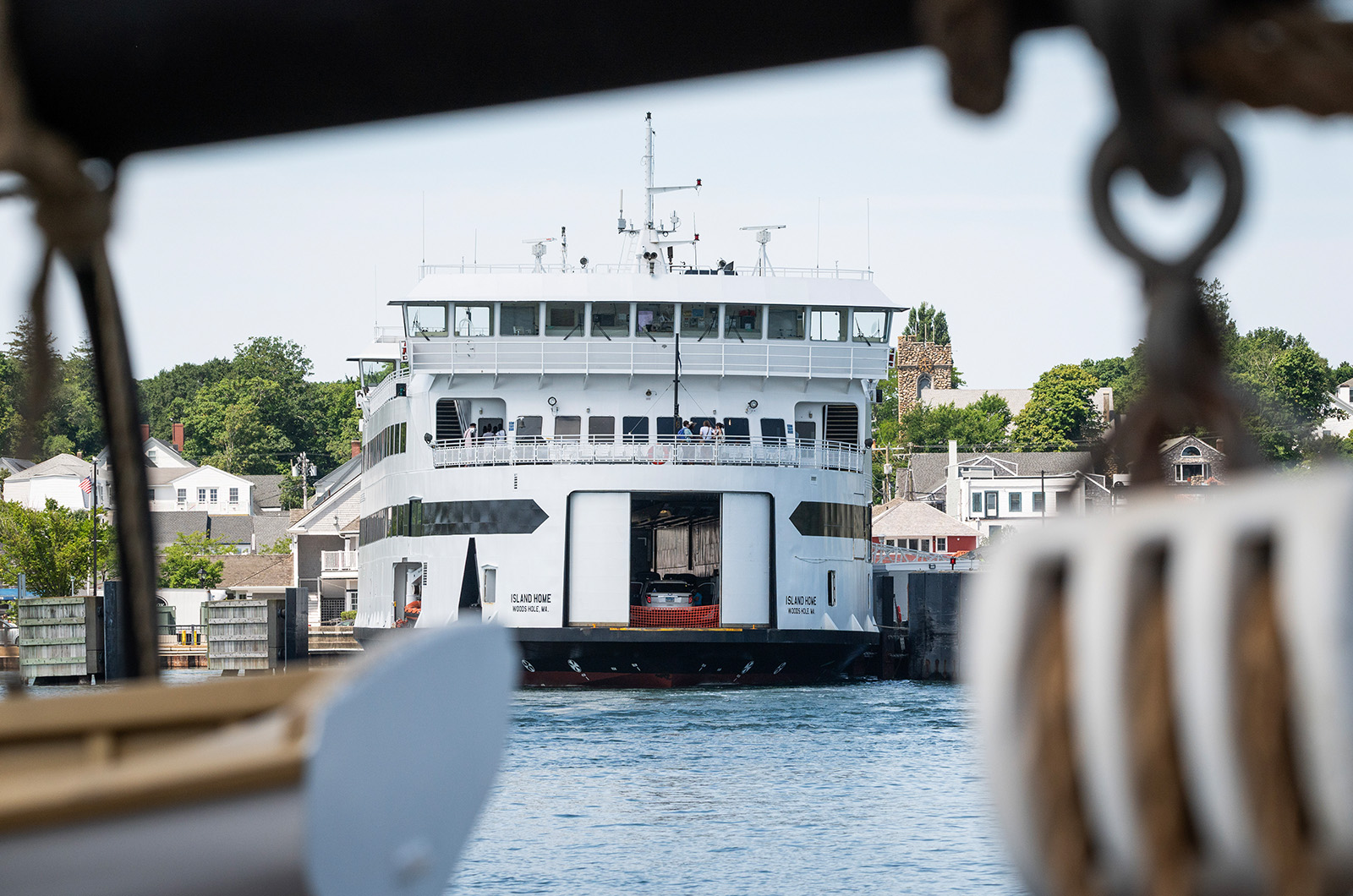
In other business Tuesday, the Steamship Authority board learned of a delay in fueling the M/V Island Home with the manufactured diesel known as RD-99.
The board voted last month to resume using the costlier, but lower-emission fuel for the Island Home’s engines, which currently emit visible smoke when powering up.
A recent train derailment in Worcester held up the fuel’s delivery, chief operating officer Mark Amundsen said, but it was on its way.
“We’re looking at the 21st [for] our first day of RD-99,” he said.
Also Tuesday, general manager Alex Kryska reported that it is likely to be another month or two before the now-vacated temporary terminal building in Woods Hole will be ready to be removed or demolished, because the authority is still removing computer lines.
The boat line then will solicit bids to clear the building site, which is destined to become a short-term parking area patrolled by Falmouth police.
Mr. Kryska said the town’s police chief asked him to install 15-minute parking signs because the current short-term area is being abused by rideshare drivers.
“[Police will be] enforcing that because they’ve seen it firsthand, that we have rideshare guys just sitting there all day long,” Mr. Kryska said.
“There’s one gentleman that parks there and actually coordinates all the other rideshares too, [and] their goal is to get rid of that guy,” he said.
Falmouth police also asked the Steamship Authority to add signage reminding motorists not to run the Railroad avenue stop sign when driving off the boats, Mr. Kryska said.
“By law, you’re supposed to yield to traffic that’s already on the road. But we’re finding that a lot of people kind of just do a rolling stop through there, so we’ve got to do what we can to make sure they stop and respect the traffic that’s already coming off Luscombe,” he said.



Comments
Comment policy »