
Last October, when flying home from Boston after my summer of farming on the Island, my bag got stopped at security.
Oh no, I thought. They’ve found me out.
The TSA officials unzipped my small duffel bag, already bursting at the seams, and proceeded to extract seven different types of squash: delicata, butternut, acorn, candy roaster, Long Island cheese, sugar pumpkin and a mini gourd.
I named each one out loud as the TSA agents pulled them out of my bag. We had a laugh, and my squash was cleared to travel home with me to Chicago.
Squash comes sooner than you would expect. It’s ready to harvest in late August and early September, although many varieties need to cure for a few weeks for their starches to turn to sugars. When I worked at Morning Glory Farm, we were harvesting giant orange pumpkins while the days were still long and the leaves had not yet begun to turn. Time felt out of joint.
When we started squash, I had already been working in the field crew for three months. I was exhausted. This has happened to me before while farming for a few months, a product of mostly seasonal allergies and the intense, outdoor physical labor that farming requires. Certain programs can help with this. Last year, the Agricultural Society received a grant from the Massachusetts Department of Agriculture to support the well-being of Island farmers.
I am certainly not the first fieldworker to experience this intense exhaustion, and I give enormous credit to farmers for the job that they do, season after season, putting in 12, 14, 16 hour days. Fall is a hard time of year. Energy is waning, labor is lean and the fields have definitely not slowed down.
And right around the time I was struggling to move as much produce as I normally could, in came the squash.
Farming seems so intuitive, doesn’t it? Plant seed in ground. Water seed. Seed grows into plant. Pick plant, eat plant. Hurray!
Actually, it’s much more complicated than that. It doesn’t feel like it, because food and farming are such givens in our day-to-day lives. But do you know which crops we seed directly into the ground, and which we nurture in the greenhouse first? Do you know how many kinds of irrigation we use to water the crops? Do you know how we harvest squash?
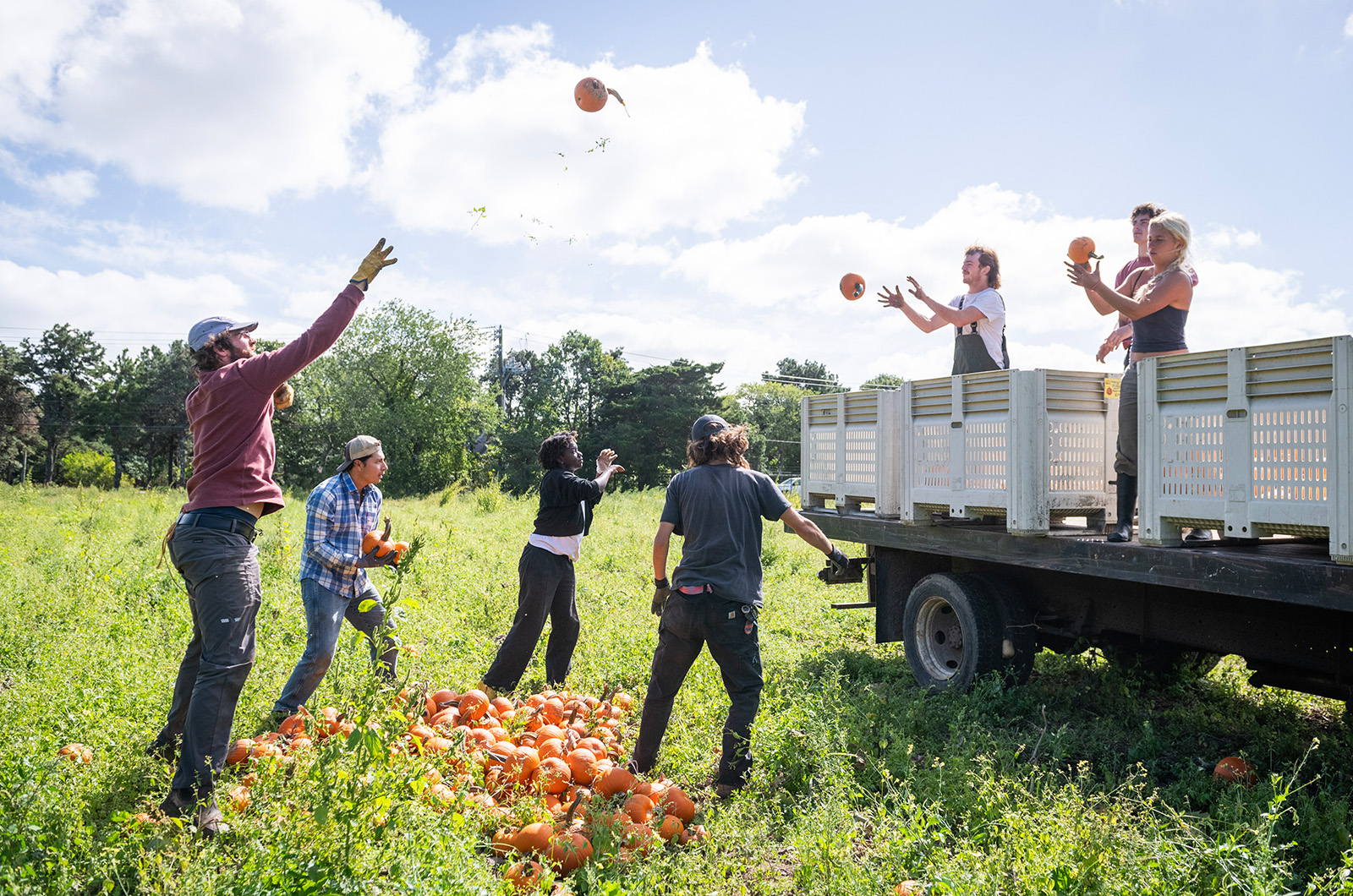
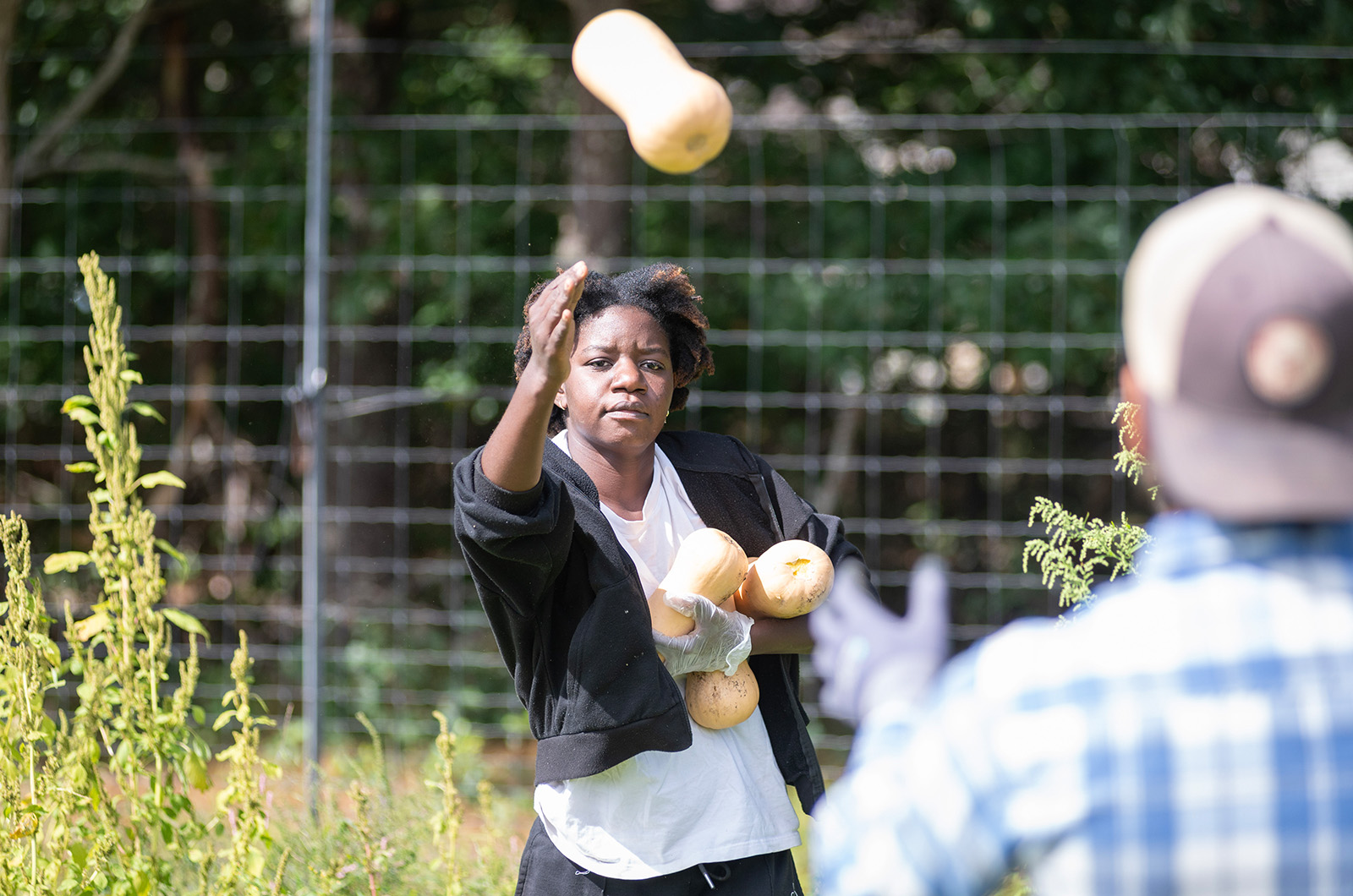
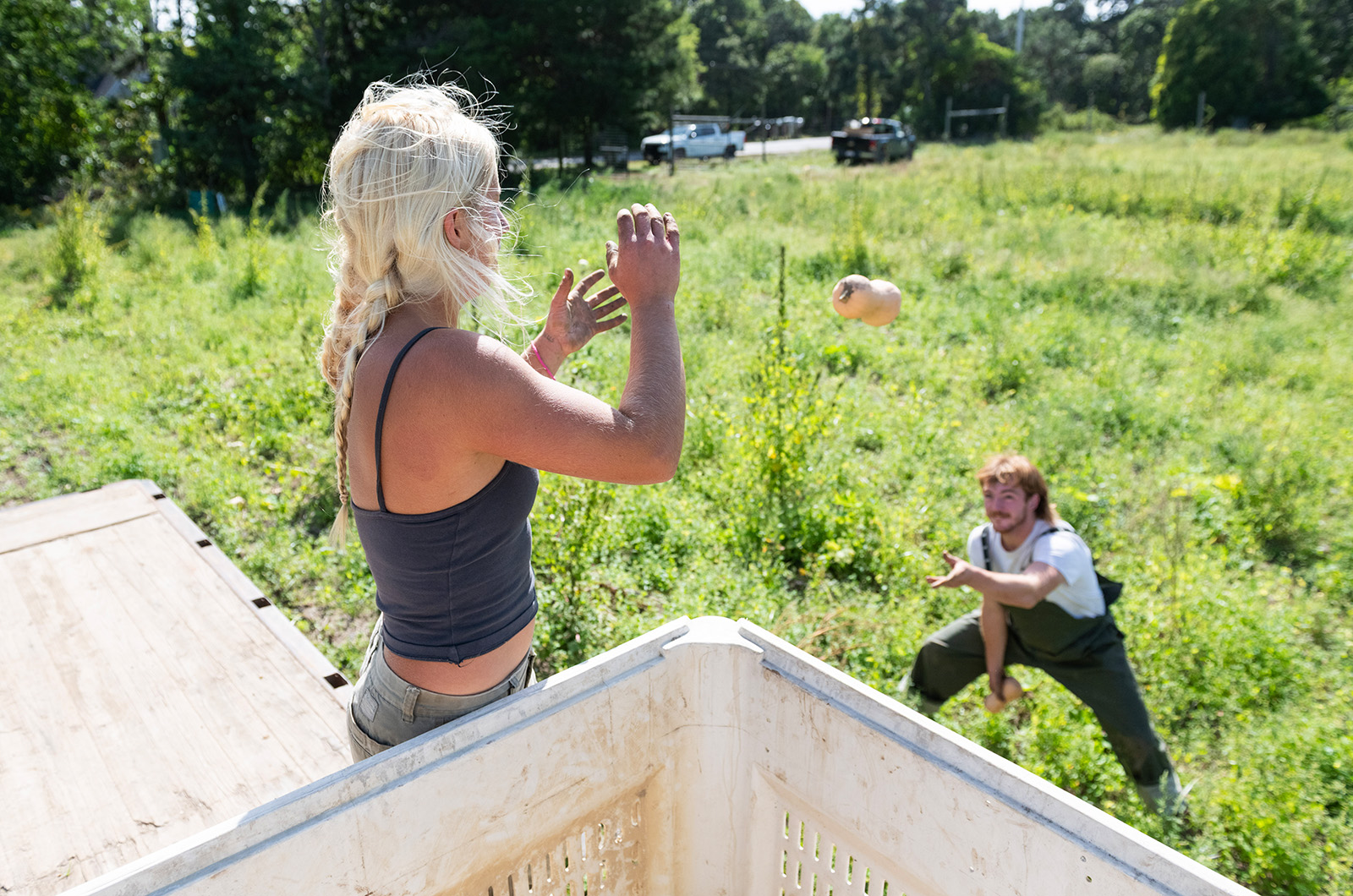
I’ll answer that third question with a lesson in butternut. We load up the big macro bins onto our flatbed truck and drive out to the fields. We locate a squash and using the heels of our feet or hands, knock off the entire stem. We make piles of a couple dozen on the field, and then stand in a line. The whole team is here, and there is an energy that you don’t find with a solitary arugula or partner carrot harvest. Instead, a chain toss begins to get the squash up to the truck, where hands are waiting to catch it.
There’s something about chucking a four-pound squash to another person, and then turning to catch the next one being hurled at your face. It’s like a game or a sport; you get to flirt with gravity and bring in a harvest, too. It’s a delightful break from the bent over picking or on-the-knees weeding. It arrives just in time to grab the collar of late-summer burnout, which threatens all our well-beings.
Not yet, says the squash.
Pumpkins are even more fun. Same idea as squash, but with garden sheers or loppers to cut the thick stem. Pumpkins can also weigh much more than squash, and then it’s a test of your strength, accuracy and communication. During my final day at Morning Glory Farm last year, there were two of us on the truck catching, and two on the ground, tossing up pale blue and pale orange pumpkins that we had hunted for through the tall weeds. Once we finished tossing up a pile, someone would move the truck down the row, and we’d start on the next one.
Farming is not easy, nor is it necessarily intuitive. Being only a field hand with no planning, management or tractor responsibilities still requires instruction, mentorship and an onsite learning curve to truly understand how to nurture and harvest a crop successfully. Then, once you’ve figured it out, there’s the repetition and the work that takes a toll.
But then the season changes, and the next crop comes, and there are new joys and challenges. A late summer-fruit (we gorged ourselves on watermelon all of August), a potato harvest in the pouring rain (a nightmare or an adventure, depending on how you look at it), a mass harvest of cabbage before a frost, ripping up whole tomato plants to clear a space for winter greens.
It’s what so many farmers love about what they do, this inevitable progression of the season despite its grind, gruel and intensity. The quiet and planning of winter, the excitement of spring. The bursting, new energy of early summer. And then squash, that beckons in the field, right when you need it most.
Come play, it says. This is a team sport. I promise it will be fun.





Comments
Comment policy »