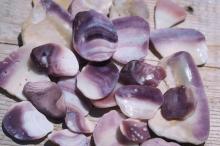
The Martha's Vineyard Shellfish Group is undertaking a years-long project to determine why and how quahaugs develop purple on the inside of their shells — and why that purple may be disappearing from the Vineyard’s waters.
In this week's 10-minute wrap-up of the news from the Vineyard Gazette newsroom, quahogs on the Island have a purple shell that’s prized for jewelry making, but in the last couple of decades the shellfish are losing their purple pigment. And a reading from a famous Frederick Douglass speech.
A record quahaug spawn at the Martha’s Vineyard Shellfish Group comes as a boon to Island towns this year where saltwater ponds are seeded annually as part of shellfish management programs.
The next time you sit down to a steaming bowl of clam chowder, consider this: your meal may be older then you are. Much, much older.
Indeed ocean quahaugs, often used in chowder, are probably the longest-lived animals on the planet. Earlier this year, researchers dredged up a 405-year-old quahaug from the frigid waters off Iceland. They did not eat it.
Isaiah Scheffer is hopeful about the future for those who love to go bay scalloping, oystering and quahaugging in Chilmark. Recent successes in all three fisheries may be due to Mother Nature, but another key ingredient is some labor-intensive, progressive shellfish restoration work. Mr. Scheffer recently gave a talk and slideshow at the Chilmark Free Public Library about that ongoing work.
When the former Massachusetts State Lobster Hatchery in Oak Bluffs was renamed the John T. Hughes Hatchery and Research Center this spring, it also got a change in purpose. The benefits of that shift are already being released in local coastal ponds.
Through the efforts of a crew from the Martha’s Vineyard Shellfish Group, the hatchery has worked as a nursery for the raising of millions of tiny baby quahaugs. Rick Karney, director of the group, said that he and his staff have been turning over the quahaugs to local shellfish constables.