
It’s a normal day in April at the solar hatchery in Oak Bluffs. Algae in different shades of green gurgles in massive tubes along the windows, restoration coordinator Alley McConnell kills infiltrated ticks downstairs, and the Martha’s Vineyard Shellfish Group is spawning quahaugs. They do this multiple times a year, priming two dozen Vineyard quahaugs to release eggs and sperm that will become the baby shellfish they plant back in the ponds.
Director emeritus Rick Karney’s fertility totems watch from the window ledge as hatchery manager Chris Edwards flushes the bottoms of 12 Pyrex dishes with warm water, mimicking the tidal floes of quahaugs’ natural habitat. This is normal, and so are the reproduction jokes the shellfish group makes, and so is the excitement when one quahaug starts to shoot sperm into the dish, turning the water cloudy and white.
What is not normal: All of these quahaugs, on the inside of their shells, are white.
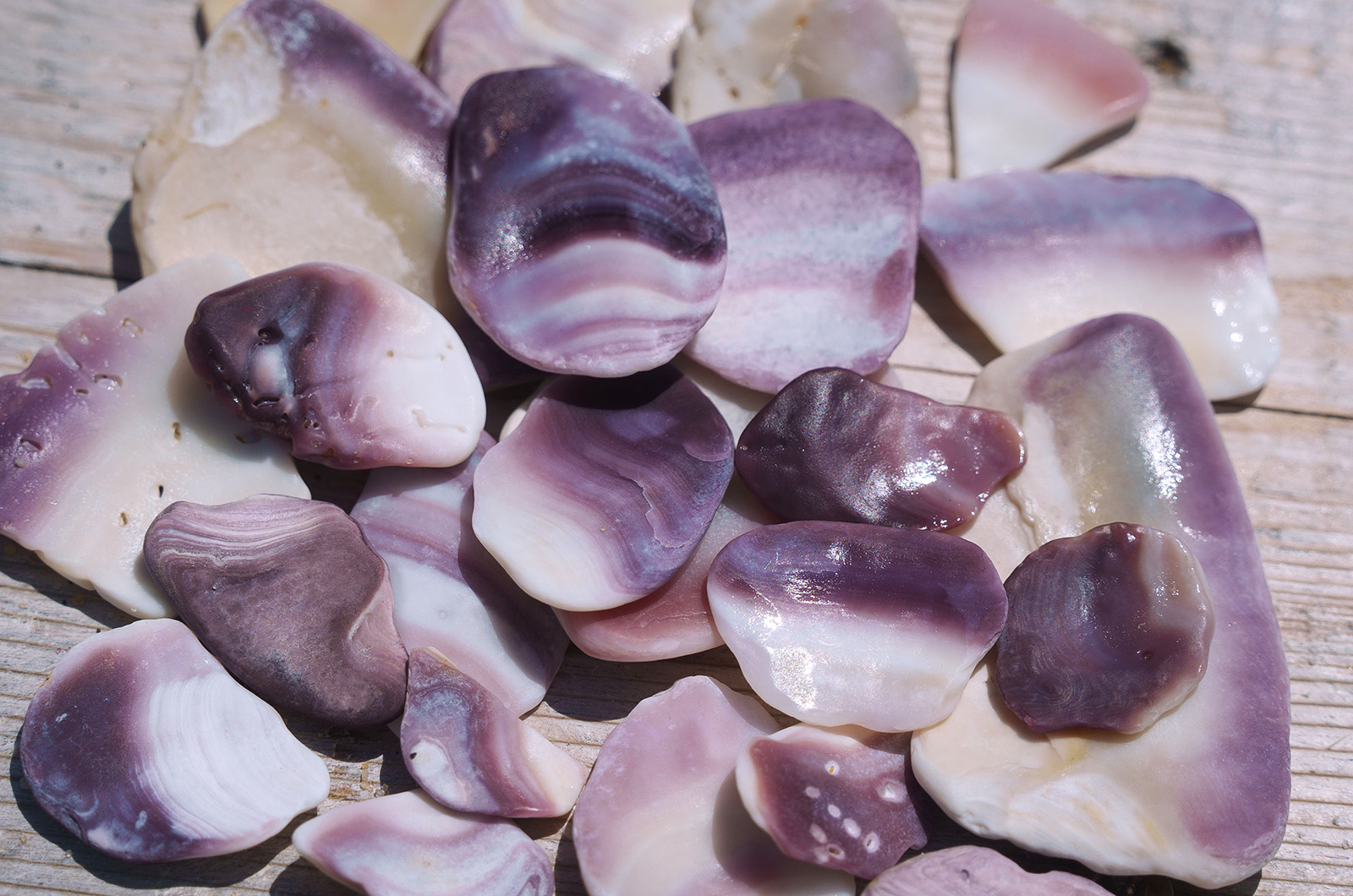
A few weeks after this spawn, the shellfish group did the same with a group of all-purple quahaugs. Spawning quahaugs is part of the shellfish group’s normal activities, but the separation of color is not. It’s the beginning of a years-long project to determine why and how the shellfish develop purple on the inside of their shells — and why that purple may be disappearing from the Vineyard’s waters.

“This project, it was born out of conversations that we started having about the...feeling that there’s less purple in quahaug shells,” said Emma Green-Beach, director of the shellfish group. “It’s not just on the Island, it’s all over. And [people are] blaming it on hatchery reared quahaugs.”
For Wampanoag tribes across the east coast, the purple shell is not just a nice touch, it’s an essential part of their history and culture. The purple shell is used for wampum, the traditional purple bead used in Wampanoag jewelry and belts, and intricately beaded pictographs commemorating special events. Today, the wrists, necks and earlobes of many Islanders — especially Wampanoag people — are adorned with the jewelry, originating in the purple-shelled quahaugs from the Island’s waters. Other jewelry makers may use the shells in their work, but it can only be called wampum if it is crafted by a Wampanoag artist.
“We want to be able to preserve this really important and unique artifact,” said Ms. Green-Beach. “It’s a characteristic of a living culture.”
The project to preserve the purple could take years of feeling around in the scientific dark for answers. It is currently taking the shape of genetic experiments — beginning with a spawn of all white and all purple quahaugs — and an environmental survey of the Island’s estuaries to help determine where the purple appears most frequently.
The project is funded by Sustainable Agriculture Research and Education and the Aquinnah community preservation committee, which raised funding at Aquinnah’s annual town meeting in May.
The shellfish group is not the first to ask about the purple in quahaugs. Independent researchers have explored the question, taking chemical and observational approaches that the shellfish group will build upon in their research.
But they are starting with genetics, and that means determining what color a quahaug is on the inside of its shell without killing it.
“It’s hilarious, we spent a lot of time guessing and then opening them, and eating them, and quizzing ourselves,” said Ms. Green-Beach.
There are other methods of determining how much purple a bivalve’s shell has, like shaving down part of the outer shell to reveal the color underneath, or plunging the quahaug in an Epsom salt bath and wedging it open just enough to take a peek.
Once each group is spawned, the seed will be planted in different spots to help determine to what extent it’s purple — or its potential to develop purple — is genetic.
“This really basic, common garden experiment will help tweeze out how much of it is environmental and how much of it is genetics, because we don’t know,” said Ms. Green-Beach.
But in the nature versus nurture conversation, others who have asked the same questions think the “purple gene” doesn’t exist — or it is more complicated than that.
Dale Leavitt, a former aquaculture extension agent and a current oyster farmer, said he doesn’t think the shellfish group’s genetic experiment will amount to significant results.
“I don’t think they’re going to find a genetic component to this,” he said. “I think it’s strictly a metabolic result...and it’s probably related to age,” said Mr. Leavitt, also a former marine biology professor at Roger Williams University.
From Mr. Leavitt’s anecdotal observations, the most purple appears in quahaugs that are both old and slow-growing, developing their shell at a slower pace than a white quahaug.
That makes sense, Ms. Green-Beach agreed, when considering the type of quahaugs selected for the commercial fishery.
“We want to be breeding for both restoration and for commercial production,” she said. “The things that we do inadvertently select for the animals that grow faster.”
Berta Giles Welch, a contemporary wampum artist and board president of the Aquinnah Cultural Center, has opened enough quahaugs in her life to know from a simple shell inspection if a quahaug will have purple. It’s a matter of their size and the shape of what Ms. Welch calls the lips, or the edge of the quahaug. A thinner, paler lip indicates that a non-native quahaug was introduced to the ponds.
“We are so fortunate with our Gay Head pond...we have an abundance of very strong purple quahaugs,” she said. “That could change, particularly if this white quahaug keeps on being introduced there. That is our concern.”
In its early years, the shellfish group brought in off-Island quahaug seed and broodstock, selected from animals that grew to full size in three to five years. The notata quahaug, which has a zigzag pattern on its outside shell, is one of those quickly-growing, purple-lacking quahaugs.
The organization’s efforts produced a higher incidence of notatas in Island waters than would occur naturally. That’s good news for the commercial fishery, which is replenished more quickly when quahaugs grow faster, meaning better harvests. But it also might mean less purple.
“So if it is the slow growers that produce the purple, then we might be planting things that grow faster and the slow growers might be at a disadvantage,” said Ms. Green-Beach.
Now that the shellfish group’s quahaugs are spawned, they will dissect the shells, measuring their size and the amount of purple in each shell. Then they will determine the age of the mollusk, slicing through the shell to count its growth rings and potentially draw a connection between age, growth rate and the amount of purple.
The same mechanisms are at play in a quahaug farm, such as the Mashpee Wampanoag Tribe’s location in Shoestring Bay. In 2011, the tribe asked Mr. Leavitt to look into the possibility of growing quahaugs with a deep purple in their shell.
Mr. Leavitt enlisted an undergraduate student, Jesse Farruggella, to determine what the purple actually is. After multiple tests to pinpoint the purple’s chemical composition came back inconclusive, Mr. Farruggella performed Raman spectroscopy on both purple and white quahaug shells.
Raman spectroscopy is a type of chemical analysis that measures how light interacts with a sample, producing a fingerprint of its chemical composition. While the white shells turned out to be just calcium carbonate, the tests indicated the purple shells contained something else: a class of pigment molecules called polyene, which is an antifungal agent.
“So that starts to imply that the quahaugs make the purple...to protect themselves in response to a marine fungal load,” said Ms. Green-Beach.
Anecdotal observations support that hypothesis, said Ms. Green-Beach. She follows a Facebook group called “All things clamming,” where Islanders and New Englanders note that the most purple quahaugs come from the “funky backwater parts of the estuaries.” In oceanic-facing habitat, there tends to be fewer quahaugs with purple.
“Pigments, in nature, are very expensive,” she added. “Birds aren’t colorful just for funsies. The males get to be colorful so they can attract mates....Chances are [quahaugs are] not making purple for no reason.”
As part of its ongoing research, the shellfish group will plant the white and purple seed in various places across the Island and New England and test for marine fungus, trying to determine the interactions between genetics and environment. But it could be years before results start trickling in.
“A little neck is easily three to five years old,” said Ms. Green-Beach. “And the quahaugs that you see on a really amazing necklace have probably come from a really old quahaug. So that’s why this project is going to take a lot of perseverance.”
But the persistence is worth it.
“It’s...erasing a part of history if you don’t acknowledge it and continue with it,” said Ms. Welch.
For Divya Randolph, a rising junior at the Martha’s Vineyard Regional High School and a member of the Wampanoag Tribe of Gay Head (Aquinnah), wampum is a symbol of her identity. She wears a wampum bracelet on her right hand, the hand she greets people with.
Last year, Ms. Randolph did her science fair project on quahaug coloration, poking into the same questions the shellfish group is considering. The purple must be preserved not only for its cultural significance, but as a contemporary way for Native people to support themselves in a place where Wampanoag people are frequently priced out, she said.
“The displacement of our tribal members to the mainland is so common that this is one sure way where people will pay money to have a Wampanoag-made wampum bracelet or necklace,” said Ms. Randolph. “It’s a means of survival.”




Comments (12)
Comments
Comment policy »