
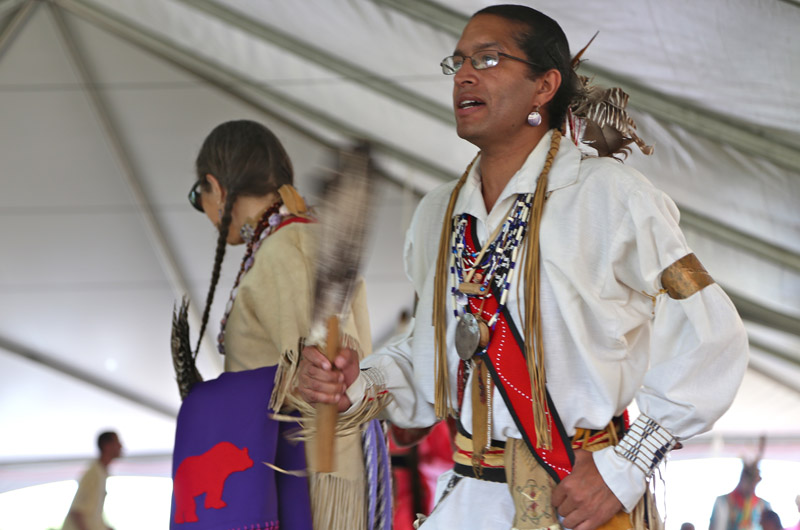
Tobias Vanderhoop is a lifelong Boston sports fan. A member of the Wampanoag Tribe of Gay Head (Aquinnah), he was born and raised in Everett, north of Boston, and still remembers the heartbreak all Red Sox fans experienced during the 1986 World Series defeat to the New York Mets.
Since then, he has cherished seeing the team break the curse of the Great Bambino and win several championships.
So, when he was invited to sing the Wampanoag tribal honor song at the Native American and American Indian Celebration during the opening ceremony of the Red Sox game against the Arizona Diamondbacks on August 19, he was delighted to accept the invitation.
“I am deeply honored to have been asked to offer a song on behalf of our people,” he said. “The most important thing that should come out of it is: we are still here.”
The Wampanoag Tribe of Gay Head (Aquinnah) will have a delegation of 30 to 40 tribal members joining Mr. Vanderhoop to participate in the day’s observation of Indigenous people at Fenway Park. They will be joined by members from other tribes across New England.
“The Red Sox organization is really good about acknowledging different heritages,” said Mr. Vanderhoop. “The fact that they have a Native American Day every year and they’ve been doing it for several years feels good to us because this is our homeland.”
Mr. Vanderhoop served as the chair of the tribal council from 2014 to 2017 and is current the council secretary. He is often at events performing, and has sung with the Black Brook Singers. He has also served as the director of the Wôpanâak Language Reclamation Project, a nonprofit organization dedicated to preserving and restoring the cultural heritage of the Wôpanâak language.
For Mr. Vanderhoop, preserving the tribe’s language, whether it’s written, spoken or sung, is critical.
“[Language] helps you understand why you should be connected to the land that you come from, what the world around you is about for your own people,” said Mr. Vanderhoop. “When you understand how to be respectful of the things that are all around you, then you understand how to be connected to your homeland.”
Wôpanâak has had a revival in recent decades after being nearly wiped out.
In 1678, after an armed conflict known as King Phillip’s War, during which the Wampanoag sachem Metacom led a failed rebellion against English colonists, the Wampanoag people and the Wôpanâak language were under threat of extinction.
In the early 1990s, hundreds of years after the conflict, there was an effort led by Jessie “Little Doe” Baird to teach others about the language of the Wampanoag people. She met with Helen Vanderhoop-Manning and together they proposed an idea to the community to start teaching the next generation the language of the Island’s first people.
In addition to founding the Wôpanâak Language Reclamation Project, Ms. Baird produced a 10,000-word Wampanoag-English dictionary and received a MacArthur Fellows Genius Grant of $500,000 to continue efforts to preserve the Wôpanâak language.
“Through her efforts and through the efforts of many other teachers that have been students of hers who have been willing to make that contribution to ensure that it grows and continues, we are fortunate enough to be able to speak it today,” said Mr. Vanderhoop.
Often Mr. Vanderhoop sings or says a prayer during community events. Recently, he sang at this year’s Native Artisans Market & Festival. He also recited a prayer before a meeting between members of the tribal council and the Aquinnah select board in June.
“The thing that feels the most amazing to me is that when I was a boy, we had words and phrases,” said Mr. Vanderhoop. “We couldn’t speak the way that our ancestors could understand us, but today we can.”
In addition to the pregame festivities, the Red Sox will offer fans a jersey designed by Sage Carbone, a member of Northern Narragansett and Mi’kmaq tribes, that says ‘Still Here’ on the back.
Tickets for the August 19 game are available on the Red Sox website.






Comments (2)
Comments
Comment policy »