
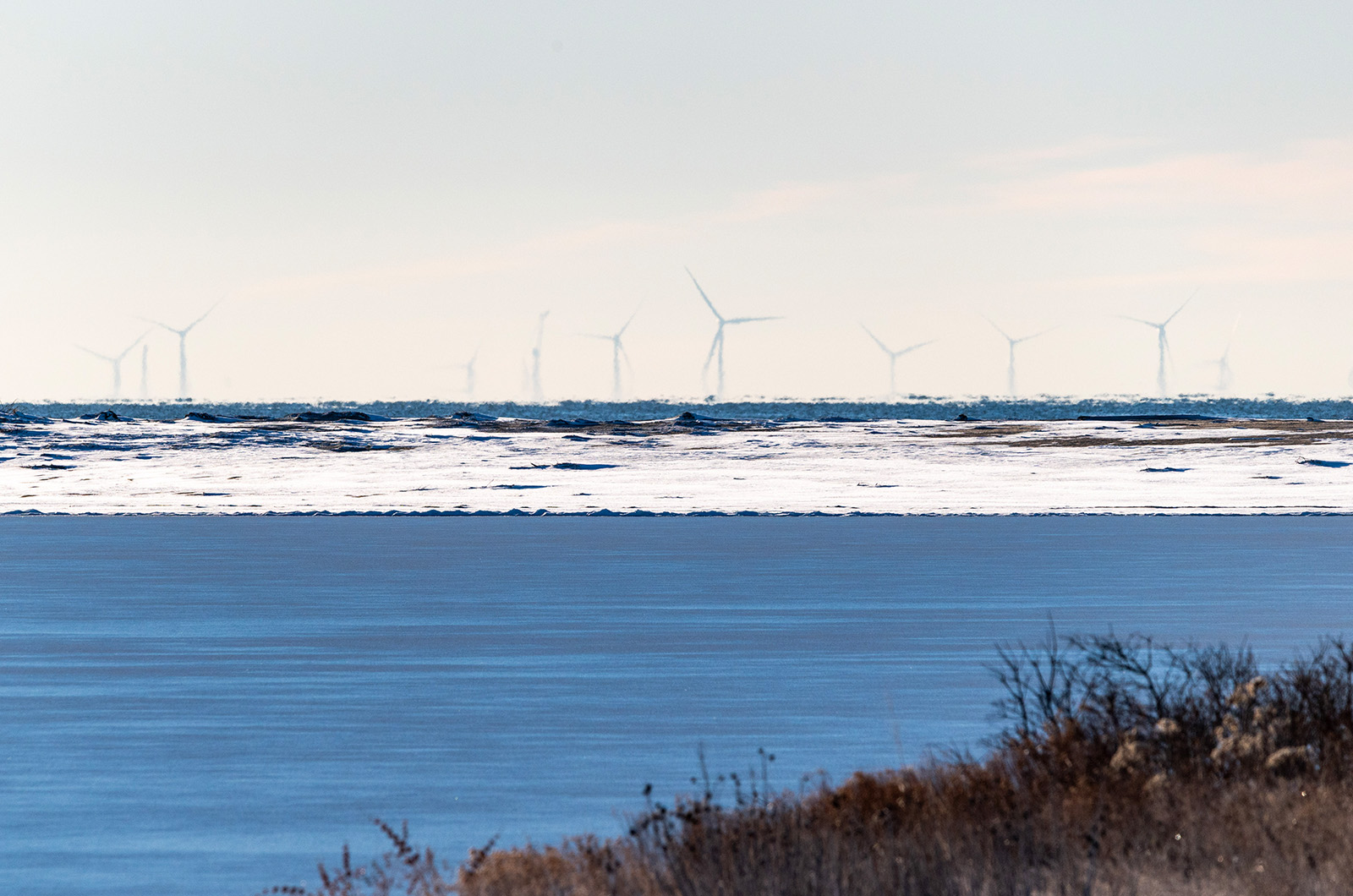
Vineyard Wind, the 62-turbine project south of the Island, can continue generating power despite the Trump administration’s order last week that halted offshore wind energy construction.
The Department of the Interior last Monday announced that it was pausing the leases for five large-scale offshore wind farms due to national security concerns. Though it was included in the order, Vineyard Wind was singled out by the government as being allowed to resume generating some electricity.
In a Dec. 22 letter to Vineyard Wind, the Bureau of Ocean Energy Management (BOEM) said that during the 90-day suspension period, Vineyard Wind may “perform any activities that are necessary to respond to emergency situations and/or to prevent impacts to health, safety, and the environment over the next 90 days and during any subsequent extensions.”
“In addition, given that this project is partially generating power, you may continue any activities from those wind turbines that are necessary for the current level of power generation,” wrote BOEM’s acting director Matthew Giacona.
Vineyard Wind was hoping to finish construction by the end of the year and started producing some power in January. As of July, 17 turbines were sending power to the grid and now, according to the state, the project is capable of producing 572 megawatts of its 800-megawatt capacity.
Vineyard Wind did not respond to a request for comment this week about how many turbines were up and running. The Department of the Interior also did not respond to questions about the reasoning behind allowing Vineyard Wind to operate in the face of the concerns around national security and a spokesperson deferred to the BOEM letter.
Offshore wind has been in the crosshairs of the Trump administration since the President’s first day in office. The Department of Interior’s order, the latest swipe at the industry, halted any activities at the offshore leases for the next 90 days as the department considers the alleged national security threats. The department said the concerns were based on classified information shared by the Department of Defense and involved the potential for radar interference from the tall turbine towers.
The legitimacy of the concerns was called into question by leaders in Massachusetts and the other states that have a stake in offshore wind energy.
On Christmas Eve, Gov. Maura Healey, along with the governors of Rhode Island, Connecticut and New York, sent a letter to Department of Interior Secretary Doug Burgum, urging him to lift the order.
“These projects have already been subject to extensive federal review, including an assessment that expressly addressed national security considerations,” they wrote.
Shutting these down would actually hurt more than help, the governors contended.
“With this irrational and erratic action, you are not solving a national security crisis; you are creating both a national security and economic disaster,” they wrote. “By obstructing domestic power generation, you are inviting grid failure, surrendering the industries of the future, and threatening the economy and national security.”
ISO New England, the nonprofit tasked with overseeing the region’s electrical grid, has also raised concerns about the government’s decision. ISO said Vineyard Wind has been supplying hundreds of megawatts of power, and halting these projects would make energy production less reliable moving forward.
“These projects are particularly important to system reliability in the winter when offshore wind output is highest and other forms of fuel supply are constrained,” the organization wrote in a statement. “While ISO-NE forecasts enough generation capacity is available for the current season, canceling or delaying these projects will increase costs and risks to the reliability in our region.”
Revolution Wind, one of the five projects affected, has said it is considering legal recourse, but, as of Monday, none of the farms off the Vineyard had filed lawsuits in Massachusetts.
Dominion Energy Virginia, a project 27 miles off Virginia Beach that had its lease paused, has sued in federal court, laying the potential groundwork for other suits. In its filings, the company argues that it worked extensively with the government over security concerns in the lead up to its approval.
The order has no rational basis and violates the Outer Continental Shelf Lands Act, as well as other laws, the project backers argued in a 47-page complaint filed on Dec. 23.
“BOEM’s arbitrary and illegal order is fundamentally inconsistent with this legal framework and BOEM’s carefully considered prior actions,” the company wrote. “Our Nation is governed by laws, and a stable legal and regulatory environment is essential to allow regulated public utilities like [Dominion], as well as other businesses, contractors, suppliers, and workers, to invest and support our Nation’s energy needs and associated jobs.”
While the court case plays out, members of the Trump administration have said that offshore wind is a scam, and that they’d rather see more oil projects come to the fore.
“One natural gas pipeline supplies as much as these 5 projects combined,” Interior Secretary Burgum wrote on social media. “[President Donald Trump] is bringing common sense back to energy policy & putting security first.”





Comments (16)
Comments
Comment policy »