
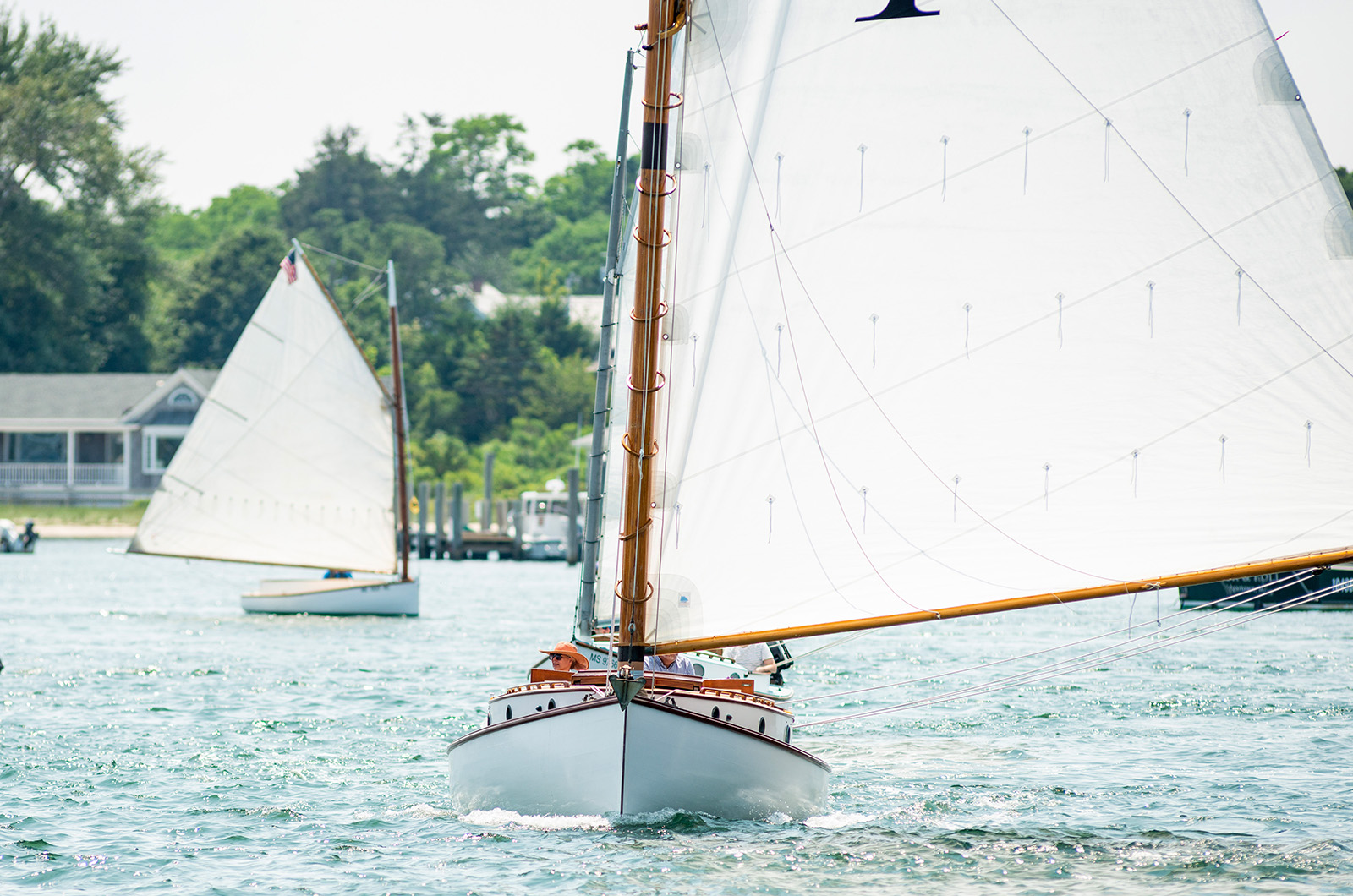
From the June 11, 1965 edition of the Vineyard Gazette by Joseph Chase Allen:
This was the day, even the heyday, of the catboat which might have been seen just about everywhere, a glittering picture of white paint and varnish, or a chafed and dirty workboat, for they were used for every ordinary purpose.
But there was one thing that the majority of catboatmen had in common: they knew how to sail, and this was vital in those days of sixty years ago, for while it was true that the great majority of the cats had gasoline engines under their docks, those engines could not be depended upon as they are today. The engine might falter, the fuel might contain water and often did, and when such things occurred, it was the sail that brought the boats home, that and the knowhow of the men who handled them.
It has been said, and is probably true, that never except on a catboat has such a press of sail been carried on a single, unsupported spar, for virtually no catboat was rigged with stays which in any way supported the mast when under sail.
By the same token, it is doubtful if men ever experienced the hazards, close calls and near-tragedies in boats of other design as they did in catboats.
Capt. Morris Cleveland of Vineyard Haven set mackerel nets “southwest of Noman’s” and was caught in a gale which breezed in the night. Before the gale subsided enough to allow him to pick up nets, he had drifted nearly of Block Island, but his boat sustained no harm and he saved his nets.
Capt. Everett Poole of Chilmark was caught in a hurricane in Buzzards Bay and was literally hurled by the surf up among the beach grass and sand dunes on the back side of one of the Elizabeth Islands. Damage to the boat was slight, if indeed there was any, save the loss of his sail, which blew away.
Capt. Charles B. Cleveland, caught on a night in late fall in the East Bend of Noman’s Land, was one of the few to work clear of a snarl of vessels dragging their anchors, and made the lee of Squibnocket in his catboat, which suffered no damage other than a broken sheet-block. The damage among the other vessels, all much larger, was considerable.
Various others were driven ashore by wind and sea while at anchor, due to a shift of wind which turned their original shelter into a lee shore, but the boats were floated to sail again.
Such was the case with a New Bedford catboat which came ashore on Noman’s Land. Dodging rocks that lay so thickly set that she could not be launched from the point where she struck, she landed with no damage except to her rudder.
Henry B. Davis, who lived on the Island at the time, made a road down the face of a sand cliff, loaded the boat on wheels, and hauled her to the top of the cliff and across to the other side of the Island, where he repaired and floated her. The hauling was done by a pair of oxen and a horse, working together.
And then there were some catboat skippers who did not stop for weather if there were things to be done. Their willingness to set forth regardless of wind and sea sprang from an unusual confidence in their boats and themselves, and in some cases, their experience in large vessels, which the run of the mill boatman of the time would regard as a liability. “A vessel captain makes a poor boatman,” they often said, yet a few such men probably made history which was never recorded.
Capt. Lindley (Linnie Wing) Mayhew was in the Life Saving Service and took his vacation during the Life Saving Service and took his vacation during the lobster season. His catboat, Faustina, was but twenty-four feet long, but Linnie knew his boat, his own capabilities and the weather. If he had agreed to market his lobsters in Woods Hole on Thursday, he went, and that was all there was to it. Of similar nature, but graduating from whaleships, were Capt. David Butler of the Bessie Howard and Capt. William Vanderhoop of Gay Head, master and owner of the Margie. Neither of these two ex-whaleman worried very much about weather, but both of them on occasion were obliged to replace a sprung mast.
So it was that the great majority of such men sailed their catboats to the finish of the catboat era and many of them graduated, as it were, from the cat with power and working canvas to something more speedy, and without the sail. Such boats had become more practical, especially for lobster-fishermen and the change had to come.
But looking back and recalling the comments of some of those men who no longer had to reeve off halliards and topping-lift, or splice lazy-jacks when they were fitting-out in spring, their words seemed regretful. There was something missing from the routine of fitting-out and in the operation of the boats they had been forced to adopt. It has been said that a man raised, as it were, in sail never ceases to mourn its disappearance. With catboat sailors, it has sometimes seemed as if their mourning was even more acute and deeply-seated than that of other men.
Compiled by Hilary Wallcox





Comments
Comment policy »