
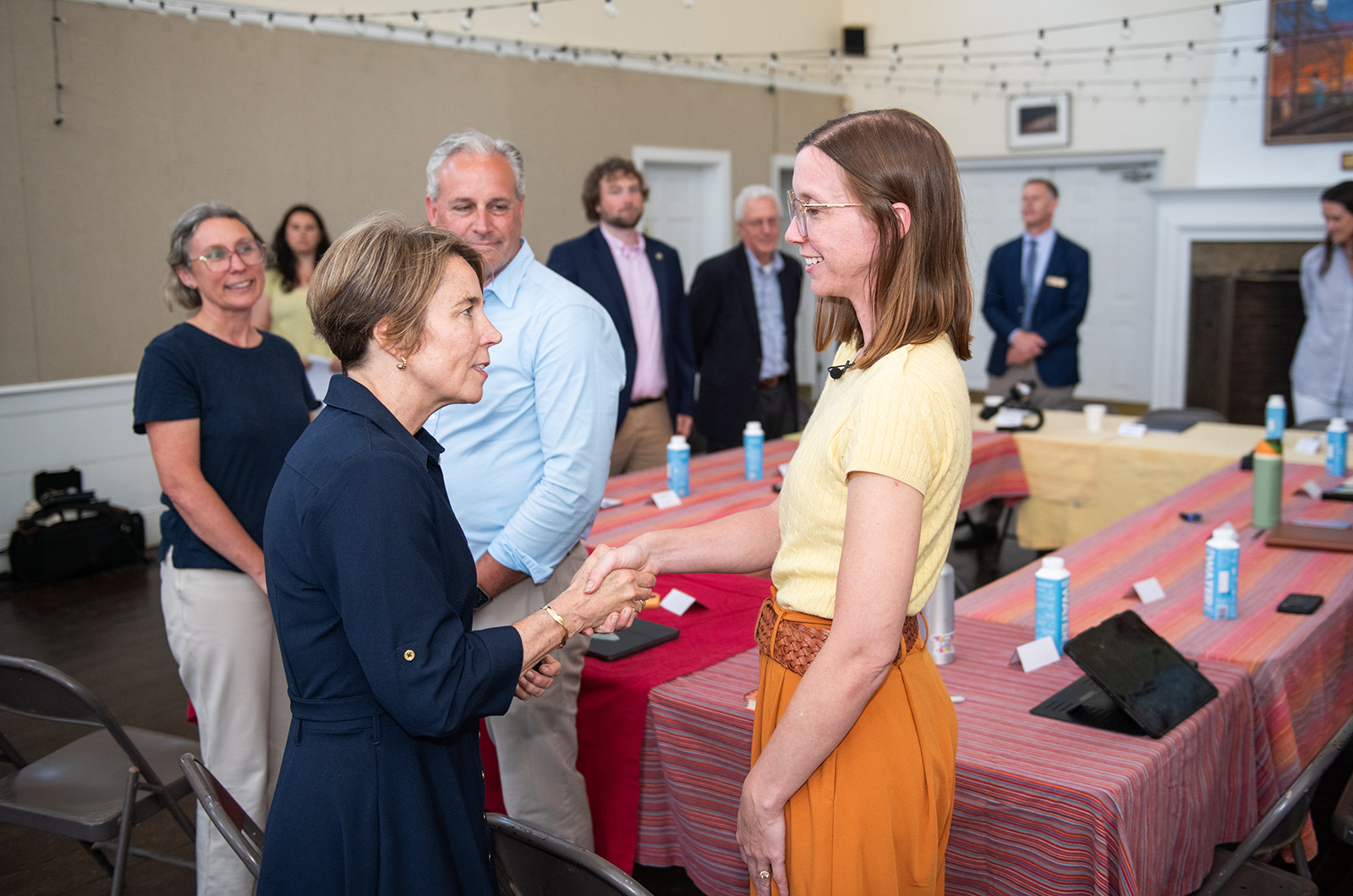
Gov. Maura Healey said this week that she wants to increase the state’s support for the Island’s ongoing battle against tick-borne illnesses and allergies.
At a roundtable talk with Island leaders at the Agricultural in West Tisbury Hall Wednesday, Governor Healey said her administration wants to put money behind several Islandwide efforts, including data collection for alpha-gal and other tick-borne illnesses, upping the year-round deer harvest to whittle down deer density and increasing access to epi-pens and protective gear.
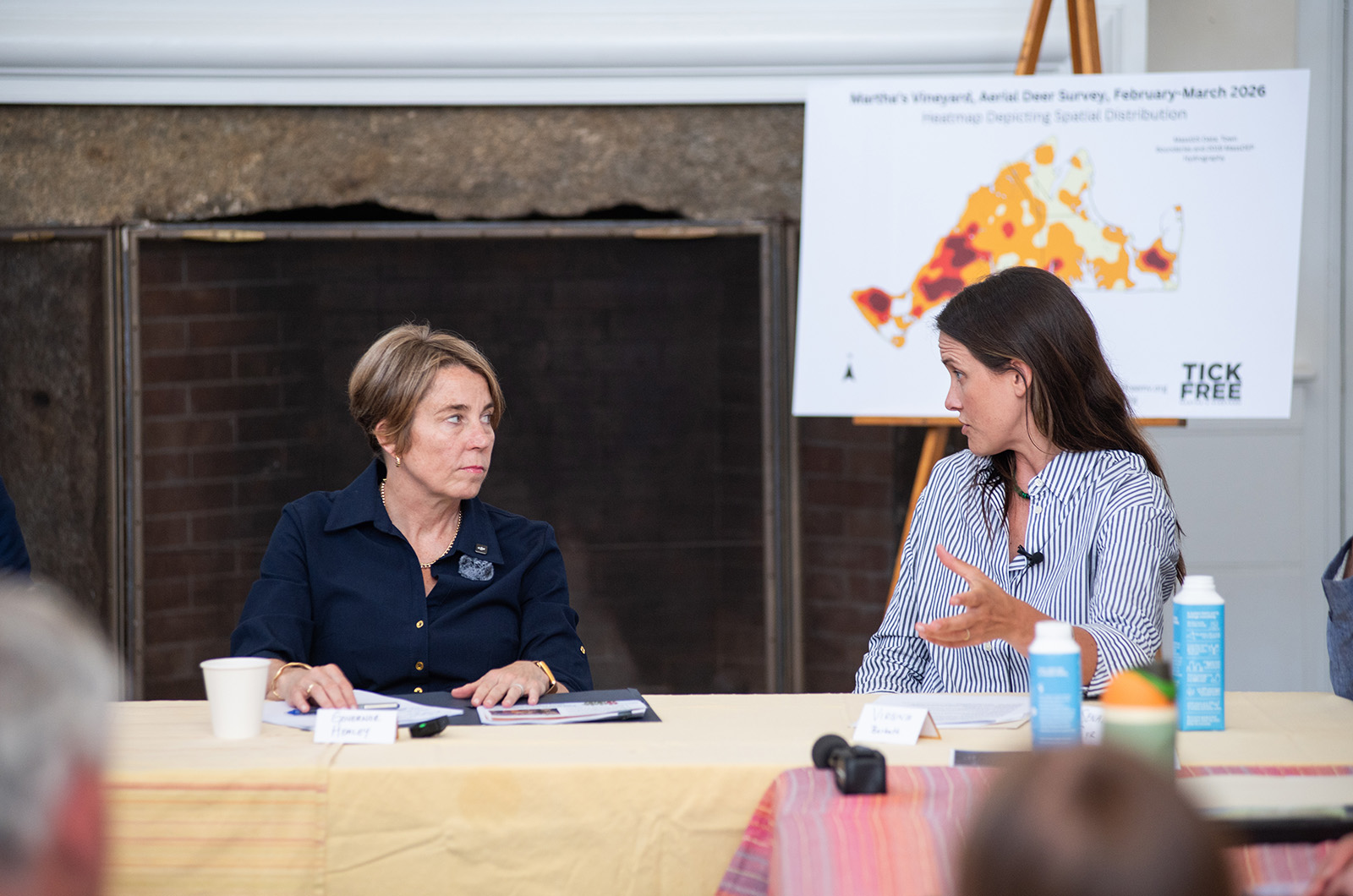
“We want to do more, and we want to prevent people from getting sick,” Governor Healey said.
Participants at the roundtable included the governor, Department of Fish and Game commissioner Tom O’Shea, Department of Public Health commissioner Dr. Robert Goldstein, Tick Free MV executive director Virginia Barbatti, state Sen. Julian Cyr, Island tick biologist Patrick Roden-Reynolds, Island tick epidemiologist Lea Hamner, agricultural society board chair Robert McCarron, agricultural society president Lauren Lynch, MassWildlife acting director Eve Schluter, MassWildlife deer and moose biologist Martin Feehan, acting resource officer for the Wampanoag Tribe of Gay Head (Aquinnah) Bret Stearns, Island Grown Initiative executive director Noli Taylor, West Tisbury town administrator Jennifer Rand and MV Hunt Club president Joe Capece.
Ms. Hamner called the rise in alpha-gal on the Island “stunning,” and Mr. Stearns added that the impact on the Wampanoag Tribe of Gay Head (Aquinnah) has been profound. While tick-bite prevention continues to be important, Ms. Hamner said Islanders are getting desperate for a more permanent and far-reaching solution.
“Lone star ticks really just changed the temperature here,” she said.
For many at the table, deer management is a necessary part of tackling tick-borne illnesses and allergies, as deer are ticks’ main reproductive hosts. Currently, the Island’s density of deer is far above state recommendations, and Tick Free MV announced this week to help facilitate a 70 per cent reduction in herd size.
Governor Healey said she was concerned about the size of the Island’s herd.
“We’re going to have to do something pretty substantial here,” she said.
Tick Free MV’s current strategy to thin the herd is to use state-issued deer damage permits, which allow agricultural producers, and any subpermittees they name, to harvest deer as pests on their land. Most of the meat harvested must go to the Hunters Share the Harvest program for those facing food insecurity.
Since conservation groups are eligible for the permits, and 40 per cent of Island land is conserved, getting conservation groups on board is a priority. Governor Healey wondered if the Island’s conservation groups would need some convincing from the state, but Ms. Barbatti said they have been open to the idea.
“I think the interest is really high,” she said.
Mr. Feehan pointed out that the permits cannot be issued unless there is a nearby processing facility, the need for which is currently being filled by the MV Hunt Club. But Tick Free MV is also working with the Agricultural Society to build a year-round cold storage and processing center to meet the demands of an increased year-round harvest.
Ms. Barbatti said this facility would be a multi-million-dollar project. Governor Healey asked those in the room working on the project to send her team a plan for the processing facility and the projected cost so she can locate state funding sources to help.
“Why don’t you get us, as quickly as you can, whatever the specs are... what you need for dollars,” she said.
On the legislative level, both Governor Healey and Mr. Cyr have backed “modernized” hunting regulations, including hunting on Sundays, crossbow use and reduced setbacks from residential dwellings.
Originally rolled into the budget bill, these provisions ultimately ended up in the environmental bond bill, which the Massachusetts House of Representatives passed on June 17. The bill still needs to get through the senate, but Governor Healey was optimistic.

“It should be on my desk very shortly,” she said.
Beyond managing deer density, support from the state for Island professionals tracking and treating alpha-gal and other tick-borne illnesses is crucial, Ms. Hamner said. She said staffing for data collection is a top need, especially given that the state made alpha-gal a reportable condition in April. The hospital is also preparing to undertake a prospective cohort study to investigate alpha-gal and the efficacy of the Island’s current treatment and prevention measures.
“Having that infrastructure in place will really be able to help us see, are we actually having the impact we intend to have?” she said.
Dr. Goldstein said the state could potentially provide staffing support to the Island using public health excellence grants. Governor Healey suggested the state could subsidize epi-pens for alpha-gal patients, as well as permethrin treatment of clothing for Islanders.
There’s nuance, officials said, when approaching the tick problem as it affects year-round Islanders versus how it could potentially impact the Island’s tourist economy. The hospital is launching a campaign to reach visitors with tick safety information on the ferries.
“There’s a balance,” Governor Healey said. “We want people to come here and enjoy this beautiful, beautiful place, but we also want them to be armed with whatever information that’s helpful in mitigating [interactions with ticks].”
Mr. Cyr praised Governor Healey and other Beacon Hill officials for traveling up Island to dive deep into one of the Island’s foremost issues.
“I can’t think of a time we’ve had such engagement,” he said.
Dr. Goldstein expressed confidence that this kind of engagement, especially among Islanders in different fields, will lead to solutions.
“The lone star tick is not new, but what’s new is that it’s coming into a community that is collaborative and interested in solving problems and [taking] action,” Mr. Goldstein said. “I don’t think there’s a solution yet identified for how to manage lone star ticks or deer ticks. I think this is the Island that will find it.”




Comments
Comment policy »