

Before Tayari Jones met the characters who would become her bestselling fifth novel, Kin, Ms. Jones found herself on a blind date with an idea.
“With a very handsome idea,” she said, recalling her contract to write about the gentrification in modern-day Atlanta. “You know — it had a very good job. My mother loved it. All of these things, but me and the idea just didn’t have chemistry. And I finally had to walk away from it.”
What Ms. Jones did next, she explained during the second event in the Martha’s Vineyard Author Series on Sunday, was “scribble.” There she met her novel’s protagonists: Niecey and Annie, two motherless black girls growing up together in the 1950s segregated South. And writing the book, she said, was like falling in love.
In a conversation moderated by journalist Michele Norris, Ms. Jones spoke about how the book came to be, reflected on the role of fiction and recalled the adventures of her previous visits to the Island.
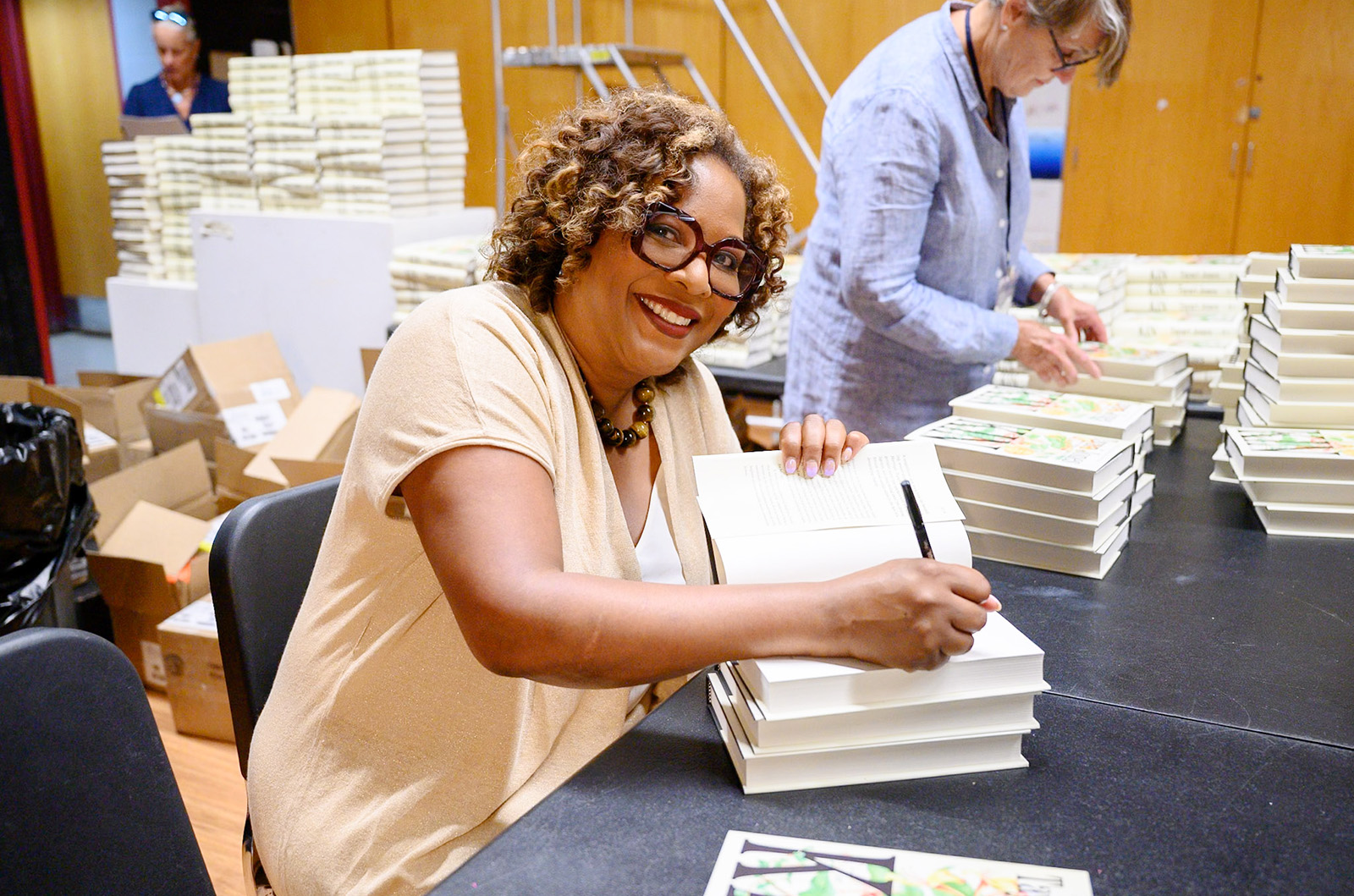
Ms. Jones, the author of the award-winning novel An American Marriage, is a professor of English and creative writing at Emory University. She prides herself on being a “relentlessly contemporary artist,” telling the stories of her own generation, she said.
Imagine her surprise when her scribbles plopped her down in the 1950s. She thought this was the backstory: These were clearly the mothers of the more contemporary characters who she thought would soon come, but never did.
“They’re young women who have come of age, so the world is also new,” said Ms. Jones of her main characters, best friends who diverge in their paths after high school. “They’re negotiating questions of sexuality. They’re negotiating questions about education...to marry, not to marry, where to live, respectability, even just negotiating those 1950s undergarments, good lord!”
Ms. Norris pointed out that racial division takes a backseat to class tensions in the novel. While Niecey attends college and marries into a middle class family, her “cradle friend” Annie remains part of the working class. But they’re still living in the segregated south.
“I like to think of the racism in their lives like it doesn’t wear hard shoes, it doesn’t walk around in heavy boots,” Ms. Jones responded. “It wears socks.... They’re living their lives and it just taps them on the shoulder and it’s there, and they have to deal with it then.”
That reflects Ms. Jones’ own upbringing, “bougie and segregated in Atlanta,” she said. She attended Spelman college, a historically black university, just like the character Niecy.
“I did not have any understanding of any limitation of what I could or could not do,” she said. “I can tell you when I was little, I thought Jimmy Carter was black. I do not know why I thought this.”
In 1976, at six years old, a young Tayari Jones told her teacher she was voting for Jimmy Carter because he was a black man, she recalled.
“I did not have any sense that a black person in 1976 could not be president,” she said. “It just never occurred to me.”
Ms. Jones wrote Kin, in part, to get to know her mother better. Through her characters’ decisions, Ms. Jones came to understand her own mother’s choices in a world where the pressure of wifedom was much more present, where adding the initial of her maiden name to the middle of her monogram was an act of resistance.
Ms. Jones’ characters’ journeys are also about finding their mothers. While Niecy’s mother dies shortly after giving birth, the character Annie goes to Memphis to find the mother who abandoned her as a baby. Both characters end the novel with mother-figures.
“I think what I’ve really learned is how many people have a longing for their mothers,” said Ms. Jones, reflecting on the response from readers. “This is a wound that people are having all over the world, really. And I’m coming to understand really the healing power of fiction.”
In 2020, Ms. Jones began to lose faith in fiction. Amidst political and racial turmoil, she found herself asking how a novel could help. But novels deepen empathy and initiate hard conversations, she said.
“No, the novel cannot change the world, but it can heal someone or start someone healing,” said Ms. Jones.
And for all Ms. Jones’ hesitation about recording the past, her novel is an archival project that contains the “small things of people’s lives.” That includes 1950s long-line girdles — which Ms. Jones researched by reading old Sears’ catalogues — and the inventive southern expressions that pepper her characters’ language, some of which Ms. Jones made up.
“I very much want to honor the poetry in everyday peoples’ speech,” she said. “It is my belief that the further people are away from the center of power. The more they bend the language to their will. Because language is free.”
This is not Ms. Jones’ first visit to the Vineyard. She wrote her third novel, Silver Sparrow, in Vineyard Haven after being rejected by an artists’ colony. It was a DIY artist experience, but it was winter.
“Did you fall in love with the Island in the winter?” said Ms. Norris.
“It was winter!” said Ms. Jones, who is from Georgia. “But if I had to be somewhere that has winter, it would be here.”
The Martha's Vineyard Author Series continues on Wednesday with Daniela Gerson at the Chilmark Community Center, and Thursday with Jill Biden at the Performing Arts Center. Visit mvbookfestival.org for a full schudule.






Comments
Comment policy »