

It wasn’t long after novelist Salman Rushdie survived attempted murder that he wanted to tell the story.
In 2022, Mr. Rushdie was about to give a public lecture in Chautauqua, N.Y. on keeping writers safe when a 24-year-old man rushed the stage with a knife, stabbing him several times. Mr. Rushdie sustained wounds all over his body, most notably to his right eye, now blind.
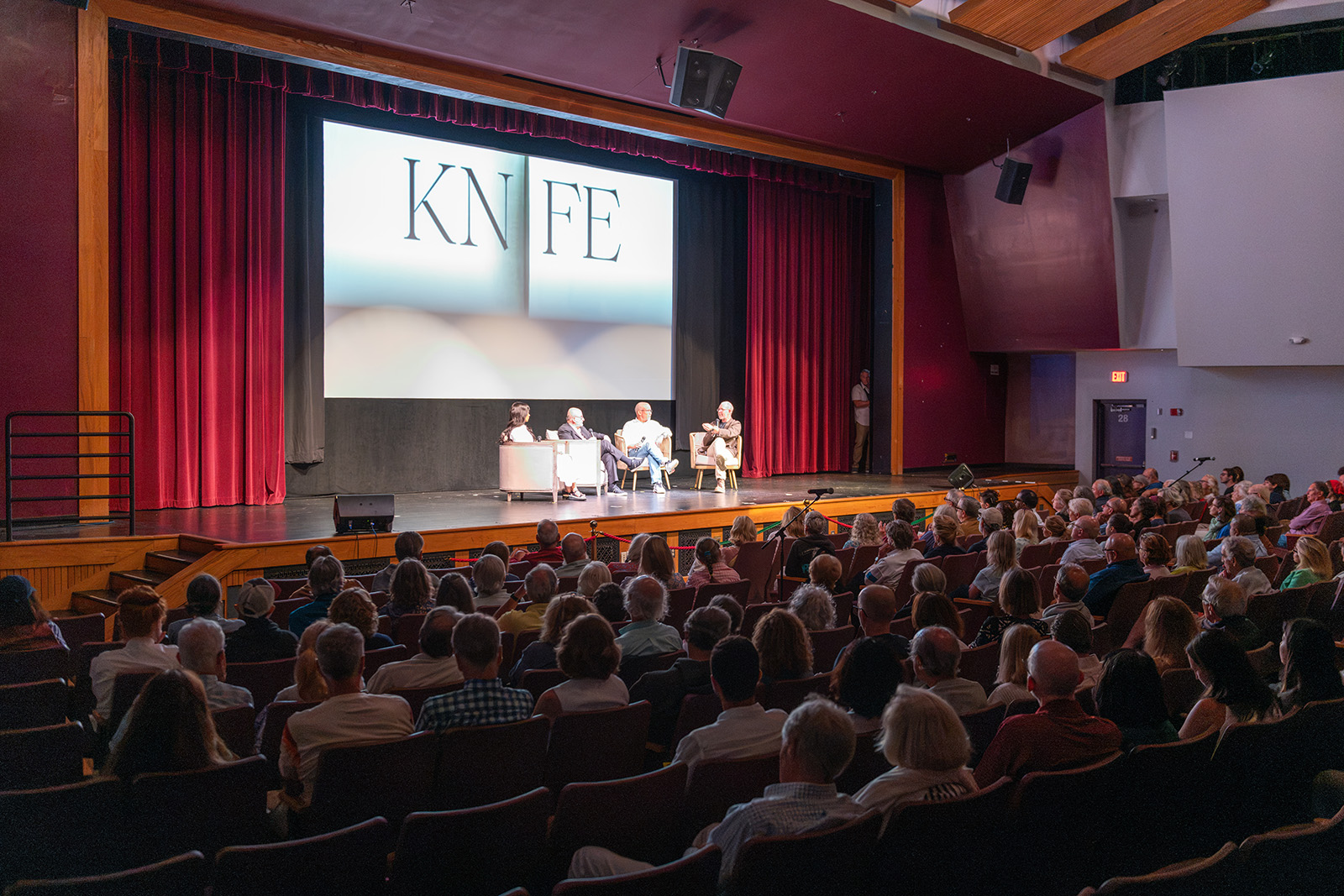
Weeks of hospitalization followed, during which Mr. Rushdie and his wife, poet and novelist Rachel Eliza Griffiths, began documenting the experience. The footage they filmed would become Knife: the Attempted Murder of Salman Rushdie, a documentary screened by Circuit Arts Friday at the Martha’s Vineyard Regional High School Performing Arts Center.
Following the film was a discussion with Mr. Rushdie, Ms. Griffiths and director Alex Gibney, moderated by Circuit Arts executive director Brian Ditchfield.
Knife, produced concurrently with Mr. Rushdie’s memoir of the same name, chronicles the attack on Mr. Rushdie and his extensive recovery. It also examines Mr. Rushdie’s upbringing, literary career and the three decades of public vitriol directed at him preceding the attack. The film will have its theatrical release in September.
In 1989, Mr. Rushdie published The Satanic Verses, a fantastical, often critical look at the life of the prophet Muhammad. In response, Ayatollah Ruhollah Khomeini, then the Supreme Leader of Iran, issued a fatwa calling for Mr. Rushdie’s execution. Protests of Mr. Rushdie and his work broke out from Tehran to London to New York. Rioters firebombed book stores that carried The Satanic Verses and burned Mr. Rushdie in effigy. He was forced into hiding.
For many, Mr. Rushdie became a symbol of free speech and the danger of its dissolution. Iran all but retracted the fatwa in 1998 and Mr. Rushdie slowly reentered public life, giving lectures and attending red carpet events. He married Ms. Griffiths in 2021.
But the 2022 attack, found later to be motivated by the fatwa, upended the sense of normalcy Mr. Rushdie managed to find.
“When you’re so near the point of death, and then you come back from it, you remember that,” Mr. Rushdie told the crowd Friday. “There was no tunnel of light, I’m sorry to say. No heavenly choir, no fire of hell.”
At the beginning of his recovery, Mr. Rushdie was on a ventilator. When he could finally speak, he asked Ms. Griffiths to track his healing by taking pictures on her iPhone. That quickly turned into a more intensive documentation of healing in both body and mind, shot on a professional-grade film camera.
“It became this space for us to tell each other stories,” Ms. Griffiths said. “It was kind of like a diary.”
Feeling they were too close to the project, the couple decided to bring on Mr. Gibney to shape their footage into a feature-length film.
“They wanted somebody to take this precious footage, which was extraordinarily shot, and see if there was something to be done with it that was both inside and outside their experience,” Mr. Gibney said.
He was honored that they put their story in his hands.
“My filmmaking process was a little bit like being the manager of the Los Angeles Dodgers,” he said. “You have this extraordinary talent around you, and your job, is just [to] sort of throw up balls and bats.”
Knife is highly referential, engaging in a kind of pop cultural free association that is a conduit for Mr. Rushdie’s storytelling. Footage of his recovery, both at its most gruesome and most triumphant, is bound together with the likes of Bob Dylan, Billy Boy and Twelve Angry Men.
These references are mostly Mr. Rushdie’s, but Mr. Gibney did some of his own riffing.
“Luckily for me, Salman was a huge film buff, as I am too,” Mr. Gibney said.
Like Mr. Rushdie’s fiction, Knife occasionally suspends reality. In one scene, Mr. Rushdie fictionalizes a conversation with his attacker to try to enter his mind. Mr. Rushdie once thought he might like to meet with his attacker in person to understand his motivations. Ms. Griffiths urged against it. In any case, Mr. Rushdie conceded, the possibility of an honest, open conversation was slim.
“I thought, maybe it’s better to make him up, to use what skill I have as an imaginative person, to imagine myself into his head, and see where that goes,” he said.
Just two days before Friday night’s screening, Mr. Rushdie’s attacker, already serving 25 years for attempted murder, was convicted of several additional charges, including engaging in an act of international terrorism. He will be sentenced on Nov. 3 and faces a maximum penalty of life in prison.
Mr. Rushdie testified against him.
“I think he might be going away for a long time,” he said.
Though Knife is a film about healing, it’s also a film about the lasting impacts of major trauma, lurking even in joyful moments. Ms. Griffiths and Mr. Rushdie compared the attack to a shadow, waxing and waning, sometimes eclipsing all else.
“The trauma of the attack doesn’t disappear,” Mr. Rushdie said. “It stays with you.”






Comments
Comment policy »