
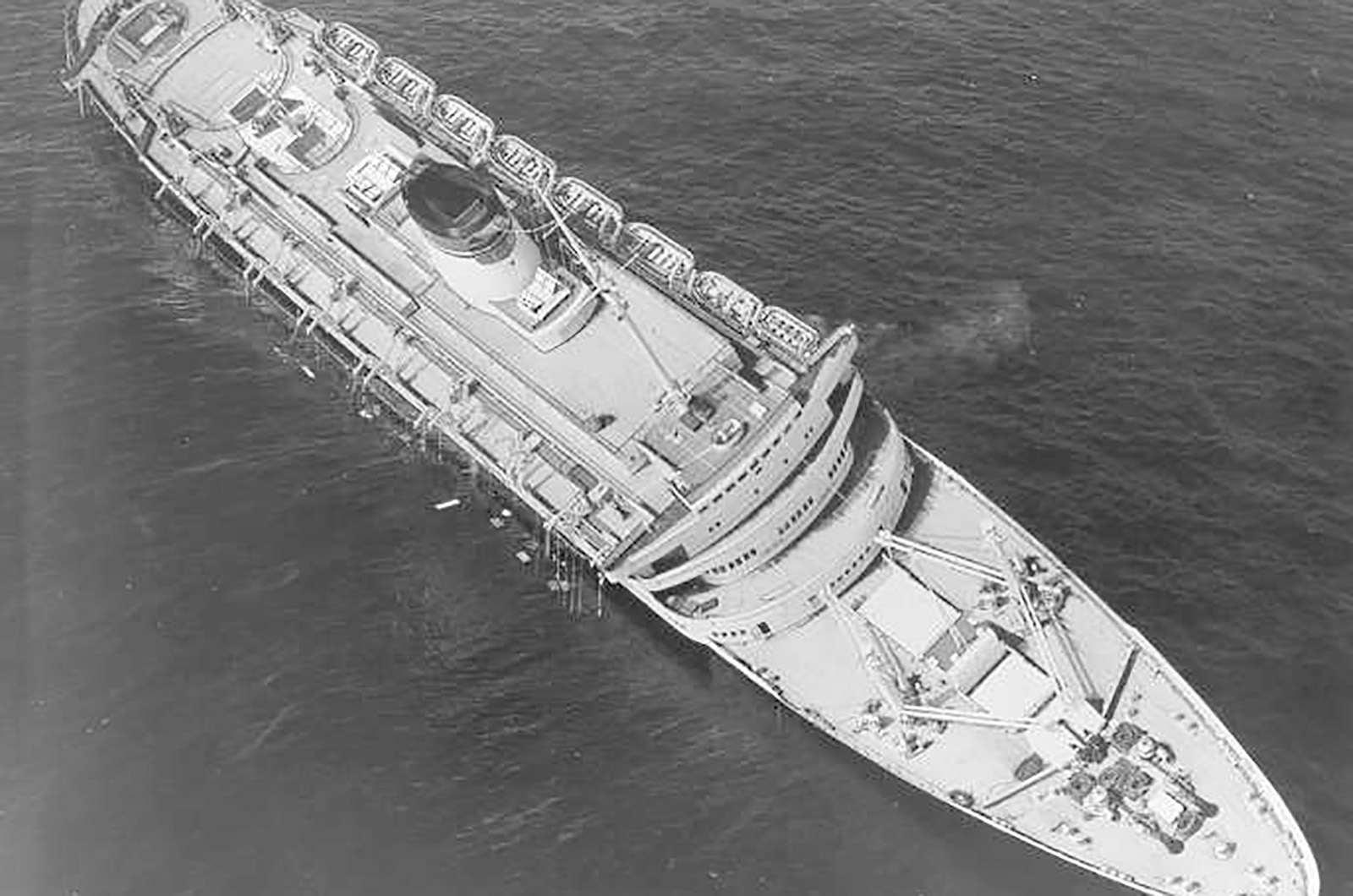
From the August 10, 1956 edition of the Vineyard Gazette:
“We feel that Dr. and Mrs. Robert Boggs covered the sinking of the Andrea Doria fully,” observed Mr. and Mrs. Francis H. McAdoo, two other Island summer residents, who went through the tragic sinking of the luxury Italian liner off Nantucket. “Their story was factual, and calmly related, and anything that we might say would be repetition. Our first and foremost desire at the present time, is that some one might write an account of the collision, pointing out, if it is possible, a way in which such things can be avoided.
“We had thought that the radar was infallible, now we know differently. Fog is a horrible thing, menacing and deadly, and if ships are to travel through it without slackening speed, additional safeguards against collision are most strongly indicated.
“We judge that the Doria was making twenty-two knots. We do not know this, but she had averaged that speed and if she had slowed down, it was not noticeable.”
This statement appeared to be final and complete, yet sitting in the palatial summer home of the McAdoos’, in the calm stillness of a Vineyard summer afternoon, memories of their harrowing experience began to stir the couple and they mentioned various details.
“We thought that something had exploded deep in the hull,” they explained. “The idea of a collision didn’t occur to us.
“Whatever it was, we realized that it was serious and we went down to our stateroom.”
“My husband told me to dress warmly,” said Mrs. McAdoo, “and fortunately I had some warm pants.”
“You know,” said Mr. McAdoo, “if you have to go overboard you want to be dressed warmly.” (Mr. McAdoo served in the Navy during wartime conditions and had a very good idea of what might ensue.) “I looked for my money,” he said, “and already the list was so great that it had slid off the chest of drawers on to the floor. The little Italian money I had slid clear under a berth and I never did get it. We didn’t save anything else.”
“You have to think,” said Mrs. McAdoo, “that if the ship sinks, your life comes first. If it doesn’t go down, then your property will be right there.”
The situation of the heavily-listing promenade deck was pictured by the McAdoos, as Dr. and Mrs. Robert Boggs had previously described it in the Gazette. “But,” Mrs. McAdoo added, “people from all classes of passengers, first, tourist and third, were gathered there. Some were people who had been visiting relatives in Italy, some were emigrants, but all of them were brave and calm. There was no panic whatever.”
“The captain has been criticized for not having something to say to the passengers,” said Mr. McAdoo, “but what could he say? He had sent out his call for assistance, asking for lifeboats, immediately. He was directing his crew over the inter-com, and he had to use Italian. His voice was calm and unhurried as he gave directions; directions which we could not know, but there was no indication of nervousness or difficulty.”
Both Mr. and Mrs. McAdoo spoke of the absence of actual lifeboat drill, the assignment to a lifeboat or instructions as to how to hold the life-jacket when jumping overboard. “It was one of the priests who told us about that,” she said. “I had never heard about it before.”
The McAdoos spent hours on the sinking ship and still more hours in the lifeboat, which was one of the Doria’s own. As a matter of fact it is possible that Mr. McAdoo was the last passenger to leave, but this cannot be verified.
“We moved,” said Mr. McAdoo, “from the promenade deck. You will understand that this deck was enclosed, with glass windows which could be pried open. But as the list became greater and it seemed as if the ship might roll over, it occurred to me that we might have difficulty getting out of those windows, which would be over our heads. So I suggested going up to the boat-deck, which was open, and we did.”
“It was pretty difficult to keep track of the passage of time,” said Mrs. McAdoo. “We were several hours aboard the ship and in the boat (actually it appeared to cover about four hours on the ship and two in the lifeboat) and we couldn’t see anything, except just once I could see far off on the horizon, a pin-prick of light which meant to me that another ship was out there.
“But there was one incident that I will never forget. I don’t know exactly when it happened. The little Italian lady had wept, the moon had come out and I could hear a sigh of relief coming up from the passengers huddling on the sloping deck below us. And then, out of the night somewhere came a voice, an American voice, speaking Brooklynese. The tones were calm, even drawling, without one trace of excitement in them: ‘Come on, lady,’ it said, ‘you’re all right, we’re right here to take you!’ And I said: ‘Everything is all right now, American sailors are here from somewhere; probably it was a Coast Guard cutter, I’ll never know, but it was wonderful to hear.’”
Compiled by Hilary Wallcox





Comments
Comment policy »