
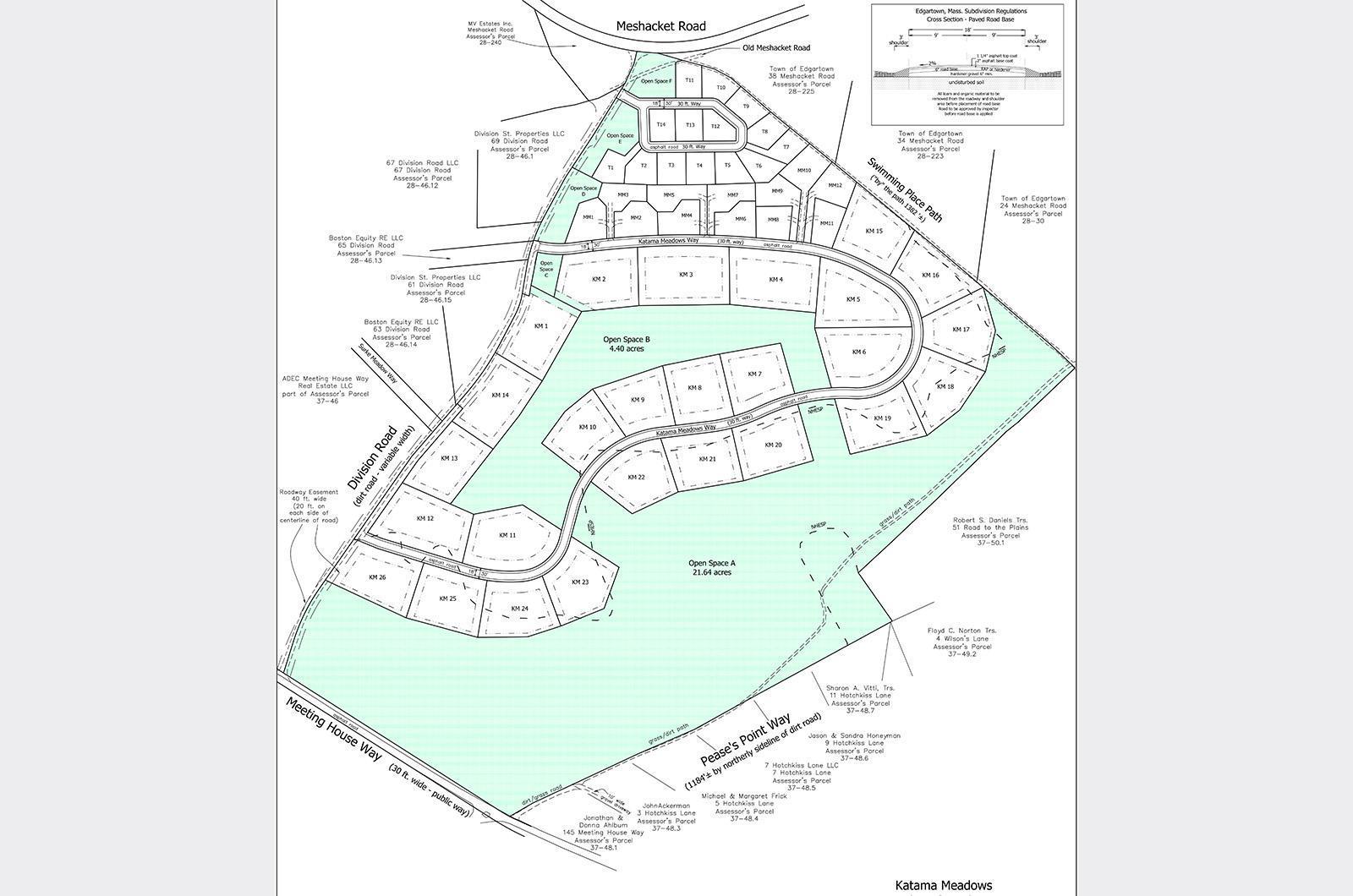
The Martha’s Vineyard Commission continues to grapple with the controversial Katama Meadows project in Edgartown, one of the largest housing proposals to come before the regional planning agency in decades.
After voting earlier this month in favor of a condition that would reduce the number of market-rate lots on the 54-acre property from 26 to 19, replacing seven home sites with open space, commissioners last week considered more ways to make the mixed-income subdivision more suitable to the Island’s housing needs.
“Perhaps this should be a project where one-third of the lots are market rate and two-thirds are income restricted,” commissioner Douglas Sederholm said during deliberations August 6.
Mr. Sederholm proposed dropping another four market-rate lots from the plan in favor of four lots with deed restrictions for Islanders of moderate means.
Development company Katama Meadows LLC initially proposed 52 building lots, equally divided between market-rate and income-restricted lots, after the commission in 2020 denied approval of an all-market-rate subdivision then called Meeting House Place.
Appealed by the developer, that denial was upheld in 2023 by a Massachusetts Land Court judge who ruled the Martha’s Vineyard Commission acted within its authority in turning down the project.
The developer appealed again, but both sides agreed to pause the legal proceedings until after the commission completes its review of Katama Meadows as a development of regional impact.
Last week, commissioners debated the planned mix of income levels for the 26 deed-restricted lots in the proposal.
The developer has offered to donate two of the 26 lots to Habitat for Humanity, with deed restrictions limiting owners to 80 per cent of the area media income (AMI) and requiring year-round residency, and sell another 10 lots for $225,000 each to year-round Island residents earning up to 200 per cent of the area median income.
Four of the 10 deeds would include a preference for public employees, according to the plan under discussion.
The remaining 14 lots would be donated to the town of Edgartown for its municipal housing needs, with the understanding that one of these lots also would be given to Habitat for Humanity and deed-restricted for owners earning up to 80 per cent of the AMI.
Another four lots would be restricted to owners earning up to 150 per cent of the AMI, and the other nine lots would be developed for municipal housing at the town’s discretion.
Further plans for these so-called town lots remain unclear, complicating the commissioners’ deliberations last week.
Edgartown officials are waiting for the results from a study of municipal employees’ housing needs, paid for by the property developers, before determining how to allocate the lots.
“There is no requirement that they sell [the lots],” Mr. Sederholm said.
“They can give them away. They can sell them for $1. They can sell them for $50,000. They can sell them for $75,000, both of which are numbers that have been used in the recent past when towns were selling lots like these,” he said.
Mr. Sederholm proposed replacing another four of the market-rate lots with deed-restricted lots, two for Islanders earning up to 150 per cent of the AMI and two for 200 per cent AMI earners, changing the overall mix to 15 market-rate home sites and 30 deed-restricted lots.
Another proposal, from commissioner Joan Malkin, would deed-restrict the nine town lots to 150 per cent of the AMI.
Ms. Malkin also suggested creating open space for the year-round community to use as a gathering place, perhaps with a playground.
“It’s a valuable point,” commissioner Ben Robinson said, noting that the town lots average around 7,000 square feet and some are smaller.
“There’s only so much you’re going to be able to do on an individual lot,” he said.
Linda Sibley, the commission’s longest-serving member, cautioned against making too many changes to the plan, which Mr. Sederholm said last week is within the MVC’s legal authority.
“I don’t challenge Doug’s assertion that we can make some pretty drastic changes … but we really don’t usually try to redesign a project,” she said..
“If we think it’s badly designed, I think we reject it [and] send it back with reasons why it’s badly designed,” Ms. Sibley said.
Deliberations are set to continue Sept. 10.





Comments (5)
Comments
Comment policy »