
Andrew Woodruff’s prop of choice is a shovel. He leans on it when he gives farm tours at Island Grown Initiative (IGI), explaining their regenerative practices and ongoing experiments to improve soil health, which he has helped design and execute. He grasps the handle, swinging the shovel as he leads a group of Vineyard farmworkers to show them the fields.
Stopping at a field of clover, he turns the spade and using his foot, pushes it into the bed. A strip of bare earth cuts through the middle of the clover, where crops will soon be planted.
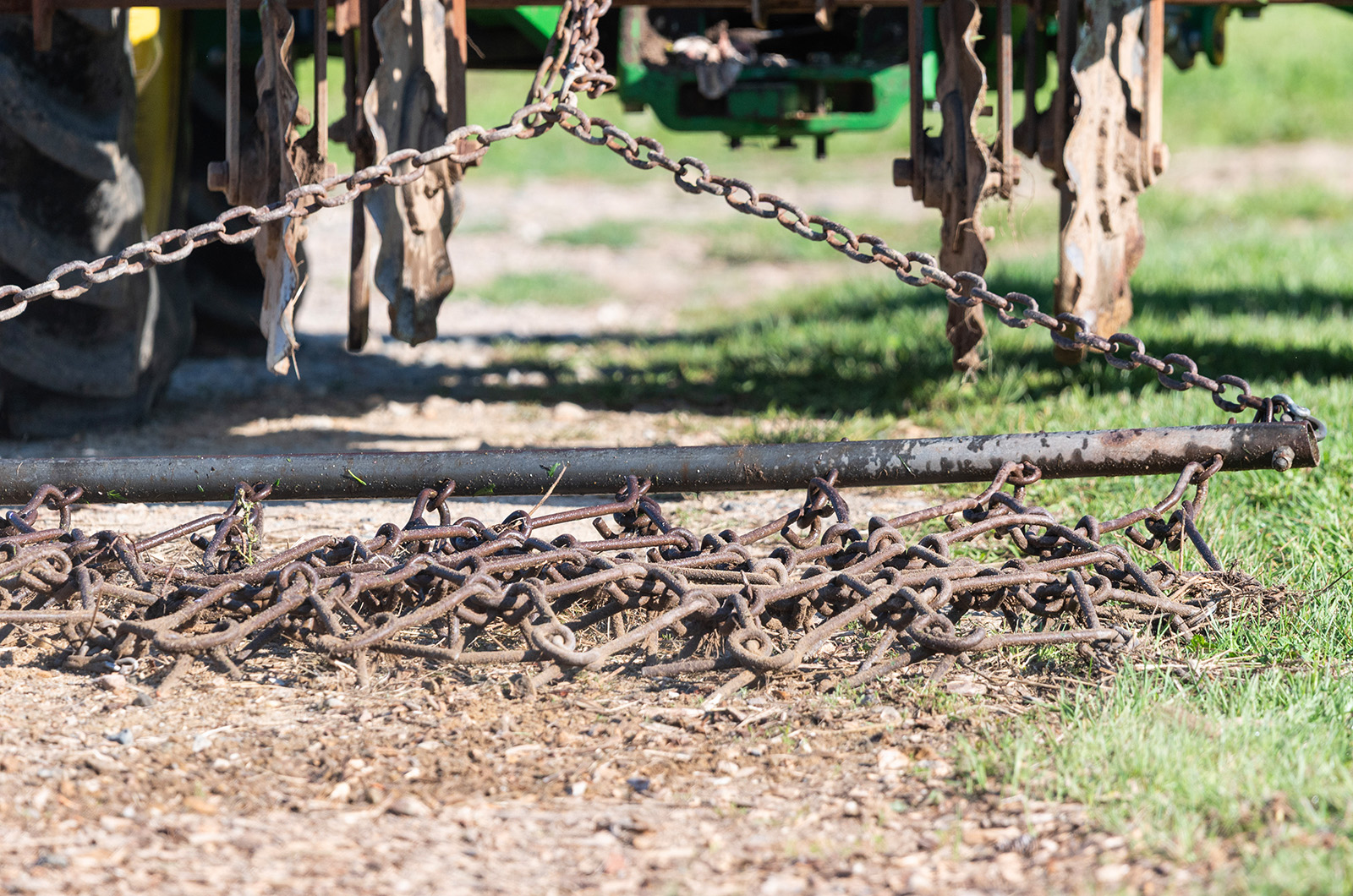
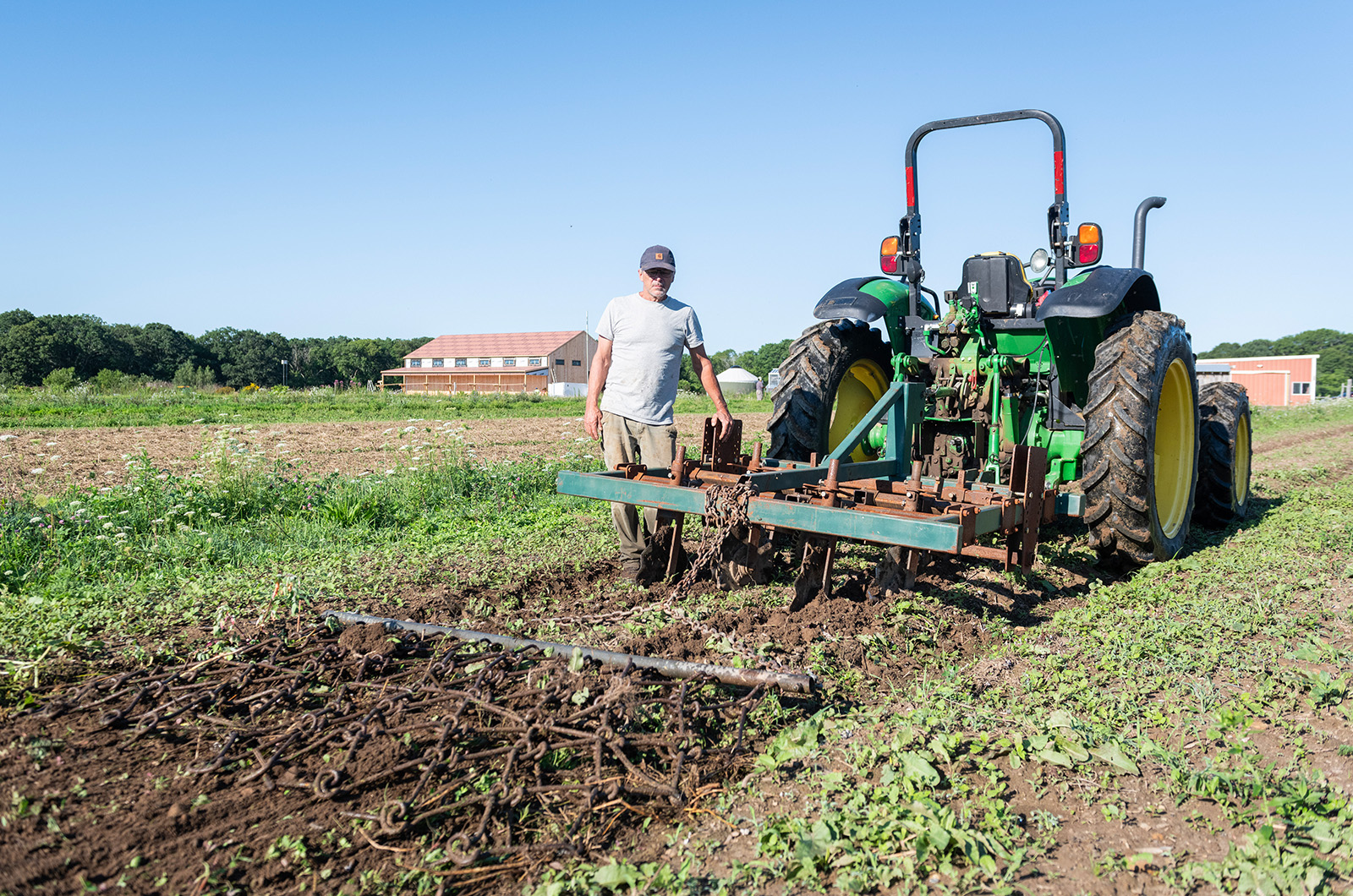
This field was prepped with Mr. Woodruff’s strip tiller, a machine of his own creation that tills thin zones into a bed, loosening a small strip of soil rather than the entire field. The machine is part of IGI’s regenerative agriculture practices, and allows the nonprofit farm to experiment with planting crops into beds of clover, an innovative way to suppress weeds without plastic.
It recently won the title of best mechanical tool this year at a competition in California, run by the Community Alliance with Family Farmers.
But Mr. Woodruff’s machine — with its third and most ergonomic version currently in production on the Vineyard — also fills the need for equipment designed for mid-sized farms, many of which are trying to practically scale regenerative agriculture, like IGI.
One of the principles of regenerative agriculture — there are six in total— is minimizing soil disturbance, such as plowing or tilling. At its most basic level, to till is to work the soil, preparing it for a crop by digging and overturning the earth.
Many farms use rototillers, a set of sharp blades which draw power from the tractor to chop up the earth. That can be destructive to soils: excessive tillage often leads to erosion, loss of organic matter and weaker water penetration and percolation by breaking up the aggregation, or soil structure.
Still, seeds don’t like compacted soil. They germinate best in loose, aerated soil — tilled soil. A strip tiller is the happy medium, targeting only the area where seeds will be planted, and preserving the rest of the bed.
“As part of our transition to reduced tillage and regenerative practices, [IGI] was letting go of some of the old ways, which was conventional equipment that has been really destructive to the soil,” Mr. Woodruff told the Gazette, while perched on a wood pallet inside a greenhouse at Whippoorwill Farm, which heowns and consults at alongside his work at IGI.
The conventional equipment ended up in the “back 40” of the farm — IGI’s boneyard for tools it no longer uses.

“I’m a little bit of a hoarder, I have to admit,” said Mr. Woodruff. “I was always trying to convince certain people not to throw anything away because there was always something good in that pile of steel.”
In that pile of steel was an old box blade grader, used to level out dirt roads and driveways. The tool is equipped with big, carbon steel shanks that scrape and scarify a roadway. The shanks became a key part of Mr. Woodruff’s strip tiller.
“In fact, maybe this whole strip tiller concept might have come out of just staring at that thing for a few years,” he said.
Mr. Woodruff’s son, mechanical engineer Kyle Joba-Woodruff, helped identify some of the stress points of the strip tiller, maximizing its strength while keeping it lightweight and relatively cheap.
The tool is able to work anywhere from one to four rows at once. It’s also adjustable, able to till a strip as small as four inches.
“It’s pretty simple,” said Mr. Woodruff. “It’s based on other technology. It’s just a lot smaller, it’s lighter, it’s more universal or modular.”
Simple, but already finding acclaim off-Island.
Josh Volk, a farming consultant and urban farmer out of Portland, Ore., helped judge the California contest that chose Mr. Woodruff’s invention for the prize of best mechanical tool.
“That type of implement fills this niche in the sustainable agriculture space: people are really focused on soil health and he’s trying to address…soil health within the scale range that’s available,” said Mr. Volk.
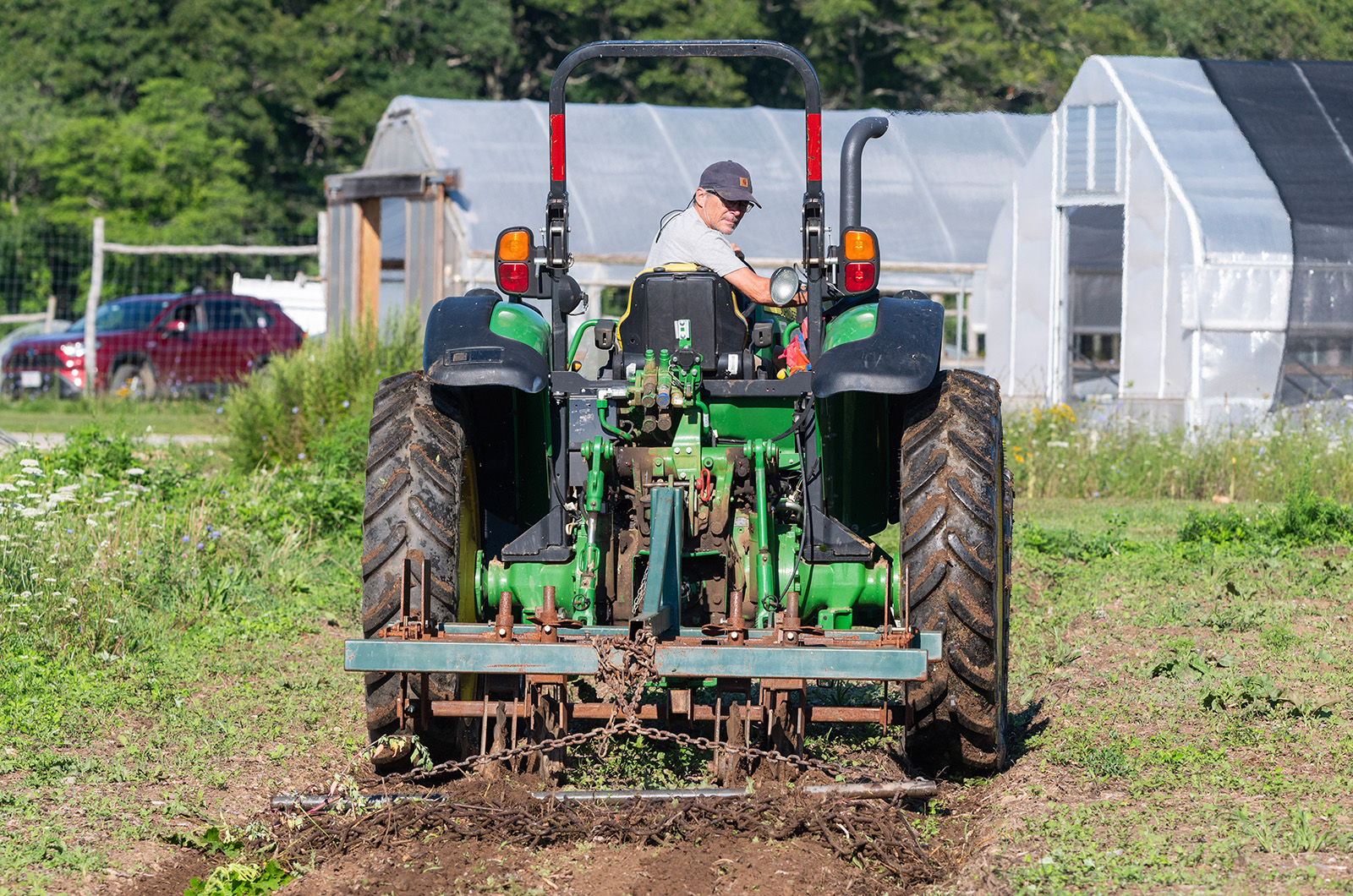
Mike Snow, a regenerative farmer in Vermont and New Hampshire, recently made a copycat using Mr. Woodruff’s designs, suitable for the scale of his farm. The size and row adjustments allow it to be useful among multiple crops and across diverse, mid-sized farms, from a few dozen acres to over a hundred.
“Let’s call it The Woody,” said Mr. Snow in a phone interview with the Gazette. “It’s just been renamed.”
Both Mr. Snow and Mr. Woodruff use the strip tiller to grow crops in beds of clover, a type of living mulch. Mulching is a tactic of moisture retention and weed suppression that farmers might normally address by planting crops into plastic covers, landscape fabric, straw or woodchips. Clover works the same way, smothering weeds while also maintaining moisture and soil structure with living roots, and never growing tall enough to compete with crops.
“The idea is that we have a living cover crop and we till just part of the field — these strips — so we’re keeping the living roots, we’ve got soil armor,” said Mr. Snow. “It’s part of the new version of the movement.”
At IGI, brassicas, tomatoes, squash and carrots are planted into clover, a system made possible with Mr. Woodruff’s strip tiller.
And it’s only going to get more efficient.
Mr. Woodruff is using the prize money from the California competition to create a third version of the strip tiller. In the newer version, which he is working with local metal fabricator Carter Payne to create, it will be easier to swap out implements and will include a shock-absorption system so when the shanks hit rocks — this happens often, breaking the metal — the tool remains intact. He’ll test the shock absorption system this September before building the full frame.
“It’s like a swiss army knife for strip tilling,” said Mr. Payne, who used to work with Mr. Woodruff at Whippoorwill Farm. Now, he specializes in brackets and hardware through his metal fabrication business.
The strip tiller isn’t a linchpin for healthy soils, but it is part of a diverse toolbox for regenerative farming, said Mr. Woodruff. He’s been farming on the Vineyard since the 80s, and has been using regenerative practices for the past ten years.
“What’s remarkable is how quickly the soil can heal once you start treating it differently,” he said. “That is what keeps compelling me to work harder and try to figure out how we can keep moving this forward, and in a way that it can be adopted by other farmers.”
Mr. Woodruff turns up a shovelful of earth and lays it on the grass. A group of curious farmers watch him as he drops gracefully to his knees; he has done this many times before. He picks up the soil, held together by the roots of the clover. He agitates it in his hands, showing the aggregation, the moisture, the rhizome sheaths: characteristics of a strong, healthy system.





Comments
Comment policy »