
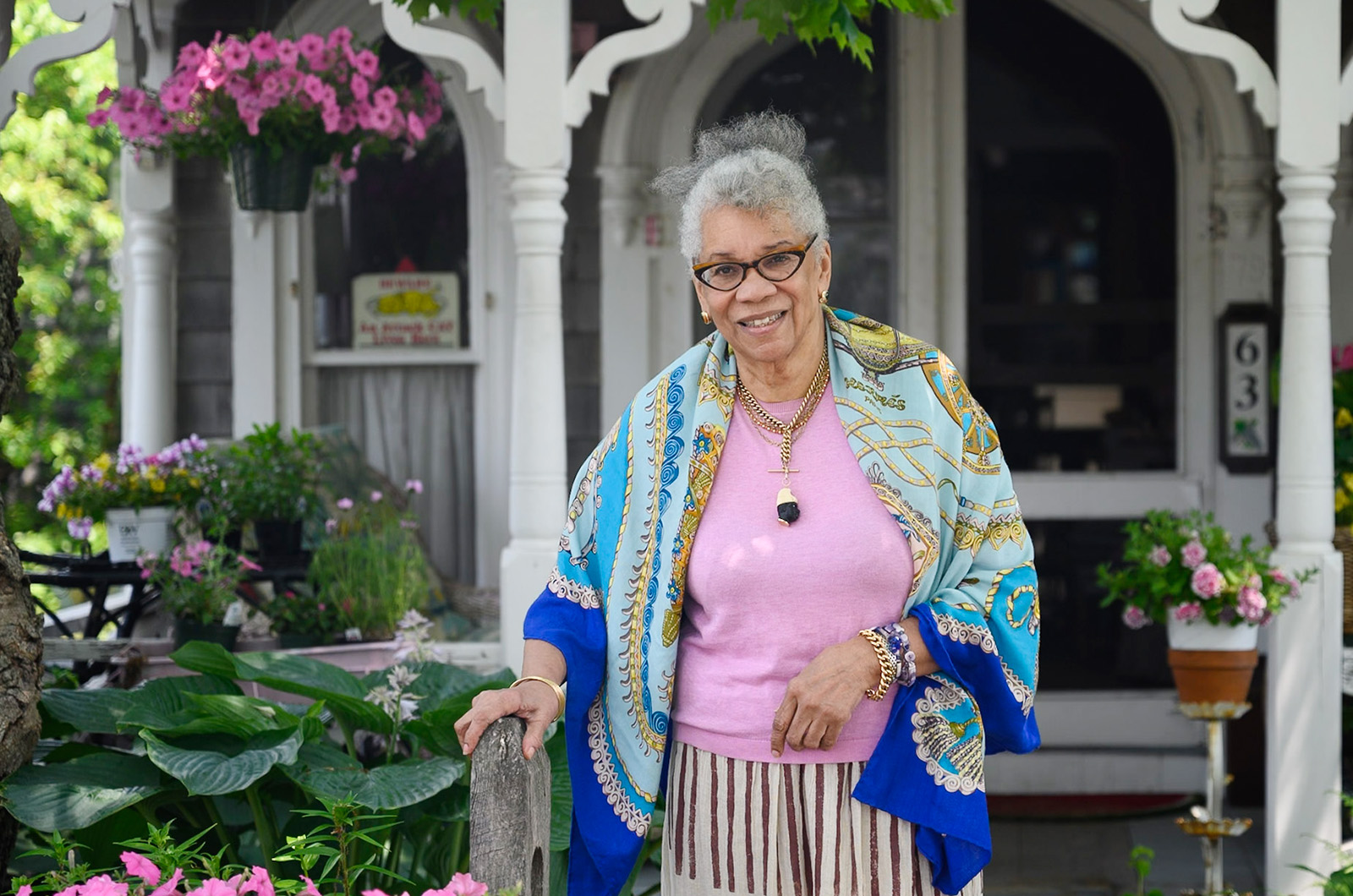
In Jessica Harris’ latest cookbook, Braided Heritage: Recipes and Stories on the Origin of American Cuisine, the author, professor and culinary historian describes food from three cultures that are foundational to America’s history and cuisine.
Braided Heritage is a collection of recipes from Indigenous, European and African American traditions interspersed with history and reflections from the chefs who provided the recipes.
“It’s like three different hanks of hair coming together to create something that is not just three hanks anymore, but that is something in and of its own,” Ms. Harris said. “These three strands, Native American, European American and African American are the foundational strands of this country.”
The book is the latest work by Ms. Harris, a Vineyard summer resident who was inducted into the James Beard Foundation’s Cookbook Hall of Fame in 2019, and won the James Beard Foundation Lifetime Achievement Award in 2020.

In addition to her work on more than a dozen cookbooks, she has served as the culinary consultant for the Smithsonian’s National Museum of African American History and Culture and the museum’s restaurant.
Her new book was supposed to be written during the Covid-19 pandemic but was delayed. Ms. Harris said that the timing worked out well, based on the current state of the country.
“I think the fact that it’s a little bit late makes it right on time,” she said. “This is a discussion that we are having. What is America and what does it come out of? How does it come together? Seeing it on the plate is perhaps a nice metaphor for some of the rest of it.”
The recipes come from the author’s friends and acquaintances. She asked them about what foods came to mind in terms of their own cultures, what meals reminded them of home and family and how they got their recipes.
“I’ve eaten at their tables, and some of them I’ve even cooked with in their houses or in mine, but seeing how that worked was interesting,” Ms. Harris said. “In all cases, it strengthened our friendships because I got to learn more about them and they got to know something about my process.”
Ms. Harris’ career did not begin with food writing. Her background is in French and theatre and she holds a doctorate from New York University, which focused on French-speaking theatre in Senegal. She was also a professor at Queens College in New York City for 50 years.
Ms. Harris began to write about food while working as a journalist at Essence. There, she became the travel editor.
“I tell people I was doing Anthony Bourdain before Anthony Bourdain was doing Anthony Bourdain,” she said.
Ms. Harris said she became aware of the deeper meaning of food from a young age, eating meals from around the world as a high school student at the United Nations School in New York.
“I grew up eating the cultures of the world at my friends’ houses. That, and my mother was a trained dietitian,” she said.
In the first section of Braided Heritage, Ms. Harris outlines the history of the first people on the American continent. In an interview with Juli Vanderhoop, owner of the Orange Peel Bakery in Aquinnah, Ms. Vanderhoop shared memories about what she ate growing up and how she was introduced to harvesting food from the land and sea.
“When I talked with Juli, she was talking about how she would go and wiggle-waggle with her feet to get shellfish and that worked, and what she ate as a child,” Ms. Harris said.
Ms. Vanderhoop’s recipes include clam fritters and beer-battered maple leaves with cranberry syrup.
Ms. Harris said that she did not organize the section on African American cuisine by nationality because African American people often do not know where their family comes from.
“I didn’t expect people to know, so it was different out of necessity,” Ms. Harris said. “So I said let’s talk about some threads that run through most of the African American world.”
Instead of by nationality, it is divided by themes, including migration, regionalism and tradition and innovation. Ms. Harris interviewed the late Abigail McGrath, who founded the Renaissance House in Oak Bluffs, to talk about cooking traditions separate from the South.
“She had no real southern roots... it was very much northern cooking, so that’s recipes like salmon poached in milk,” Ms. Harris said. “It’s a very different kind of eating.”
Ms. Harris said that each strand of the braid has contributed foundational aspects of American cuisine, which is made up of interactions between different cultures.
“There’s a lot of us, and we are mixed and mingled and braided,” she said.
“That’s who we are on the table and in our veins, and it’s certainly what we eat.”
Jessica Harris will take part in a panel discussion on Saturday, August 2 at 11 a.m. The talk is entitled Eating Our Stories, and will also feature Julia Blanter, Steven Satterfield and Eric Kim; moderated by Ligaya Mishan. The group will also talk on Sunday, August 3 at 12:15 p.m., with Joan Nathan moderating.





Comments (4)
Comments
Comment policy »