
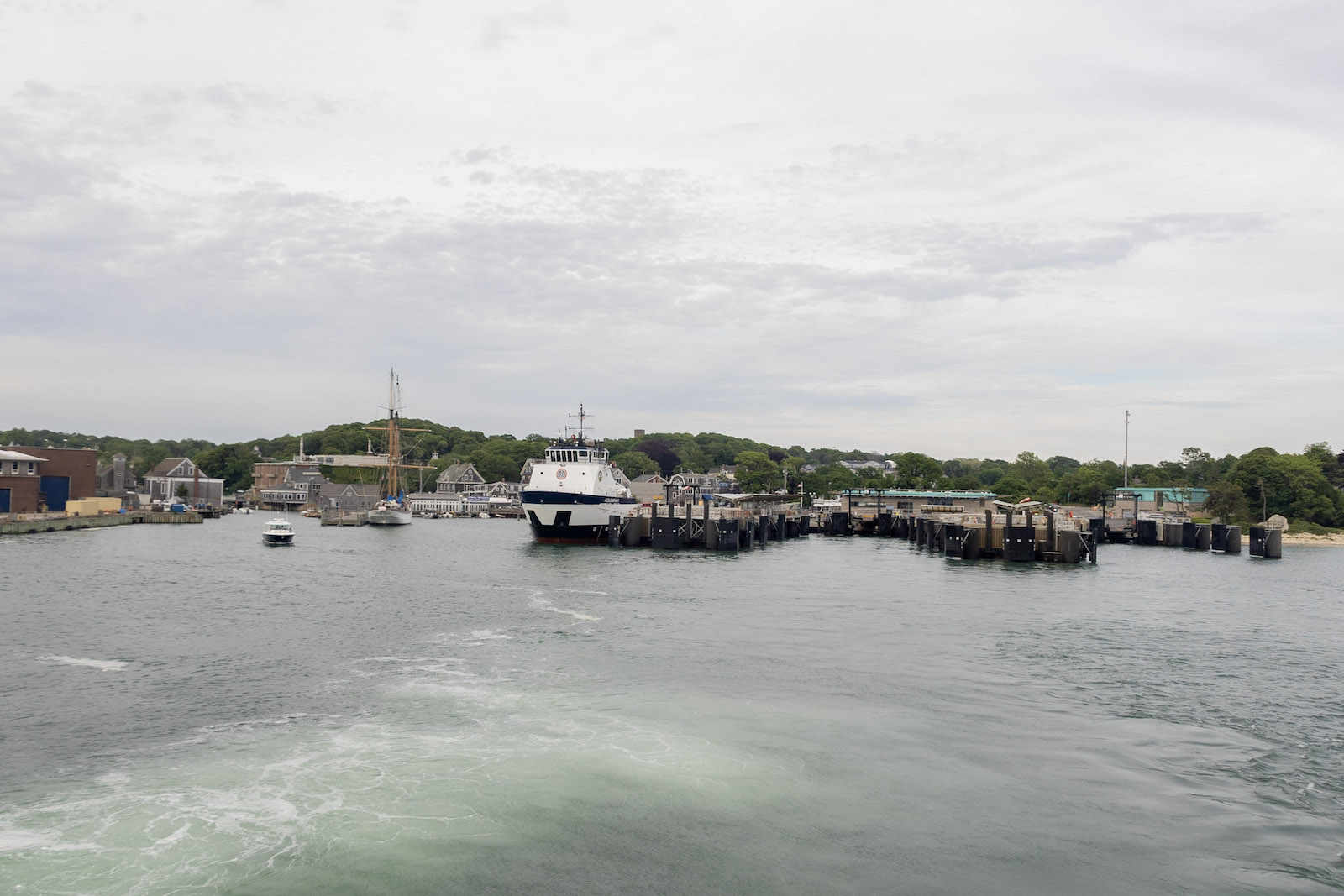
Steamship Authority general manager Alex Kryska said Tuesday that he expects to open the new terminal building in Woods Hole early next week, once final preparations have been completed.
“With any construction project, you have a punch list of items that you need to clean up,” Mr. Kryska told the authority’s governing board during the meeting on Nantucket. “If we can get that all done this week, we’ll be open by Tuesday.”
The Steamship Authority recently received a certificate of occupancy for the terminal building, which rises high above its surroundings because of 21st-century building codes for flood-prone areas.
Originally planned as a two-story structure, the building was scaled back to one floor after an outcry from Falmouth residents and others who said its elevated bulk blocked views of the water.
A nearby utility building was added to hold employee lockers, a break room and other facilities previously planned for the ticket building.
The main building, which stands in the center of what had been a vehicle staging area, is clad in stone and equipped with public restrooms, a waiting area with bench seating and five ticket windows, including one that is accessible to wheelchairs.
The building was expected to cost $32 million when construction began in the fall of 2024, but has risen to $37 million with change orders, according to a financial report presented Tuesday by chief operating officer Mark Amundsen.
The project’s history dates back to 2013, when the authority first began planning a comprehensive overhaul of the entire Woods Hole terminal.
After four years of design work and permitting, a temporary building with ticket windows, restrooms and a waiting area opened in late 2017.
Early the next year, the old waterfront building was demolished to make way for a third ferry slip, part of the $60 million waterside phase of the terminal reconfiguration.
The new terminal building and redesigned vehicle areas represent the second phase of the project, with the third and last phase — chiefly landscaping and other site work — expected to begin this fall.
Mr. Amundsen cautioned that travelers will find a drastically different circulation pattern at the Woods Hole terminal, and will need to watch for new signs pointing the way.
“There’s a lot of signage … because it’s going to be a complete change in direction for our traveling public, getting off the buses, going into the ticketing,” he said.
More changes will come after the summer when phase three begins, including the removal of the temporary ticket building to make way for bicycle and ride-share parking.
Mr. Kryska said the Steamship Authority would hold a public conversation on the project at the Woods Hole Community Hall, June 17 at 6:30 p.m.
Among other business Tuesday, the board heard legislative updates from the Steamship Authority’s lobbyists on Beacon Hill and in Washington, D.C., and a report from SSA grant coordinator Caroline Muldoon.
The Steamship Authority receives about $10 million a year in federal funding for preventive maintenance and capital planning, Ms. Muldoon said, with the Federal Transit Administration and the Federal Highway Administration each contributing about $5 million.
The federal funds have helped support the conversion of the M/V Barnstable and M/V Aquinnah from oil field vessels to SSA freighters and the replacement of vehicle transfer bridges in Vineyard Haven and Nantucket.
Because the federal money is only provided when eligible work is being done, Ms. Muldoon said, the Steamship Authority has already planned how to use it over the next five years.
Transit administration grants will fund the annual dry dock and repair program for ferries, the replacement of two diesel buses with electric buses, the purchase of four new rescue boats, a new wastewater pump out system at the Hyannis terminal and the replacement of traffic booths at terminals, she said.
Federal highway funds will support the next phases of slip work at the Vineyard Haven terminal, repairs at the Fairhaven maintenance terminal and continuing improvements at the Woods Hole terminal, Ms. Muldoon said.
The state also makes transportation grants available, she said, including funds recently used to replace maintenance vehicles in Fairhaven.
Operations and communications center manager Joseph Russas reported on ferry staffing.
“Marine operations is fully staffed across the board on all vessel positions, with additional personnel available,” Mr. Russas said.
The Steamship Authority requires 243 marine positions for its summer schedule and has 260 active employees for those jobs, he said.
“Three employees are currently in training [and] we have 12 on-call personnel available to assist with vacancies, peak demand periods, and unexpected absences,” Mr. Russas said.
“Currently, we have 30 rostered captains; we need 27 for the summer schedule. We have 29 rostered pilots [of] 26 that are required,” he said.
Below decks, the engineering chiefs and oilers are also staffed above required levels, Mr. Russas said.
During the public comment period of Tuesday’s meeting, Mr. Amundsen responded to a question about the lower-emission fuel that was used last year in the M/V Island Home.
The renewable diesel product, known as RD-99, is no longer available in the Steamship Authority’s delivery area, Mr. Amundsen said.
Last year’s pilot program was possible because a Rhode Island supplier could provide the fuel, but that company no longer offers RD-99 and the closest source now is in New York, making delivery costs prohibitive, he said.




Comments (9)
Comments
Comment policy »