

Long before Daniela Gerson and Talia Inlender met and fell in love, their family names appeared on a gravestone together. Both women are granddaughters of Holocaust survivors from the town of Zamosc, Poland. When the Germans arrived in Zamosc in 1939, both families fled east, surviving the war in Siberian labor camps while other members of their family were killed by the Nazis.
On a stone memorial in a New Jersey cemetery memorializing those killed in Zamosc, both the Inlender and Gerson names are inscribed.
This is one of the many chilling connections between Ms. Gerson and her wife Ms. Inlender, which she recounts in her book, The Wanderers. Ms. Gerson, a seasonal Islander, talked about her family’s history and the book’s genesis at the Martha’s Vineyard Author Series Wednesday at the Chilmark Community Center, in conversation with documentarian David Modigliani.
Part family memoir, part political history, part love story, the book weaves Ms. Gerson and Ms. Inlender’s meeting with the story of their families, told as the pair travel through Europe to uncover the details of their families’ escape from the Nazis.
Ms. Gerson was working as an immigration journalist in Los Angeles when she met Ms. Inlender, an immigration lawyer, at a picnic in the park. A few weeks later, at a bar with some friends, the pair discovered their families were both from the same Polish town, Zamosc.
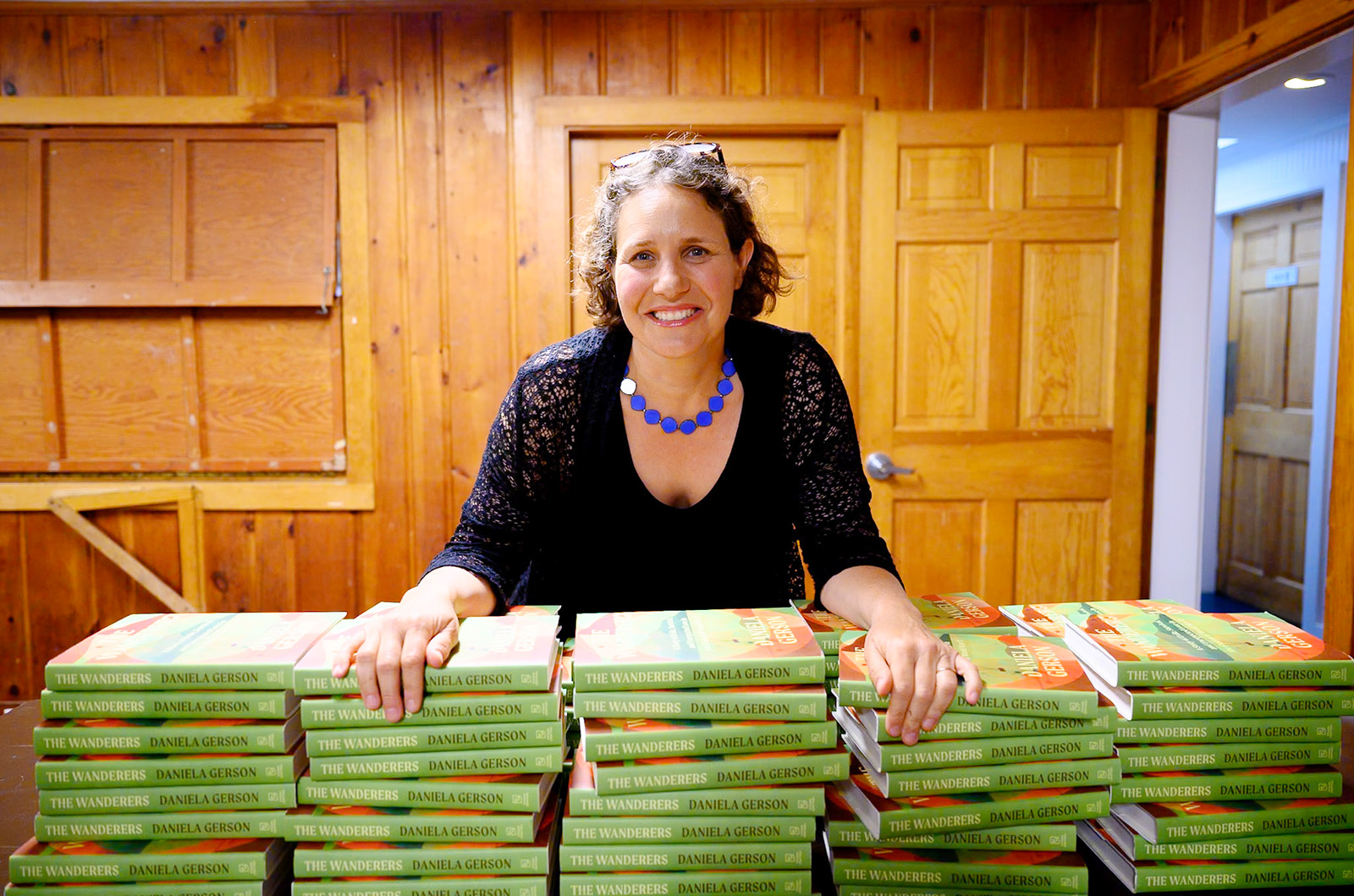
“It was just chills, because it’s a place that’s almost mythical, where you’d only heard about it as a place where no one was from except your family,” said Ms. Gerson.
It wasn’t until years later, married with two children and visiting the Vineyard, that Ms. Gerson and Ms. Inlender began seriously researching their families’ intersecting journeys.
“And no, we are not cousins,” Ms. Gerson said with a laugh.
The couple planned a trip to Poland with their children to uncover more about their families, especially Ms. Inlender’s, who did not talk much about surviving the Holocaust. There, they realized just how close their families were to each other: a two-minute walk from one another in Zamosc, just across the main square.
Ms. Gerson discovered that both families were part of the largest group of Polish Jews who survived the Nazis. Hundreds of thousands fled east to the Soviet Union while the borders were still open in 1939, surviving the war in the Siberian Gulag, where they were deported by cattle car.
“It was the middle of the summer, and so it was light all the time, and they crossed the Volga [River] and they just kept going and going and going, and they don’t know where they’re going to stop,” Ms. Gerson recounted.
While Ms. Gerson relied on her family member’s recollections of their escape, she also found inconsistencies in the records as she dove deeper into her research.
“You inherit one story — first, every family member tells it differently — and then once you probe it against the record, it doesn’t always match,” she said. “I found lies on identity papers. I found lies on reparations requests. I found lies on documents submitted to the American Red Cross.”
It’s particularly common in refugee stories to modify names, ages and health conditions in order to receive visas, said Ms. Gerson. Her father thought his name was Abe Blumstein until he turned 13, when his father told him his real name, Gerson, and his real age, 12.
“Talk about a challenging adolescent transition,” Ms. Gerson said.
The family came to the United States under the visas of the Blumstein family, and lived under that name for years. It was one of the stories that Ms. Gerson investigated in her research, and like much of her family history, the truth was more complicated.
“There were a huge number of fabrications, and it made it really challenging to find the truth,” she said. “But when I look at my family’s lies, they did it in order to survive, in order to offer something better for their children so we could one day we could be sitting here, on the stage at the Chilmark Community Center.”
Mr. Modigliani asked why Ms. Gerson thinks her family survived. Was it luck? Was it foresight?
“They did act, and move, and they also worked together as family units often, and kept together, and I think that helped them survive,” Ms. Gerson responded. “That was very much a throughline of my family’s story.”
At the end of the evening, Ms. Gerson reflected on how the U.S. is treating immigrants today, referring to it as a militarizing enforcement of xenophobic immigration restrictions.
“I do feel very strongly that we are clearly not seeing the humanity in other people who are in this country for the same reasons that so many have come before and have contributed,” she said.
Closing your borders does not work, she continued. People find their way in, or create immigration pressure elsewhere — one of the lessons she learned both from her family’s history and reporting extensively on immigration.
“I think we’re all struggling right now with [the question], how do we respond? How can we be effective?” she said.
While Ms. Gerson said she thinks she was able to uncover most of the story, there are still threads that continue to this day. People write to her connecting their own family stories, and there are still unanswered questions.
“There’s always something else,” said Ms. Gerson. “You cannot tell every perspective.”



Comments
Comment policy »