
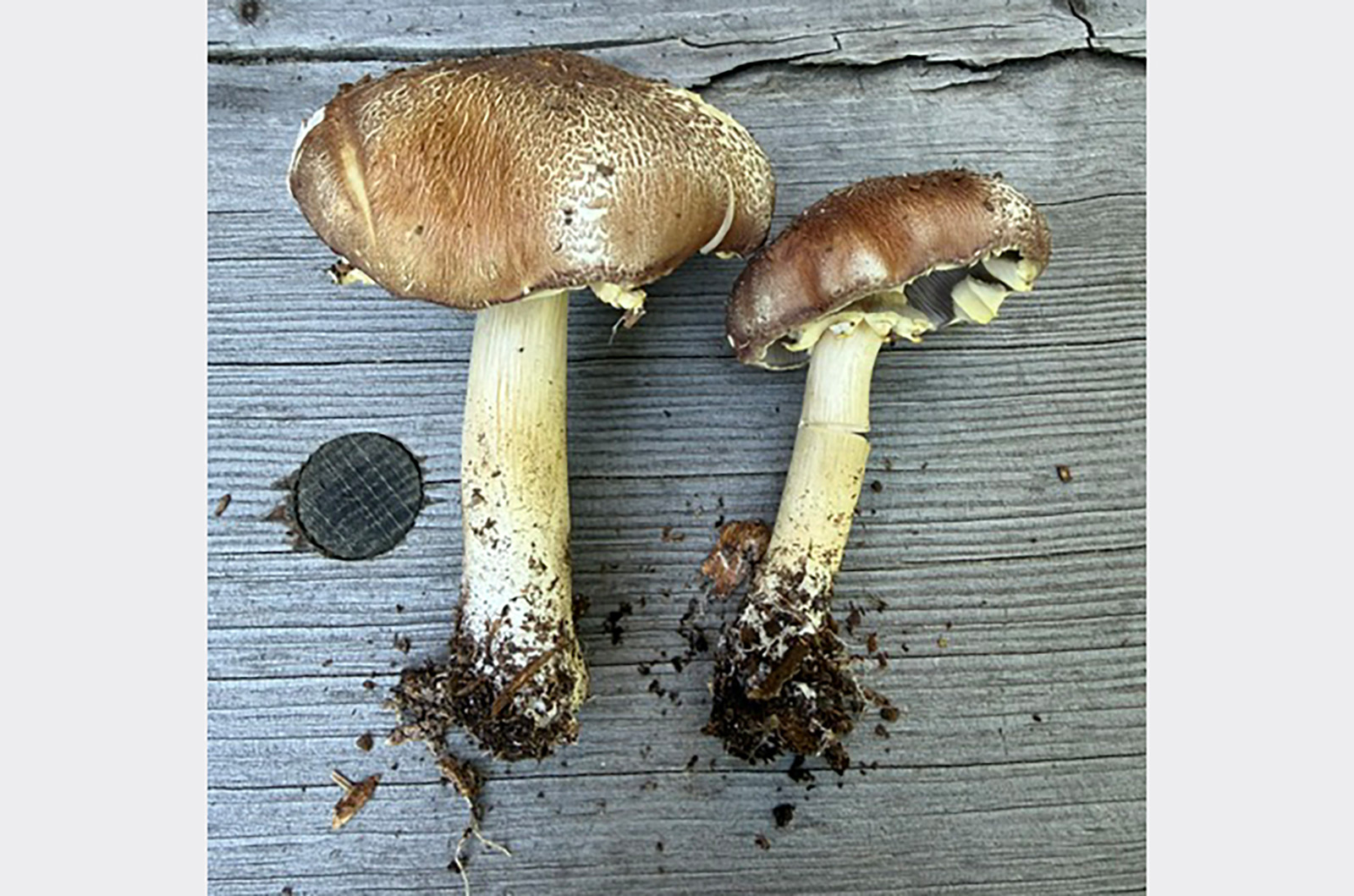
It took a couple of botanical Billies to describe and document a giant of the fungal world.
This wealth of Williams working with mushrooms began in the late 19th century with William Gibson Farlow. Farlow was an American botanist, born in Boston, who spent his career at Harvard.
Farlow’s specialty was cryptogams, the name of a formerly recognized group of plant-like organisms that are flowerless, fruitless and seedless. The word cryptogam means hidden reproduction and its members use spores, vegetative, or other atypical approaches to replicate themselves. Lichen, algae, ferns, mosses, liverworts and fungi are all included in the group.
His was a traditional academic life of science, studying, publishing and teaching. The other William, William Alphonso Murrill, born 25 years after Farlow, took a more eccentric path.
This Billy had a bit of wanderlust and travelled far and wide in his work. Employed by the New York Botanical Garden, Murrill frequently took seemingly spontaneous trips abroad, often failing to inform his colleagues and supervisors. It was during one of those surreptitious trips that he disappeared, not being seen or heard from for eight months. Turns out he was ill and returned to the states to find no job (his position had been filled in his absence) and his wife wanting a divorce.
Murrill disappeared again to a quiet life collecting mushrooms in Florida. Known as the Gainesville Mushroom Man, he was recognized by a mycology professor who “came across an unkempt and haggard, yet tall, robust, dignified, pleasant stranger providing a piano concert for the transient tourists” at a Florida campsite. The professor gave Murrill a position at the University of Florida, where the latter became a fixture on campus until his death.
Farlow and Murrill are both credited with describing and naming a mushroom that would become king. Stropharia rugosoannulata, also called King Stropharia, garden giant, Godzilla mushroom, and, less grandly, wine cap mushroom, is a fungus that demands fealty.
Native to North America and commonly found in mid-Atlantic regions and New England, this shroom lives large. Some specimens can weigh up to five pounds, and it is known as the largest (and very prized) edible mushroom.
Italian chef, restauranteur and author Antonio Carlucci has pointed out that this species is “highly versatile, being able to fit into almost any dish seamlessly.” This Godzilla mushroom was domesticated for food production in the late 1960s in Europe and Asia. China is now one of the largest commercial producers of this giant, having grown more than 200,000 tons per year in 2021.
Foragers also seek this discernable and reportedly delicious mushroom. As a saprotroph, King Strophoria feeds on dead organic matter instead of live roots. It is often found in wood chips, and that is where I discovered a solid specimen. I was not confident enough in my identification at the time, so did not eat the enormous mushroom. In the future, I will check the spore print (dark purple brown), look for the unique cog-like annulus (ring) around the stipe (stem), and confirm the wrinkly gills that can be seen on the underside of the cap.
Next time I will collect these majestic mushrooms and create a noble nosh. Just some additional observation will allow for a positive identification. Like these fungal forefathers showed, where there is a “Will” there is a way.
Suzan Bellincampi is director of the Felix Neck Wildlife Sanctuary in Edgartown, and author of Martha’s Vineyard: A Field Guide to Island Nature and The Nature of Martha’s Vineyard.




Comments
Comment policy »