

A new early hunting season for the Vineyard started this week as part of an overarching effort to cut down the deer population on the Island in the name of public health.
In the first three days after the season opened Monday, at least 40 deer were harvested on the Vineyard. Ten to twelve were brought in the first day to the Martha’s Vineyard Agricultural Society deer locker in West Tisbury. That number is higher than normal for opening day, according to Patrick Roden-Reynolds, an Island tick biologist and avid hunter who manages the cooler.
“The state and Massachusetts Wildlife have been doing well to increase opportunities in all ways for hunting to increase harvest,” Mr. Roden-Reynolds said on Tuesday. “From what I’ve seen so far, the early season opener yesterday was positive.”
Health experts, hunters and state officials have all been working together to encourage more hunting on the Vineyard. Deer are the primary food and reproductive host for ticks, which have become a major health concern given the Island’s high rates of Lyme disease and alpha-gal syndrome.
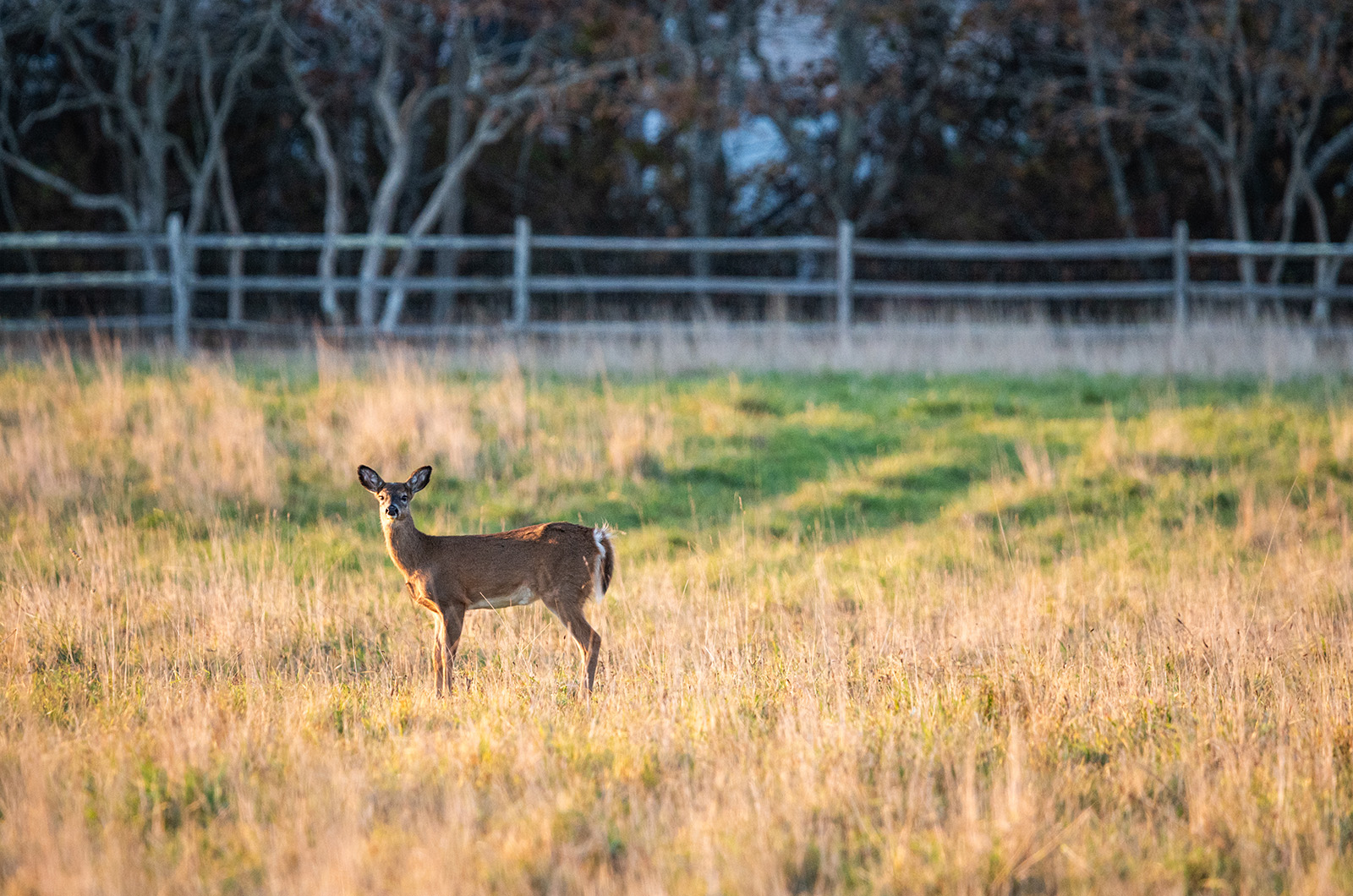
Last year, the state approved an extended winter hunting season to Feb. 14, from its longstanding end date of Dec. 31. The longer season helped push the Vineyard close to its record deer harvest, with 330 extra deer added between the Vineyard and Nantucket, which is also part of the extended season.
This year both the Islands have a new fall season that runs from Sept. 21 to Oct. 1, where hunters can use bows and primitive firearms. Archery season starts Oct. 5 and the deer harvest continues on the Islands through Feb. 13.
Martin Feehan, a state deer biologist, said for early season, he was hoping for at least 100 deer harvested between the two Islands in these first 10 days.
“We definitely should exceed that, but the question is going to be by how much,” he said.
There has also been a concerted effort to boost the number of deer damage permits — a type of permit that allows year-round hunting on qualifying agricultural and conservation lands. This summer, using deer damage permits, hunters collectively harvested 59 deer, which amounts to 1 per cent of the Island’s total deer population.
The Martha’s Vineyard Hunt Club, a collective of hunters on the Island, has been hunting this summer with those permits and taking advantage of the early season.
“It’s not about hunting as much as just more people out there trying to get the population down to a manageable amount,” said Brian Athearn, the founder of the hunt club.
State estimates put the Vineyard’s deer density at more than 50 deer per square mile — well above the state’s goal of 12 to 18 deer per square mile. To get there, officials estimate that the Island would need to kill about 1,500 deer, which will require a sustained effort and more hunters.
“Early season is going to give us an edge to try to knock the population down,” Mr. Athearn said. “I actually believe with a combo of deer damage permits and awareness from homeowners we can do this. If we get all the hunters coordinated, we can do this.”
In addition to the extended hunting season for the Islands, the state has also eased the reporting protocols for hunters who are coming here from off-Island. In the past, deer harvested on the Island needed to be reported to the state at a check-in station on the Vineyard. The state is now allowing hunters to report the deer to a check-in station back on the mainland.
Other changes are also on the horizon.
The state legislature has been considering three bills. One would legalize hunting on Sunday, another would allow expanded crossbow use and a third would allow archers to hunt closer to occupied dwellings.
Tick Free MV, a nonprofit that started in 2025 to fight ticks, is working to set up a new deer processing facility at the Agricultural Hall to help streamline the butchering process and encourage more hunters to donate their harvest.
Virginia Barbatti, Tick Free MV’s executive director, said that working with people across the Island is essential to checking the deer population.
“We need to first focus on bringing the deer herd into ecological balance for the other interventions layered in to be effective,” she said. “We can get there through partnerships with landowners, hunters, the tribe, each of the towns and conservation organizations.”
Tick Free MV plans to provide hunter incentives — $100 for every buck and $150 for every doe — for deer that are donated and distributed to Island food programs. The nonprofit has also teamed up with the chamber of commerce to create a hunting guide for off-Island hunters.
“There’s a lot we’re doing to make this as productive a season as possible,” she said. “We’re funding incentives for donations for a second year, and we’re hoping to see an increase in the number of donations this year.”
For many hunters, the desire to cut back the deer is personal. Mr. Athearn has alpha-gal syndrome, the allergy to red meat and other mammalian products caused by the bite of a lone star tick.
Despite not being able to eat his own venison, Mr. Athearn continues to hunt and donate the harvest to those in need.
“Every deer I shoot goes to somebody’s table. For me, it’s the love of hunting, but it’s also the love of my community,” he said. “I’m going to keep doing what I’m doing unless someone tells me to stop.”






Comments
Comment policy »