
Alan Bloom was destined for a life among flowers. With that name and his family business of market gardening, it must have been preordained.
Bloom, a modern flower farmer, lived and worked in England. He ultimately excelled in his profession, expanding the family business to be one of the largest in Britain, and exporting plants worldwide.
Beyond sales, Bloom’s scientific talents also flourished as he developed, grew and sold new varieties of plants. Though his supposed specialties were conifers and alpine flora, over his life Bloom developed more than 150 varieties of perennials.
His work in the field is impossible to overstate. With 30 books, radio and television appearances and a life dedicated to plant perfection, it is not surprising that Bloom was honored with many awards and designations. One revered title that was bestowed was MBE, or Most Excellent Order of the British Empire, which rewards important service to the country and the world.
The bandmembers of The Beatles also each received MBEs in 1965, though John Lennon later renounced it during his peace protests. About 800 people receive this award annually, though most don’t return it.
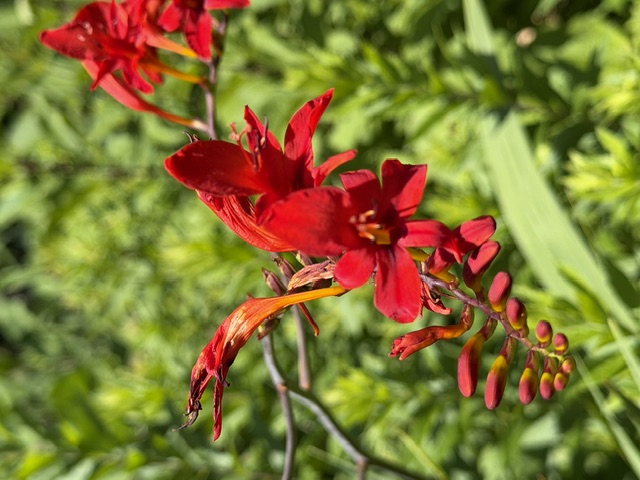
The MBE designation, while impressive, is not why I find that Bloom and my column come together (as those Beatles often said). That honor comes from the development of a unique variety of Crocosmia that delights me every summer.
Crocosmia are a genus of plants native to southern and eastern Africa that have become fan favorites in domestic gardens. A member of the Iris family, Crocosmia grows from swollen stem bases called corms with large, narrow leaves and wiry stems that end in a profusion of bright, colorful tubular flowers. First domesticated by French flower breeder Victor Lemoine in the nineteenth century, Crocosmia has gone on to proliferate and delight gardeners worldwide.
The darling variety developed by Bloom is Crocosmia lucifer, also called Coppertip, Falling Star and Montbretia. This devilishly desired fiery red flower is also beloved by hummingbirds (and other pollinators) for its nutritious nectar, and is the most asked about flower in Felix Neck’s butterfly garden. First planted there by late West Tisbury plantwoman Susan Silva, it is only one of many thoughtful legacies she left in our community.
Bloom also somehow found time for other interests. A steam engine enthusiast, he combined his favorite things and opened the Bressingham Steam and Gardens Museum, which boasts full-sized and miniature steam engines, a rideable railway through the grounds, vintage vehicles, glorious gardens and a very special carousel called the Gallopers. The Gallopers carousel was built in 1897, 21 years after our beloved Flying Horses, so the love of lucifer is not the only commonality that Bloom had with Islanders.
Another was the railway. The Vineyard did indeed have a steam engine operating as the Martha’s Vineyard Railroad from 1872 to 1896, plying the beach route between Oak Bluffs and Katama.
All of this is to say that the world is small, human curiosities are varied, and we all have more in common than in opposition. Grow plants, explore many interests and don’t ever miss an opportunity to take a spin on a carousel. Like Alan and Susan, and the flowers they both loved, your passions will bloom.
Suzan Bellincampi is director of the Felix Neck Wildlife Sanctuary in Edgartown, and author of Martha’s Vineyard: A Field Guide to Island Nature and The Nature of Martha’s Vineyard.





Comments
Comment policy »