
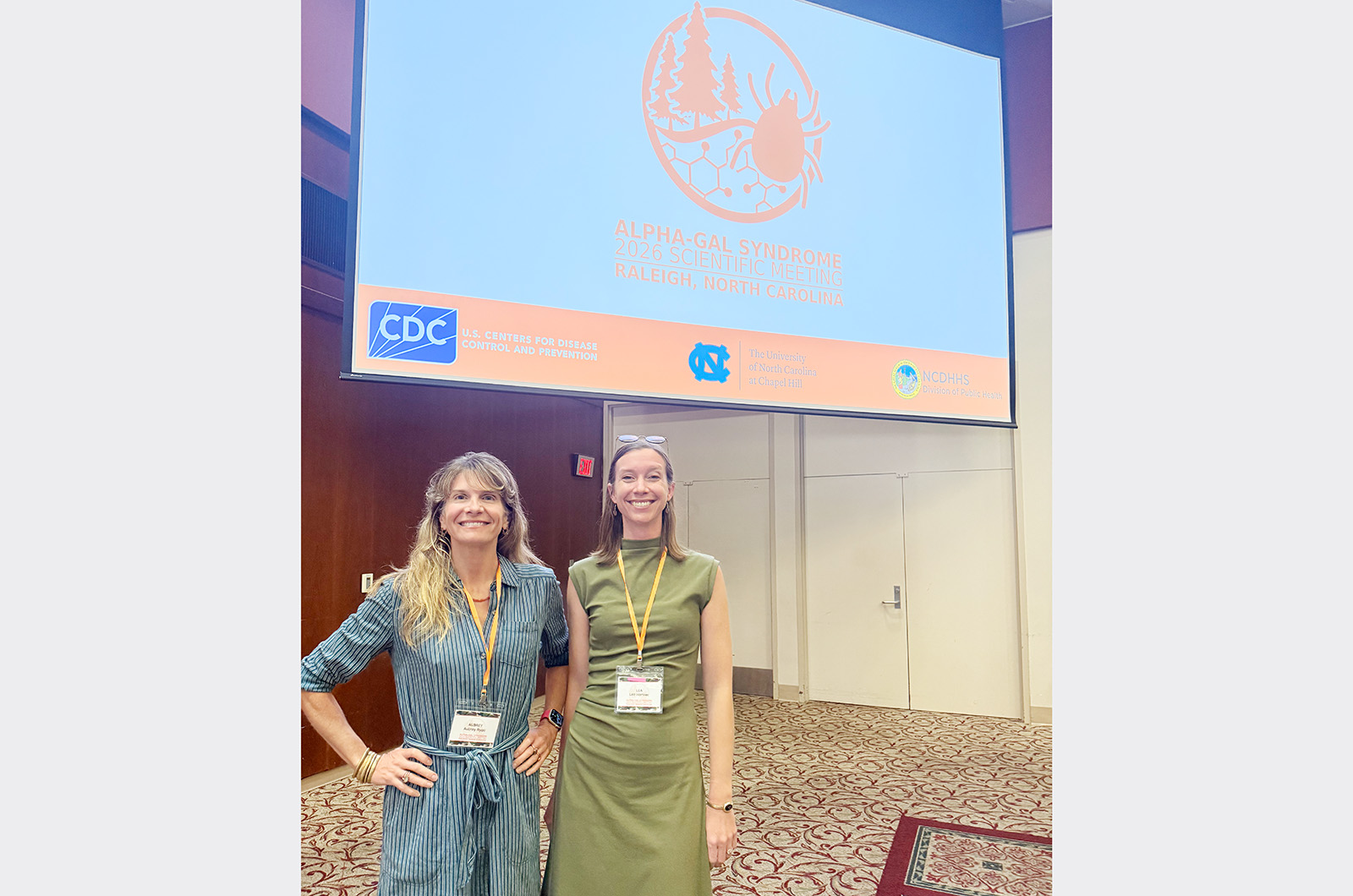
An Island epidemiologist and clinician represented the Vineyard at the nation’s first ever in-person alpha-gal syndrome conference earlier this month.
At the Alpha-gal Syndrome Scientific Meeting in Raleigh, N.C., tick epidemiologist Lea Hamner and physician assistant Aubrey Stimola Ryan convened with the nation’s top physicians, epidemiologists and entomologists, as well as officials from Centers for Disease Control and Prevention (CDC), to pool knowledge on alpha-gal, the allergy to mammalian products transmitted by lone star ticks.
The conference focused on strategies for treatment, prevention and public awareness, as well as the syndrome’s impact on the economy and mental health — all important topics on the Vineyard, where alpha-gal and the lone star tick are increasingly shaping Island life.

“It gave me an opportunity as a clinician to hear all the clinical work going on in all different fields of medicine, and ask a ton of questions to gather some information that I can bring back to my own clinical practice,” said Ms. Stimola Ryan, who will soon open her own tick clinic on the Island.
As a speaker at the conference, Ms. Hamner presented on the Vineyard’s growing alpha-gal problem and the Islandwide effort to prevent and treat it. She spoke alongside professionals from Arkansas, Virginia and Suffolk County, N.Y., which includes the Hamptons — all of which have been fighting their own battles with lone star ticks.
“Alpha-gal is not unique to Martha’s Vineyard, but we are unique in many ways that result in our tick population being through the roof,” she said.
On the Island, tackling alpha-gal and other tick-borne afflictions has been an all-hands-on-deck effort, engaging nonprofits, medical providers and businesses. Though Ms. Hamner wishes efforts were further along, she said the way the Vineyard has mobilized drew the admiration of other professionals and agencies at the conference, including the CDC.
“I do think that Martha’s Vineyard, in terms of organizing an Islandwide approach to this problem, stands kind of separate from most communities,” Ms. Hamner said.
For many on the frontlines of the Island’s tick problem, the focus remains on reducing the Island’s population of white-tailed deer, which are the arachnids’ main reproductive hosts. Ms. Hamner said that many experts see a connection between the lone star tick and unchecked deer population growth across many regions of the country.
“There was fairly good recognition in the room [at the conference] that the reason the lone star tick has expanded its territory... in the United States is the deer,” she said.
Many mainland communities do not see deer management as a logistically feasible tick-reduction solution, given that mainland deer can freely migrate and reproduce. But Ms. Hamner and Ms. Stimola Ryan pointed out that the Island’s closed geography makes deer population management a uniquely suitable approach to stopping the lone star’s spread.
“There was recognition that an Island has the best shot,” Ms. Hamner said.
At the conference’s end, experts came to a consensus on the most important action items moving forward. These included making alpha-gal reportable in more states, making it a more prominent part of the preexisting national strategy for vector-borne disease and advocating for more robust food and medication labeling.
While conference organizers hope to convene alpha-gal experts annually in the future, national, cross-disciplinary work will continue in the meantime through the Alpha-Gal Syndrome Expert Advisory Council, of which Ms. Hamner is a member.
“No one wants to create a plan that sits on a shelf,” she said.
For both prevention and treatment of alpha-gal, avoiding tick bites is key, Ms. Hamner and Ms. Stimola Ryan said. Alpha-gal patients can go into remission if they avoid more lone star bites, and the gold standard for protecting against them is treating clothing with the synthetic insecticide permethrin.
But a way to clinically prevent or cure alpha-gal is far off, said Ms. Hamner.
“I’m sorry to say to the public who’s suffering right now that a medical intervention for your alpha-gal syndrome [or] to help you cure your alpha-gal syndrome is not in the near future,” she said.
It’s important to make alpha-gal patients feel heard, Ms. Stimola Ryan said, whether they’re seeing a doctor on the Vineyard or in an area where alpha-gal isn’t common. She and Ms. Hamner pointed to the Alpha-gal Alliance as a hub of information for both patients and providers.
“We need to make sure that clinicians elsewhere … are also aware of this issue,” Ms. Stimola Ryan said.
For Ms. Stimola Ryan, there is a lot to be learned from other communities dealing with the lone star tick. She is heartened by all the work being done on the local, state and national level to fight it.
“It was really invigorating to see that we’re not alone,” she said.




Comments (11)
Comments
Comment policy »